
Chrotogonus
Chrotogonus
Description
How to identify
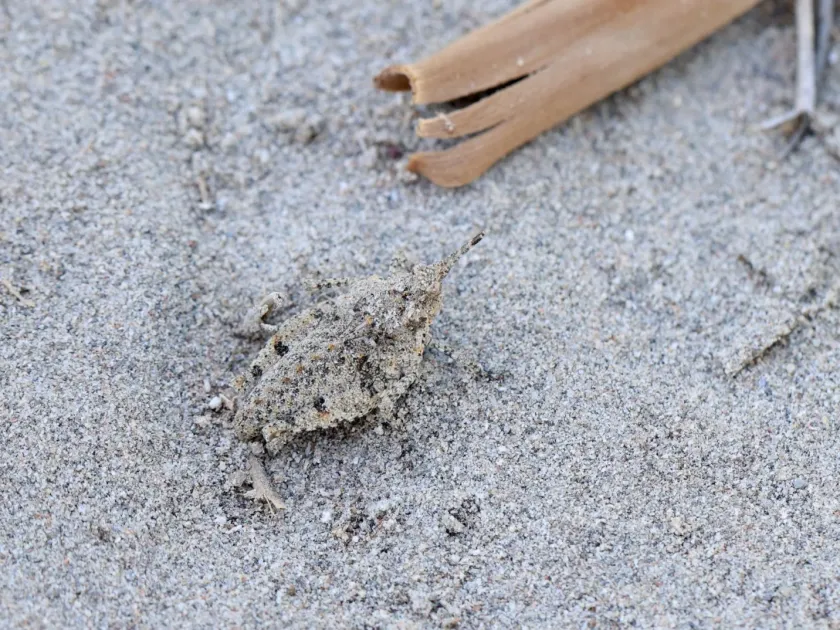
Chrotogonus is a genus of short-horned grasshoppers belonging to the family Pyrgomorphidae. These insects are characterized by a stout, slightly flattened body, often featuring brown, grey, or mottled coloration that provides excellent camouflage on soil surfaces.
The exoskeleton of these insects is typically rough and granular in texture. They possess shortened elytra and wings, with some species being flightless, which confirms their status as terrestrial inhabitants of arid and semi-arid regions.
The head is generally conical with a downward-pointing chewing mouthpart. Their hind legs are developed for jumping, although they are less active in flight compared to typical migratory locusts, preferring to crawl on the ground.
Females are usually larger than males. Identifying specific species within the genus often requires a detailed examination of the pronotum and genital structures, as their morphological characteristics are frequently similar.
The life cycle of Chrotogonus is closely linked to soil conditions, where they spend a significant amount of time hiding under crop debris or burrowing into the top layers of the earth.
What it damages
Chrotogonus species are polyphagous pests capable of causing significant damage to a wide range of agricultural crops. Seedlings of cereals, legumes, and vegetable crops are particularly vulnerable.
In regions with heavy infestations, they threaten crops such as cotton, alfalfa, millet, sorghum, and various garden vegetables. These pests can completely devastate young sprouts, leading to severe crop thinning.
In addition to direct leaf feeding, these insects often damage stems at the base, which frequently results in the lodging and death of young plants during their early developmental stages.
The intensity of damage is directly related to pest population density. During outbreaks, Chrotogonus can strip fields bare, leaving only leaf veins and gnawed stems behind.
The greatest damage is observed in dryland farming conditions, where surrounding wild vegetation dries up, causing the pests to migrate en masse to irrigated areas with succulent sprouts.
When it appears
The activity of Chrotogonus is highly correlated with temperature and soil moisture. They prefer open, dry spaces with sparse vegetation.
Egg-laying occurs in the soil, where eggs are protected within a pod secreted by the female. Embryonic development is accelerated in warm, dry soil conditions.
Nymphs pass through several instars, gradually increasing in size. In hot climates, development can be quite rapid, allowing for multiple generations to occur within a single growing season.
Adult insects are most active during the day when the soil is warm. Under unfavorable conditions or at night, they often burrow into the substrate for protection.
Seasonal population peaks often occur in mid-summer when mass hatching of the primary generation takes place, coinciding with the period of greatest vulnerability for many crops.
Signs of infestation
The first sign of infestation is the presence of irregular-shaped holes on cotyledons and early true leaves. The edges of damaged leaves often appear chewed or frayed.
Upon inspecting the soil surface near damaged plants, one may spot the insects themselves, which often freeze when threatened, mimicking small clods of earth.
On early-stage seedlings, a characteristic sign is the mass cutting of plants at the soil level, which can look similar to the damage caused by cutworms.
In areas where pests congregate, small dark granules of frass (excrement) can be found on the soil surface surrounding the affected plants.
The presence of a high number of adult insects is often accompanied by a specific chirping sound typical of many Orthoptera species.
Control measures
The primary control method involves good agricultural practices aimed at reducing egg survival. Deep plowing and thorough inter-row cultivation help destroy egg pods.
Chemical control is justified during periods of high population density. The use of stomach-contact insecticides is recommended for effective management of these grasshoppers.
Crop treatments should be applied during the early morning or late evening when the pests are most active on the plant canopy and less hidden in the soil.
A crucial preventive measure is the management of weeds along field perimeters, which serve as reservoirs for reproduction and feeding at the start of the season.
The use of biologically based products containing entomopathogenic fungi or bacteria also shows promising results within integrated pest management programs.
Taxonomy
- Latin name
- Chrotogonus
- Order
- Orthoptera (locusts)
- Family
- Acrididae
- EPPO code
- CHRGSP
Discussion
No discussions yet — be the first.