
Green-striped grasshopper
Chortophaga
Description
How to identify
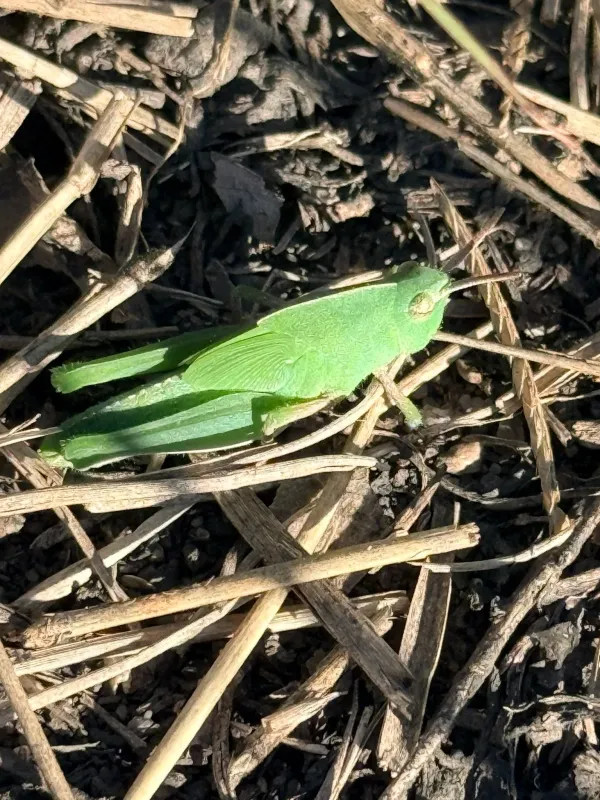
The green-striped grasshopper (Chortophaga viridifasciata) belongs to the order Orthoptera and the family Acrididae. This species is known for its polymorphism, appearing in green or brown phases, often with a distinct dorsal stripe.
Adult insects measure between 25 and 40 mm in length. They are equipped with fully developed wings for flight and strong hind legs adapted for jumping when threatened.
Nymphs resemble smaller, wingless versions of the adults. They undergo several developmental instars, gradually increasing in size while remaining active feeders throughout the process.
They are highly adaptable creatures, capable of surviving in various environments including pastures, meadows, and agricultural fields where they find abundant plant food.
Their visual senses are highly acute, allowing them to detect predators or human presence from a distance and move swiftly into cover.
What it damages
As a polyphagous pest, the green-striped grasshopper feeds on a wide variety of plants. In agriculture, it poses a threat to small grains, legumes, and forage grasses.
Both late-stage nymphs and adults are highly destructive due to their robust chewing mouthparts, which allow them to consume significant amounts of biomass daily.
Damage typically involves the removal of leaf tissue, which impairs the plant's ability to photosynthesize, ultimately leading to yield reduction and poor crop quality.
High population densities can lead to total defoliation, particularly in seedling crops, where entire fields can be devastated in a short timeframe.
These pests often feed on field margins, acting as a reservoir that threatens adjacent healthy crops as the season progresses and food sources become scarce.
When it appears
The life cycle of the green-striped grasshopper is characterized by early emergence. They typically overwinter as nymphs, hidden within the soil or dense vegetation.
During early spring, nymphs resume feeding and growth as temperatures rise, reaching adulthood relatively quickly compared to other grasshopper species.
Mating and egg-laying occur in the early to mid-summer period, with eggs deposited in the soil, ensuring the next generation is ready for the upcoming season.
The duration of the developmental cycle is heavily influenced by the local climate, with warmer and drier conditions significantly accelerating their reproductive rate.
By late summer, the new generation of nymphs is established, and they begin preparing for winter diapause to survive the colder months.
Signs of infestation
Key signs of infestation include ragged leaf margins and irregular holes in foliage, which are diagnostic indicators of grasshopper feeding activity.
Observing a field on a sunny day often reveals swarms of grasshoppers jumping away from an approaching person, indicating their presence in the vegetation.
The presence of frass (fecal pellets) on leaves and the soil surface serves as a clear indication that a population of grasshoppers is actively feeding in the area.
In cases of severe infestation, patches of yellowed or dying plants become apparent as the insects deplete the water and nutrient resources of the crop.
Monitoring field edges and non-crop areas often reveals the source of the infestation, providing an opportunity for early intervention before crop damage becomes widespread.
Control measures
Cultural control practices, such as deep autumn tillage, can disrupt the overwintering sites of nymphs and reduce the total population in the field.
Effective weed management on field perimeters is crucial, as this limits the available food source and habitat for grasshoppers outside of the primary crop.
Chemical control involving insecticides is warranted when monitoring suggests that the density of the pest exceeds the economic injury level for the specific crop.
Biological control, including the use of entomopathogenic fungi or natural predators, offers a sustainable alternative to traditional chemical applications in managed areas.
- Regular field monitoring during spring
- Barrier spraying for perimeter protection
- Proper crop rotation to disrupt life cycles
Taxonomy
- Latin name
- Chortophaga
- Order
- Orthoptera (locusts)
- Family
- Acrididae
- EPPO code
- CHOTSP
Discussion
No discussions yet — be the first.