
Australian plague locust
Chortoicetes terminifera
Description
How to identify
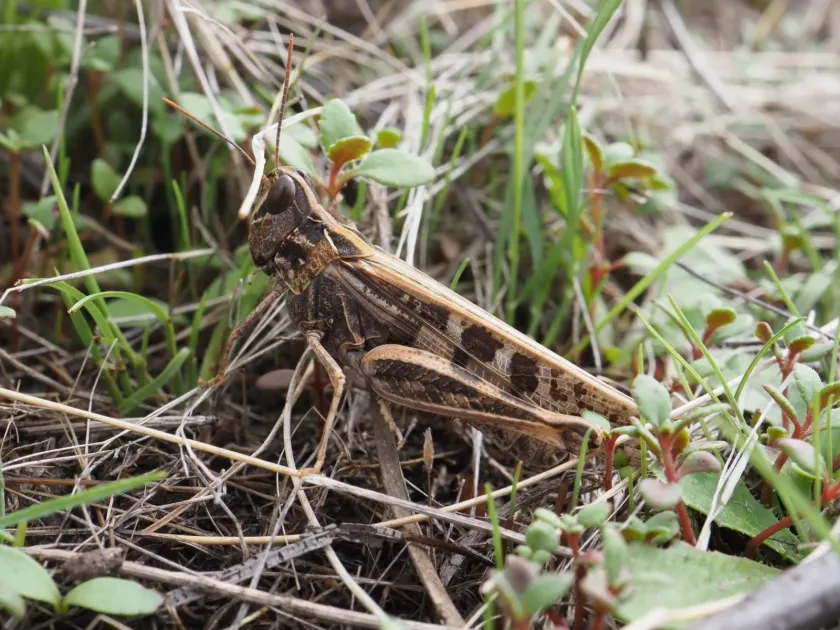
The Australian plague locust belongs to the order Orthoptera and the family Acrididae. Adult specimens typically exhibit a coloration ranging from light brown to dark grey, often with distinct dark markings on their wings.
A key identifying feature of this species is the presence of black spots at the tips of the hind wings, which is a defining morphological characteristic. Adult body length generally ranges from 25 to 40 millimeters, with females being notably larger than males.
Nymphs, or immature locusts, undergo five distinct stages of development, increasing in size and developing reproductive structures. During these stages, they are highly mobile and prone to congregating in dense groups.
The species exhibits phase polymorphism: at high population densities, the insects change their color and behavior, transitioning from a solitary phase to a gregarious swarm phase. In the gregarious phase, the locusts become significantly more aggressive and migratory.
Identification is often confirmed by their powerful hind legs and the characteristic chirping sound produced by males during the mating season when they aggregate in vast numbers across fields and pastures.
What it damages
The Australian plague locust is a polyphagous pest that poses a severe threat to a wide range of agricultural commodities. Both grain crops and vegetable plantations are highly susceptible to their feeding activities.
The greatest danger is posed to cereal crops such as wheat, barley, oats, and maize. Large-scale outbreaks can decimate young seedlings across vast agricultural landscapes in a matter of days.
In addition to cereals, these insects aggressively consume pasture grasses, lucerne, and other fodder crops, which has a devastating impact on the regional livestock and dairy industries.
During peak outbreak periods, the locusts also damage ornamental plants, fruit trees, and vineyards, stripping foliage, young shoots, and bark from the plants.
- Cereals (wheat, barley, maize)
- Fodder crops and lucerne
- Vegetable crops
- Horticultural and ornamental plants
When it appears
The lifecycle of the Australian plague locust is strictly governed by temperature and moisture availability. Under favorable environmental conditions, the pest can complete up to three generations per year.
The species overwinters primarily in the egg stage, with eggs laid by females in dense soil within protective pods. Nymph emergence occurs during the spring as temperatures remain consistently warm.
The summer months are characterized by the most rapid growth and swarm migration. Population peaks and subsequent crop damage are most frequent following rainfall, which promotes vegetative growth and nymph survival.
Activity gradually declines in the autumn, concluding with the deposition of egg pods into the soil to ensure the survival of the population through the winter, after which the adult insects perish.
Consistent monitoring of meteorological conditions allows agronomists to forecast population spikes and implement preventive measures to localize infestation centers early in the season.
Signs of infestation
The first indicator of an infestation is the presence of large numbers of nymphs within the fields, which move rapidly and leave behind heavily defoliated plants.
Damaged crops often display a characteristic net-like feeding pattern, where the veins of the leaves remain intact while the soft tissues are completely consumed. In dense swarms, the field may appear as if it has been recently mowed.
The presence of a gregarious swarm is easily identified by the loud noise produced during takeoff and the vast patches of bare ground where all vegetation has been completely stripped.
Evidence of egg-laying can be found in the soil, appearing as small holes drilled by females, which are often observed on compacted tracks or field edges.
The sudden appearance of predatory birds flocking to specific areas is another reliable visual marker that indicates high densities of the pest in that particular location.
Control measures
The most effective strategy is the early detection and treatment of breeding grounds while the nymphs are in the early instars and before they transition to a migratory swarm phase.
The application of modern insecticides, particularly organophosphates or pyrethroids, allows for the rapid containment of threats. It is crucial to follow label directions to minimize impact on beneficial insects.
Biological control methods, such as the use of entomopathogenic fungi like Metarhizium, have shown promising results in sustainable farming systems when applied under appropriate humidity levels.
Agrotechnical practices, including deep autumn tillage, help to destroy egg pods, which significantly reduces the population for the following season and helps prevent large-scale outbreaks.
Early warning systems and monitoring via satellite imagery assist agricultural authorities in responding quickly to swarm movements, often enabling timely aerial spraying of infested zones.
Taxonomy
- Latin name
- Chortoicetes terminifera
- Order
- Orthoptera (locusts)
- Family
- Acrididae
- EPPO code
- CHORTE
Discussion
No discussions yet — be the first.