
Australian plague locust
Chortoicetes
Description
How to identify
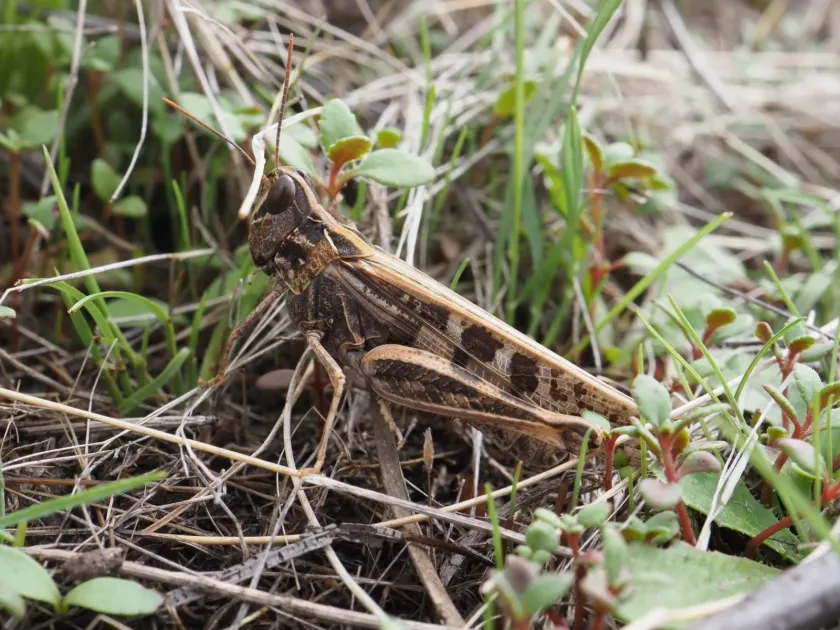
The Australian plague locust (Chortoicetes terminifera) belongs to the family Acrididae. Adults typically measure 25 to 40 mm in length, with coloration varying from light brown to olive green, providing excellent camouflage in grasslands.
A diagnostic feature of this species is a prominent dark, almost black spot at the tips of the hind wings. This feature is particularly noticeable during flight and helps distinguish it from other grasshopper species found in the region.
The species exhibits phase polymorphism; under conditions of high population density, individuals transition from a solitary phase to a gregarious (swarming) phase, undergoing changes in behavior, body shape, and color.
The hind tibiae are often tinged with red or orange, serving as a reliable identification marker for field agronomists. Males are generally smaller and more agile, while females are equipped with robust ovipositors for egg-laying.
Biological success of this species is driven by its adaptation to arid environments, where eggs are laid in compact soil, allowing them to remain dormant during dry spells and hatch rapidly following sufficient rainfall.
What it damages
As a polyphagous pest, the Australian plague locust is capable of consuming a wide array of vegetation. The primary economic impact is felt by cereal crops, including wheat, barley, and oats, especially at the seedling and tillering stages.
Pastures and fodder crops are also heavily affected, creating critical shortages for livestock production. Dense swarms can strip a field of all green material within a very short period of time.
Beyond cereals, the pest damages horticultural crops, including vegetables, vineyards, and fruit trees. During major outbreaks, the scale of destruction can lead to complete loss of seasonal agricultural produce.
Damage involves not only the consumption of foliage but also the destruction of reproductive structures, which prevents grain fill and fruit development. This makes population control vital for regional food security.
- Cereal crops (wheat, barley, oats).
- Natural and improved pastures.
- Vegetable and horticultural crops.
- Ornamental plants and gardens.
When it appears
The life cycle of Chortoicetes terminifera is closely tied to climatic patterns, specifically rainfall events. Under optimal moisture and temperature conditions, the species can complete multiple generations within a single season.
Eggs are deposited in soil in pods. They remain in diapause until environmental triggers, such as substantial rainfall, stimulate egg development and subsequent hatching of the nymphs.
The nymphal stage consists of five distinct instars. During this period, the insects are flightless but highly voracious, feeding actively on available vegetation and causing localized damage.
Adults are highly mobile and, in the swarming phase, capable of long-distance migration. These flights are primarily diurnal and are driven by the search for fresh food sources and suitable breeding grounds.
Outbreaks often follow prolonged dry periods broken by widespread rainfall, which triggers synchronized hatching across vast areas, leading to the rapid formation of large-scale swarms.
Signs of infestation
The earliest sign of an infestation is the observation of dense bands of nymphs (hoppers) moving through pastures or field margins. These groups often congregate in sunny areas to bask.
Plants showing characteristic ragged leaf margins or complete stripping of foliage are clear indicators of locust presence. In severe cases, fields may look as if they have been mechanically harvested.
The presence of large amounts of frass (feces) at the base of plants is a definitive sign of active feeding. A loud, continuous stridulation sound is also common when large populations of adults are present.
Migration swarms appear as dark clouds in the sky, often audible due to the sound of millions of wings. These swarms cause immediate concern and require urgent management intervention.
Field monitoring of soil for egg pods during the off-season allows for the prediction of potential outbreaks, enabling proactive measures before nymphs emerge in massive numbers.
Control measures
Effective management focuses on the early detection and control of nymphal bands. By targeting the flightless stages, farmers can prevent the formation of massive swarms and subsequent regional migration.
Chemical control is the primary method, utilizing insecticides applied via ground equipment or aerial spraying. It is crucial to target younger instars, as they are more susceptible to treatment.
Agricultural practices, such as deep tillage, can be employed in areas with known egg-laying sites. This disrupts the egg pods, exposing them to desiccation and natural predators.
Biopesticides based on entomopathogenic fungi offer an environmentally friendly alternative for locust control, specifically targeting the pests while minimizing chemical residues in the agroecosystem.
Coordinated regional surveillance programs are essential for success. Sharing data on swarm movement and breeding activity among landholders allows for efficient, wide-area control operations.
Taxonomy
- Latin name
- Chortoicetes
- Order
- Orthoptera (locusts)
- Family
- Acrididae
- EPPO code
- CHORSP
Discussion
No discussions yet — be the first.