
Dark-winged grasshopper
Chorthippus scalaris
Description
How to identify
The dark-winged grasshopper belongs to the order Orthoptera and the family Acrididae (short-horned grasshoppers). It is a medium-sized insect displaying sexual dimorphism.
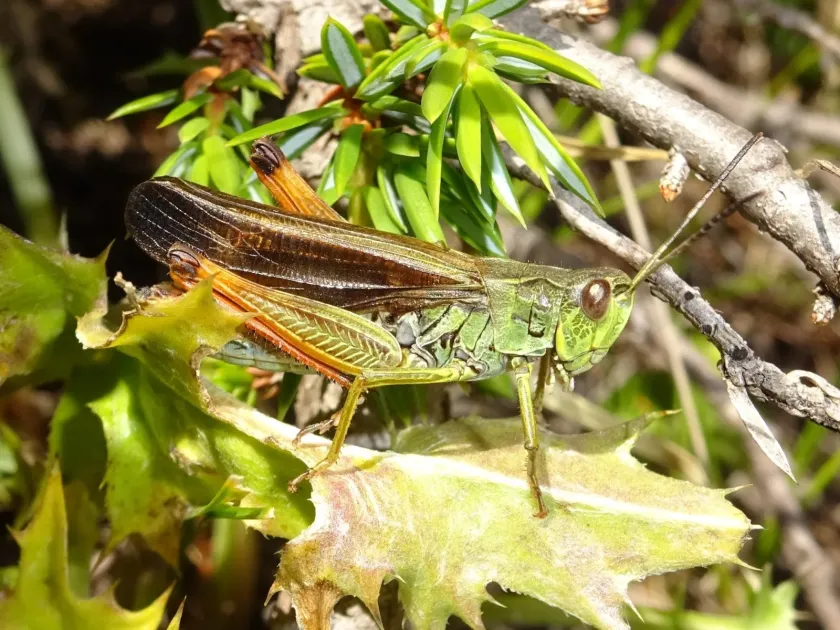
Males typically measure between 14 and 18 mm in body length, while females are significantly larger, reaching 18 to 25 mm. Their coloration varies from brownish-grey to greenish, providing effective camouflage in grass.
A distinctive feature of this species is its dark, almost black hind wings, which are clearly visible during flight. The pronotum has a characteristic pattern, and the lateral carinae are slightly curved inward.
This species is a typical inhabitant of meadow-steppe ecosystems. It is primarily found in temperate regions, preferring open habitats with abundant grassy vegetation.
Nymphs resemble adults but are smaller and lack developed wing pads. They undergo five stages of development, increasing in size during each molt.
What it damages
This pest is a polyphage, but it causes the most significant damage to cereal crops. The insects feed on the soft tissues of plants, including leaves, stems, and reproductive parts.
The dark-winged grasshopper causes serious damage to spring and winter cereal crops. At high population densities, these insects can almost completely destroy the vegetative mass of young plants.
In addition to cereals, the pest actively feeds on natural and cultivated pastures. Excessive multiplication leads to the degradation of forage lands and a reduction in hay yield.
Field colonization often begins at the edges of fields bordering unplowed areas, gullies, or meadows. During dry years, the migratory activity of the pest increases significantly.
Damage during the jointing and heading stages leads to substantial yield losses. Grasshoppers chew leaf tissues, disrupting photosynthesis and weakening the development of the grain spike.
When it appears
The life cycle of the dark-winged grasshopper includes one generation per year. They overwinter exclusively in the egg stage, with eggs deposited by females in the soil at a depth of 2–3 centimeters.
Nymph emergence occurs in the spring, usually at the end of April or May, when average soil temperatures reach levels optimal for incubation.
The period of intensive nymph feeding lasts between 30 and 45 days. During this time, they pass through all molting stages while actively consuming fresh green vegetation.
Adults (imagos) appear in mid-summer, usually in June or July. Their peak activity occurs during hot, sunny daylight hours, characterized by high flight activity.
Mating and egg-laying occur in the second half of summer. Females form egg pods (oothecae), providing protection for their offspring in the soil until the following spring.
Signs of infestation
The primary sign of field infestation is the presence of roughly chewed leaves. The edges of the leaf blades appear ragged, which is a clear indicator of grasshopper feeding.
The pest's presence is easily identified by the mass jumping of insects when walking through a field. In areas of high concentration, the characteristic stridulation (chirping) of males is audible.
In cases of severe infestation, patches appear in the field where vegetation is almost completely destroyed. The remaining plants appear stunted, turn yellow, and may lodge.
Insect excrement on the soil surface or leaves provides indirect evidence of an actively feeding grasshopper population.
Special attention should be paid to field borders, where high densities appear early, allowing for detection before the population spreads across the entire crop area.
Control measures
Effective management begins with agrotechnical measures, such as deep fall plowing. This leads to the mechanical destruction of egg pods and ensures the death of the eggs.
Regular monitoring of the pest population in its reservoir areas—such as road verges, fallow land, and shelterbelts—is essential. Destroying weeds reduces the available food supply.
Upon reaching the economic threshold of damage (usually more than 5–10 individuals per square meter), the application of insecticides from the organophosphorus or pyrethroid groups is necessary.
An important technique is the early detection of nymph hatching sites. Spraying the edges of fields allows for the localization of the population, preventing it from migrating to the main crop.
- Timely application of insecticides to infested fields.
- Use of biological control agents, such as entomopathogenic fungi.
- Strict adherence to crop rotation and rigorous weed control in surrounding areas.
Taxonomy
- Latin name
- Chorthippus scalaris
- Order
- Orthoptera (locusts)
- Family
- Acrididae
- EPPO code
- CHOHSC
Discussion
No discussions yet — be the first.