
Common Green Grasshopper
Chorthippus parallelus
Description
How to identify
The Common Green Grasshopper (Chorthippus parallelus) is a member of the Acrididae family, commonly found in pastures, meadows, and agricultural grassland environments.
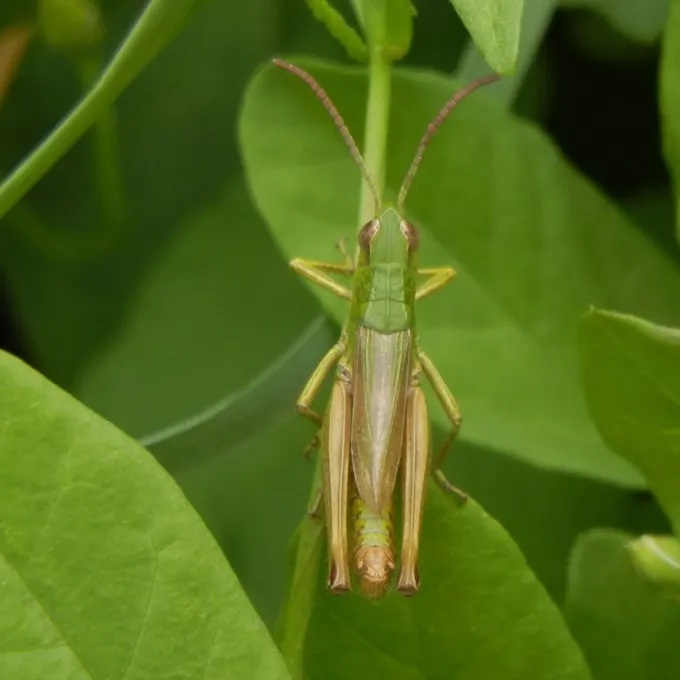
These insects are medium-sized, with adults typically measuring between 13 to 23 mm in length. Despite the name, they display significant color variations from bright green to brown or grey.
A key identifying feature is the wing structure; both males and females have shortened wings that do not fully cover the abdomen, making them poor fliers compared to migratory species.
The pronotum features parallel lateral keels, which is a diagnostic trait for this species, differentiating it from other grasshoppers found in the same habitats.
The life cycle is hemimetabolous, meaning they grow through several nymphal stages (instars) that resemble the adults but lack functional wings and reproductive capabilities.
What it damages
This grasshopper species feeds primarily on grasses and cereal crops. They consume the leaf blades, which can lead to significant reductions in green forage yield.
During heavy infestations, they can denude pastures and hay meadows, causing direct economic loss by reducing the availability of nutritious feed for livestock.
Young cereal crops are particularly vulnerable; feeding by high numbers of nymphs can result in reduced plant vigor, stunted growth, and thinning of the crop stand.
In addition to direct consumption, they weaken plants by creating wounds on the leaves and stems, which facilitates the secondary entry of pathogens and viruses.
The economic impact is most pronounced in dry years when limited forage availability causes grasshoppers to congregate in higher densities on the remaining green vegetation.
When it appears
The life cycle begins in spring, usually in May, when eggs overwintering in the soil hatch into nymphs, triggered by rising soil temperatures.
Nymphs undergo four to five molts over a period of 30 to 40 days, during which their appetite increases proportionally with their growth and physical development.
Adults emerge mid-summer, typically in July, and remain active until the onset of autumn frosts, focusing their energy on feeding and mating.
Egg-laying occurs in late summer and autumn, with females depositing their egg pods just beneath the soil surface in compacted earth, ensuring protection through the winter.
The most active period for both feeding and reproduction corresponds with warm, sunny conditions, which are ideal for their metabolic and developmental processes.
Signs of infestation
The initial signs of infestation are ragged or notched edges on the leaves of grass species, created by the feeding activities of the nymphs.
As the population density increases, patches of yellowing or scorched-looking vegetation become visible, indicating areas where the grasshopper pressure is highest.
Observation of the field often reveals the insects jumping away as one approaches, which is a reliable method for assessing their presence and relative abundance.
- Visible holes in leaf tissues or completely stripped stems.
- Accumulation of small, pellet-like frass on the soil or leaves.
- Audible stridulation (chirping) by males in dense infestations.
During autumn inspections, the presence of egg pods in the upper soil layers of field margins serves as a predictor for potential population pressure in the following season.
Control measures
Cultural control is the most effective approach; deep plowing of fallow land or field edges destroys overwintering egg pods and significantly reduces the next generation.
Regular mowing of field margins and uncultivated areas helps eliminate favorable micro-habitats, forcing the grasshoppers into areas where they are easier to manage.
Chemical control should be employed only when population thresholds are exceeded, utilizing spot treatments with appropriate insecticides to minimize impact on non-target species.
Biological control, including the conservation of natural predators such as birds and parasitic wasps, can play a role in maintaining the population at a manageable balance.
Continuous monitoring during the early spring nymphal stages is crucial to enable early intervention before the insects reach the adult stage and become more difficult to control.
Taxonomy
- Latin name
- Chorthippus parallelus
- Order
- Orthoptera (locusts)
- Family
- Acrididae
- EPPO code
- CHOHPA
Discussion
No discussions yet — be the first.