
White-bordered grasshopper
Chorthippus albomarginatus
Description
How to identify
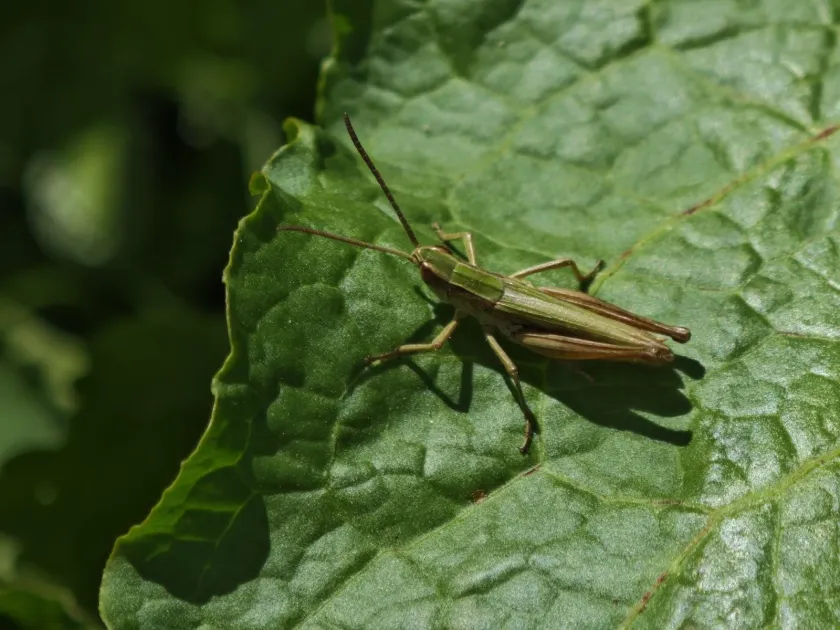
The white-bordered grasshopper (Chorthippus albomarginatus) is a member of the Acrididae family within the Orthoptera order. Adults typically measure between 13 and 22 millimeters in length.
They exhibit significant color polymorphism, ranging from bright green to brown or grey, which serves as camouflage in grass. A distinctive feature is the white margin along the front edge of their tegmina (forewings).
Males usually have wings that extend beyond the abdomen, while females may have shorter wings. The hind wings are transparent, sometimes showing a subtle darkening at the tips.
Nymphs appear similar to adults but lack developed wings and reproductive organs. They undergo several molts, gradually increasing in size throughout their development stages.
Females deposit their eggs into the soil, usually near the roots of grasses, creating egg pods protected by a hardened, foamy secretion that ensures winter survival.
What it damages
This species is a polyphage that shows a strong preference for graminaceous plants. It causes significant damage to both wild grasses and cultivated cereal crops.
Main agricultural hosts include wheat, barley, oats, and millet. In addition to grains, they frequently inhabit and damage perennial and annual forage grasses.
During mass outbreaks, these grasshoppers can devastate pastures and hayfields, stripping them of green biomass and significantly reducing livestock feed quality.
While they prioritize grasses, they may also consume legumes if the primary food source is exhausted or unavailable due to dry weather conditions.
Heavy feeding on young seedlings during the tillering stage of cereals results in sparse crop stands, leading to substantial yield losses at harvest time.
When it appears
The life cycle is univoltine, meaning there is only one generation per year. The insect overwinters in the egg stage, located in pods within the top 3 centimeters of the soil.
Hatching typically begins in late spring, usually in May, when soil temperatures remain consistently high enough to support embryonic development.
The emergence period of nymphs can be extended depending on the local microclimate and variations in soil temperature across different parts of the field.
Adults typically emerge in June or July. This period marks the peak of their activity, as they move rapidly to feed and mate to produce the next generation.
By autumn, the cycle concludes: after laying eggs, the adults perish, leaving the eggs to endure the winter months until the cycle restarts the following spring.
Signs of infestation
The first signs of infestation are ragged leaf margins on cereal plants. The insects feed along the edges, leaving uneven and notched leaf blades.
When populations are high, clear patches of decimated vegetation appear in the field, with stems left stripped and leaves almost entirely consumed.
The intense chirping or stridulation of males during the day is a clear indicator of a high population density within an infested field or grassland.
A quick inspection of the crop usually reveals the presence of grasshoppers jumping or flying away in response to human presence or agricultural machinery.
Visible insect excrement in the form of small, pellet-like droppings found on leaves and the soil surface confirms active feeding and a long-standing presence of the pest.
Control measures
Effective management begins with deep autumn tillage, which disturbs the soil and destroys the egg pods, exposing them to environmental stress and predators.
Maintaining clean field borders and managing weeds along fences and roadsides is critical, as these areas often serve as primary breeding reservoirs for the pest.
When the economic threshold is exceeded, chemical control using appropriate insecticides is necessary. Applications are most effective against early-instar nymphs.
Biological control agents, such as entomopathogenic fungi, can be utilized in regions with sufficient humidity to suppress population growth.
- Regular field monitoring for population spikes.
- Implementation of crop rotation.
- Targeted use of registered insecticides when thresholds are reached.
Taxonomy
- Latin name
- Chorthippus albomarginatus
- Order
- Orthoptera (locusts)
- Family
- Acrididae
- EPPO code
- CHOHAL
Discussion
No discussions yet — be the first.