
Uhler's green plant bug
Chlorochroa uhleri
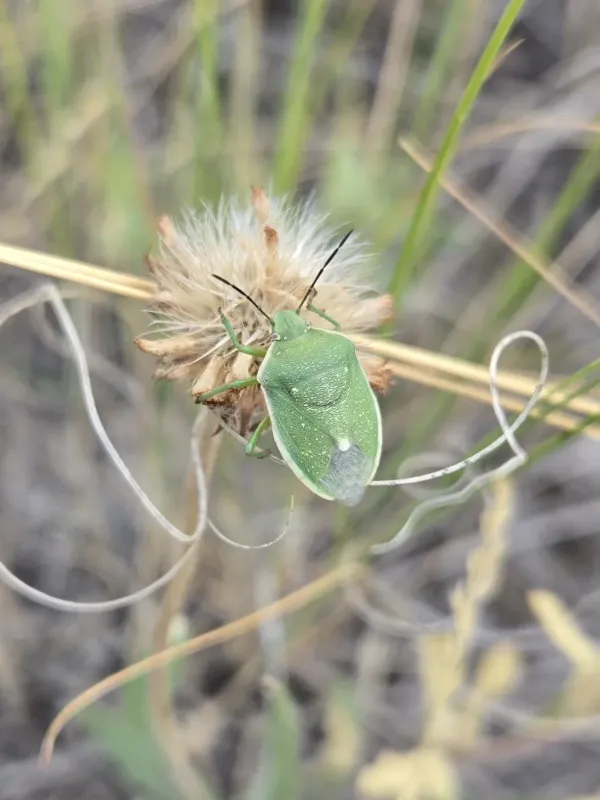
Description
How to identify
Uhler's green plant bug (Chlorochroa uhleri) is a member of the order Hemiptera and the family Pentatomidae, commonly known as stink bugs. Adult bugs typically reach 10–12 mm in length and have a distinct shield-like body shape.
Their coloration is generally bright green, often with pale or reddish margins on the pronotum and scutellum. This green hue provides excellent camouflage against host plant foliage, making them difficult to spot.
The insect possesses a specialized piercing-sucking mouthpart designed for feeding on plant sap. The antennae are five-segmented, a diagnostic feature common to all shield bugs.
Females deposit barrel-shaped eggs in clusters, usually on the underside of leaves. Nymphs go through several instars, gradually changing in size and developing colors similar to the adults as they mature.
These bugs are known for having scent glands on the thorax that emit a pungent odor when the insect is disturbed or threatened, a trait common to many pentatomids.
What it damages
This bug is a generalist feeder (polyphagous) that attacks a wide variety of agricultural crops, causing economic losses in cereals, legumes, and vegetable gardens.
The most significant damage occurs when adults and nymphs feed on developing fruit, pods, or grain heads. By piercing the plant tissues, they drain vital sap, which often leads to poor development or total failure of the harvest.
Common hosts include wheat, barley, corn, soybeans, and various pulses. In vegetable plots, they are known to attack tomatoes, cucumbers, and peppers, affecting both yield quantity and quality.
In cereals, feeding causes white or shriveled grains, which lowers the commercial value and germination potential. In legumes, punctures often lead to the development of opportunistic fungal infections.
Beyond direct feeding, Chlorochroa uhleri can act as a vector for various plant pathogens, further reducing the overall health and vigor of the infested crops.
When it appears
Adult bugs overwinter in protected areas, including leaf litter, debris, and the topsoil layer, where they remain dormant until spring temperatures rise.
As the weather warms, they emerge from hibernation and begin feeding on wild host plants or weeds before migrating to agricultural fields as crops reach the susceptible developmental stage.
The breeding cycle typically begins in the early summer months. Depending on the local climate and temperature conditions, one or more generations can develop within a single season.
Peak populations are usually observed when crops are in the reproductive stage. As temperatures begin to drop in the autumn, the bugs initiate their migration to overwintering sites.
Understanding these seasonal migrations is crucial for timing scout operations, as the influx of bugs from nearby weeds into field margins often precedes major infestations.
Signs of infestation
Early signs of infestation include small, chlorotic spots or necrotic punctures on leaves and stems, resulting from the bug's piercing-sucking feeding activity.
Extensive shedding of flower buds or the development of deformed, stunted fruit is a strong indicator of significant bug pressure during the early reproductive stages.
In cereal fields, a close inspection of heads might reveal discolored, shriveled, or empty grains, which is a classic symptom of shield bug feeding.
A strong, unpleasant odor released when plants are touched or shaken serves as a reliable field sign of a high population density of these pests.
Finding egg masses on the undersides of leaves is a clear warning that a new generation of nymphs will soon hatch, necessitating immediate management action.
Control measures
Cultural control is essential, including the removal of crop residues and diligent weed control along field margins, which reduces overwintering and early-season habitat.
Crop rotation should be utilized to break the cycle of bug populations, ensuring that the field environment is less favorable for high-density colonization.
Chemical control via insecticides is typically warranted when scouting indicates that populations have surpassed economic injury thresholds.
Applications are most effective when timed for early morning or evening hours, when the bugs are more active and visible on the upper parts of the plants.
- Maintain regular scouting schedules to monitor population spikes.
- Incorporate biological control agents such as predatory wasps or bugs.
- Harvest crops promptly to reduce the duration of exposure to the pest.
Taxonomy
- Latin name
- Chlorochroa uhleri
- Order
- Hemiptera (bugs, aphids, leafhoppers)
- Family
- Pentatomidae
- EPPO code
- CHLOUH
Discussion
No discussions yet — be the first.