
Green shield bug
Chinavia marginata
Description
How to identify
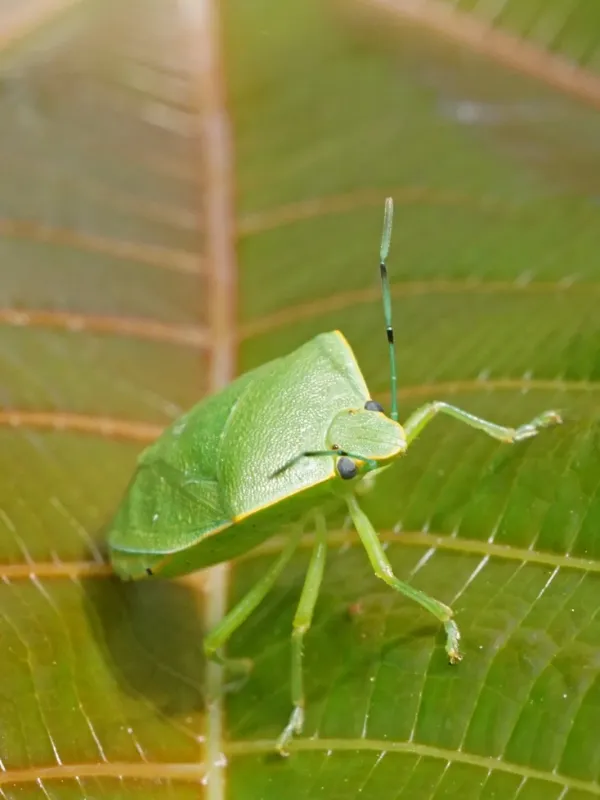
The green shield bug Chinavia marginata belongs to the order Hemiptera and the family Pentatomidae. Adult bugs have a characteristic shield-shaped body and a vibrant green color, which acts as excellent camouflage on plant foliage.
The body length of an adult typically ranges from 10 to 15 mm. The head is small and attached closely to the pronotum. A key diagnostic feature of this species is the thin, light or yellowish border along the edges of the pronotum and abdomen, which identifies it from other related shield bugs.
The life cycle includes the egg stage, five nymphal instars, and the adult stage. Eggs are usually laid in neat rows on the underside of host plant leaves. Early-stage nymphs tend to remain in groups, dispersing gradually as they progress through their developmental stages.
This species is a polyphagous insect. They overwinter in the adult stage, hiding under plant debris, fallen leaves, or within bark crevices near their food sources, allowing them to survive cold periods.
Activity begins with the onset of warm spring weather. After emerging from diapause, the bugs begin feeding and mating, followed by egg-laying on suitable host plants, which is often a critical period for crop development.
What it damages
This pest attacks a wide variety of agricultural crops. It causes significant damage to vegetables such as tomatoes, peppers, and cucumbers, as well as legumes like soybeans, beans, and peas, often leading to reduced harvest quality.
Both nymphs and adults cause damage to plants. Using their piercing-sucking mouthparts, they puncture plant tissues—leaves, stems, young shoots, and fruits—to feed on the nutrient-rich sap.
When young fruit ovaries are punctured, the fruit often becomes deformed, stunted, and may drop prematurely. Puncture sites frequently develop discoloration, pitting, and necrotic spots, which degrade the marketability and taste of the produce.
The feeding process disrupts the plant's metabolism and weakens its overall immunity. Furthermore, the puncture sites provide entry points for secondary fungal and bacterial infections, significantly compounding the damage to the crops.
Mass outbreaks during the fruit-filling stage can result in substantial crop losses, particularly in soybean fields and vegetable gardens, where the bugs may concentrate in large numbers, overwhelming the host plant.
Signs of infestation
The most reliable sign of an infestation is the visual presence of the bugs themselves on the underside of leaves or on the fruits. Careful inspection often reveals barrel-shaped eggs laid in symmetrical groups on leaf surfaces.
The surface of the fruit will display light or yellowish puncture marks. Over time, these spots may develop into sunken necrotic areas or pits, indicating that the bugs have successfully extracted sap and damaged the internal tissues.
Wilting of young shoot tips and leaf curling are also symptoms of a high population density. The plant may appear stunted and generally unthrifty due to the continuous loss of cellular fluid and damage to vascular tissues.
A specific, unpleasant odor emitted by the bugs' scent glands when disturbed is another common indicator. This smell may linger near the infested plants, serving as a warning sign for gardeners and farmers.
- Presence of bright green bugs on plant foliage.
- Egg clusters found on the underside of leaves.
- Deformed fruits with visible puncture spots or pitting.
- Wilting of young shoots and yellowing of foliage.
Control measures
Cultural control methods involve cleaning up plant debris after the harvest season to eliminate overwintering sites for the bugs. Deep autumn plowing is also recommended to destroy hibernating adults in the soil.
In small-scale gardens, manual collection of bugs and their egg clusters is highly effective, especially in the early morning when the insects are less active due to lower temperatures. Regular scouting of plants ensures early detection.
Biological control focuses on attracting natural enemies, such as predatory insects and egg parasitoids (e.g., Telenomus species). Bio-insecticides based on entomopathogenic fungi can also be employed to suppress population numbers.
If the pest population exceeds the economic threshold, chemical insecticides (such as pyrethroids) may be necessary. Applications should be timed to avoid the flowering stage to protect beneficial pollinators.
Crop rotation and keeping vegetable plots away from wild host plants help reduce the risk of massive colonization. Creating an unfavorable environment for the bugs significantly lowers the need for chemical interventions.
Taxonomy
- Latin name
- Chinavia marginata
- Order
- Hemiptera (bugs, aphids, leafhoppers)
- Family
- Pentatomidae
- EPPO code
- NEZAMA
Discussion
No discussions yet — be the first.