
Oak crescent moth
Cerostoma parenthesella
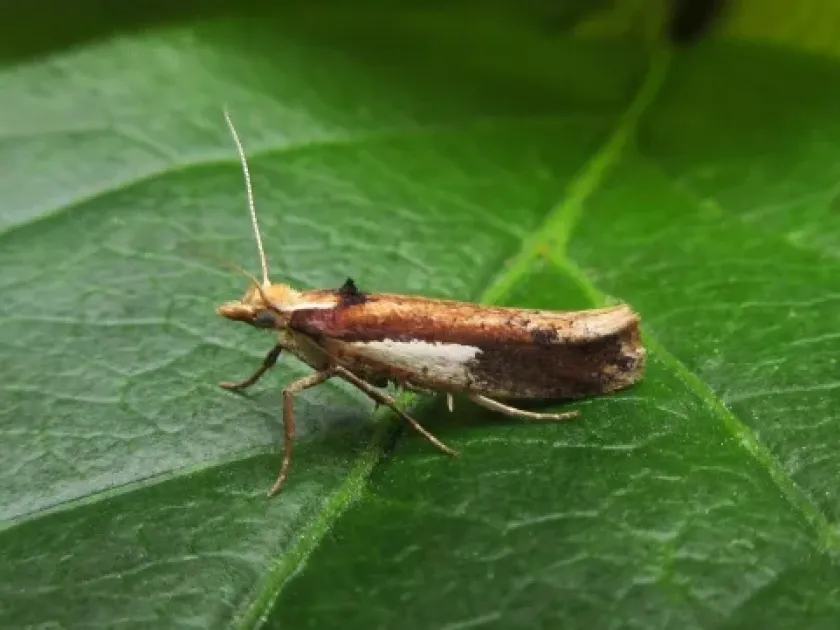
Description
How to identify
The Oak crescent moth (scientific name: Cerostoma parenthesella) is a small moth belonging to the Ypsolophidae family within the order Lepidoptera. Adults typically have a wingspan ranging from 15 to 18 mm.
The moth is easily identified by the distinct markings on its forewings, which resemble brackets or crescents, giving the species its common name. The hindwings are characteristically sickle-shaped.
The body coloration ranges from ochre to brownish-grey, which provides excellent camouflage against the bark of oak trees where the adults often rest during the day.
The larvae, or caterpillars, reach lengths of up to 15 mm. They typically exhibit a greenish color with subtle dark longitudinal stripes, allowing them to blend in perfectly with the undersides of leaves.
Pupation occurs within a firm, spindle-shaped white cocoon that the larva spins inside a folded leaf or within the deep crevices of the tree bark.
What it damages
The primary host for this pest is the English oak (Quercus robur), although it can occasionally be found on other oak species within the Quercus genus.
The larvae feed primarily on young foliage in the upper canopy. Heavy infestations can lead to significant defoliation, which impairs the tree's ability to perform photosynthesis.
Consistent annual damage can lead to a reduction in timber increment and overall decline in tree health, making the trees more susceptible to secondary pest attacks.
In forest nurseries, damage to young seedlings is particularly hazardous, as it can exhaust the plants' energy reserves and potentially lead to growth stunting or mortality.
While mature trees can usually withstand a single season of defoliation, repeated cycles of infestation severely weaken the immune response of the oak forest stands.
When it appears
The species completes one generation per year. Adult moths hibernate during the winter, seeking shelter in tree bark crevices, hollows, or leaf litter at the base of the trees.
In spring, as the oak buds break, the overwintered adults emerge to mate. Females lay their eggs singly or in small clusters on the young leaves and shoots.
Larval hatching typically occurs in late spring or early summer. The caterpillars then feed actively for approximately one month, which is the period of maximum damage.
Pupation takes place in mid-summer. The pupal stage lasts between two to three weeks before the next generation of adults emerges.
The summer generation of adults is nocturnal. They spend their time feeding on plant sap and nectar before preparing for their own period of hibernation in the autumn.
Signs of infestation
A key indicator of an infestation is the presence of leaves that are rolled or tied together with fine silken threads, forming protective nests for the larvae.
Feeding marks are characteristic, showing irregular holes or window-like patterns where the larvae have eaten the leaf tissue while leaving the epidermis intact.
The presence of larval frass (small dark pellets) caught within the silk webs or scattered on the leaves beneath the infestation is a sure sign of active feeding.
Visible silk webbing hanging from branches in the canopy is a clear indicator that the moth population has reached a high density in the area.
- Rolled leaves tied with silk
- Small, window-like feeding patches
- Premature yellowing and leaf shedding
- Presence of dark larval excrement
Control measures
Biological control is the preferred method in large forest areas. Formulations containing the bacteria Bacillus thuringiensis effectively reduce larval populations without harming non-target species.
In nurseries or high-value landscapes, systemic insecticides may be applied if monitoring indicates that the larval population will cause unacceptable levels of damage.
Maintaining high biodiversity in forest stands encourages natural predators, such as insectivorous birds and parasitic wasps, which act as important biological control agents.
Sanitary forest management, including the removal of heavily infested branches and dead wood, helps to reduce the local overwintering population of the moths.
Pheromone traps are essential tools for monitoring the flight period of adults, allowing foresters to time control interventions precisely for maximum efficacy.
Taxonomy
- Latin name
- Cerostoma parenthesella
- Order
- Lepidoptera (butterflies)
- Family
- Ypsolophidae
- EPPO code
- CRSTPA
Discussion
No discussions yet — be the first.