
Bamboo locust
Ceracris kiangsu
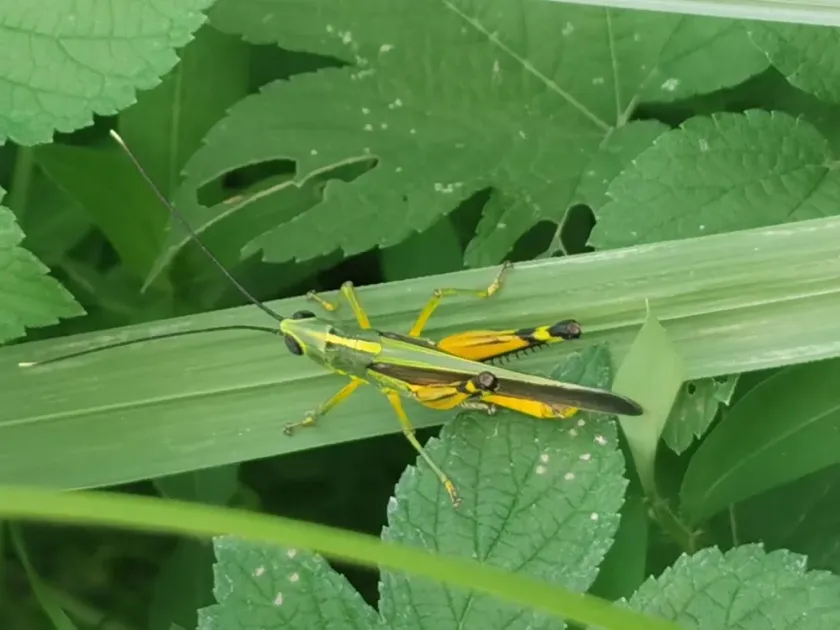
Description
How to identify
The bamboo locust (lat. Ceracris kiangsu) belongs to the order Orthoptera and the family Acrididae. This insect features a robust, yellowish-green or brown body, which provides excellent camouflage among bamboo stalks and foliage.
Adults reach approximately 40–50 millimeters in length. They possess well-developed hind legs adapted for jumping and powerful wings, enabling them to travel long distances during migration in search of food.
Nymphs appear similar to adults but lack fully developed wings. Throughout their development, they undergo several molting stages, gradually acquiring the coloration characteristic of mature adults.
This species is highly social during mass outbreaks, forming dense swarms. Such high population density makes them extremely destructive to vast areas of green vegetation.
Identifying the pest requires inspecting the underside of leaves and stems, where insects tend to congregate during early morning and late evening. Visual monitoring of nymph density is critical for early diagnosis.
What it damages
While bamboo is the primary food source for this locust, it is also polyphagous. When the preferred food source is scarce, they may feed on maize, sugarcane, and other cereal crops.
Mass outbreaks can lead to complete defoliation of bamboo forests in a very short time. Both adults and nymphs aggressively feed on leaf blades, leaving only the tough veins, which leads to plant exhaustion.
Damage results not only in the loss of green mass but also in the suppression of the bamboo root system. Severely damaged plants become highly susceptible to secondary infections and fungal pathogens.
In many agricultural regions, this species is classified as a quarantine pest. Economic losses are significant, encompassing yield reductions in commercial crops and the costs of replanting damaged areas.
Continuous defoliation results in the death of young bamboo shoots, which are essential for population regeneration. Without timely intervention, the damage can reach catastrophic proportions for local ecosystems.
When it appears
The life cycle of the bamboo locust is closely linked to seasonal temperature and humidity fluctuations. Typically, this species completes one generation per year, though variations can occur in warmer climates.
The pest overwinters primarily in the egg stage, with eggs deposited by females into the soil. Egg-laying sites are often located in well-drained, sunlit patches of compacted soil near bamboo plantations.
Mass hatching of nymphs occurs in the spring when soil temperatures reach optimal levels for insect metabolic activity. During this stage, nymphs begin feeding aggressively and grow rapidly.
The peak of adult damage occurs during the summer months, coinciding with the most intense growth period of bamboo. In late summer and early autumn, mating occurs, followed by egg-laying.
Seasonal monitoring includes using light traps to record adult migratory patterns. This enables agronomists to forecast the potential scale of infestation for the following season.
Signs of infestation
The first sign of infestation is the appearance of numerous skeletonized leaves on the tips and side branches of plants. Insects begin feeding from the leaf edges, gradually moving toward the midrib.
The presence of fine, granular frass (excrement) beneath damaged plants indicates active feeding by the locust population. Accumulations of this waste are a reliable indicator of high pest density.
A characteristic acoustic sign is the stridulation (chirping) of males during their active period, which helps locate the population even in dense thickets. However, visual inspection remains the primary detection method.
Detecting a large number of nymphs in the root zone requires immediate implementation of control measures. It is much easier to manage the pest at early stages before it spreads to neighboring sections.
The presence of birds or other natural predators actively hunting in the bamboo stands may serve as an indirect indicator of high locust density in a specific sector.
Control measures
Control of the bamboo locust must be integrated, combining agrotechnical, biological, and chemical methods. A key step is destroying egg-laying sites through deep plowing of soil during the autumn season.
Chemical treatments using systemic and contact insecticides are most effective during the early nymph stages. Pyrethroid-based products can rapidly reduce population numbers.
Biological control involves using entomopathogenic fungi, such as Beauveria bassiana or Metarhizium anisopliae. These biological agents can trigger epizootics among locusts under humid conditions.
The use of pheromone traps assists in tracking population dynamics and applying targeted control measures, which minimizes the area requiring pesticide application.
- Deep soil cultivation to destroy egg pods.
- Application of specialized insecticides upon reaching economic thresholds.
- Biological control using natural enemies and pathogens.
- Creation of barrier zones using non-host crops.
- Continuous monitoring of insect migration paths.
Taxonomy
- Latin name
- Ceracris kiangsu
- Order
- Orthoptera (locusts)
- Family
- Acrididae
- EPPO code
- CERWKI
Discussion
No discussions yet — be the first.