
Ceracris
Ceracris
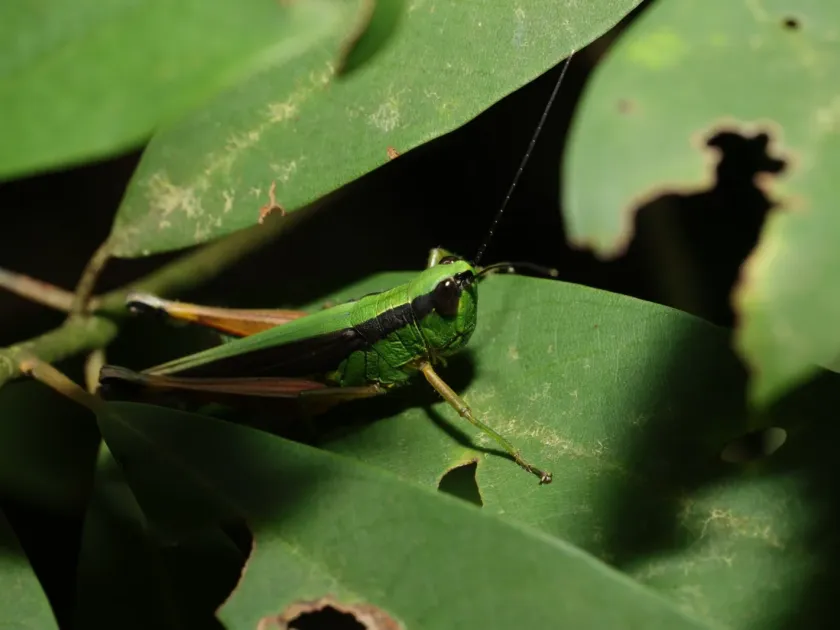
Description
How to identify
The genus Ceracris belongs to the order Orthoptera and the family Acrididae (short-horned grasshoppers). These are large insects characterized by strong hind legs adapted for jumping.
Physically, these insects often display bright coloration, which serves as camouflage in their natural environment or as a warning signal to predators. Species differentiation is based on wing venation and the specific structure of male genitalia.
These insects are primarily diurnal, showing peak activity when soil temperatures rise. Depending on environmental conditions, they may switch from a solitary lifestyle to a gregarious phase, making them highly destructive to agroecosystems.
The biology of Ceracris is closely linked to arid and semi-arid regions where they find optimal conditions for laying eggs in the soil. Larvae undergo several molts, gradually increasing in size until they reach the adult (imago) stage.
It is crucial for agronomists to monitor populations at the egg-pod stage, as this is the most effective time for forecasting potential pest pressure in upcoming seasons.
What it damages
Ceracris species are polyphagous, meaning they feed on a wide variety of plants. This puts both wild vegetation and many agricultural crops at significant risk.
The greatest economic impact is observed in cereal crops, including wheat, barley, and oats. Forage grasses in pastures are also heavily impacted, leading to feed shortages for livestock.
Technical crops like maize and sorghum are also susceptible to massive attacks during population outbreaks. Grasshoppers can defoliate a significant portion of a plant's biomass in a very short period.
Adult migrations pose a particular danger, as they can travel long distances in search of fresh food. During these periods, almost all green vegetation along the swarm's path is under threat.
The level of damage depends on the developmental stage and population density, which can reach hundreds of individuals per square meter during mass outbreaks.
When it appears
The activity of Ceracris throughout the year is strictly tied to temperature. The pest overwinters as an egg inside a protected soil capsule known as an egg pod.
Larval emergence typically occurs in spring when average soil temperatures reach specific thresholds. This period is critical for implementing preventive pest control measures.
Summer months are characterized by rapid larval growth and development, with older instars causing the most significant damage. Mid-summer is the peak for adult activity and reproductive cycles.
The life cycle is generally annual, but under favorable climatic conditions and a lack of natural enemies, the population can grow exponentially.
The autumn period marks the end of the reproductive cycle, egg-laying into the soil, and the death of adult insects, setting the stage for the next year's generation.
Signs of infestation
Symptoms of an infestation include characteristic ragged leaves and stems. Grasshoppers typically start by eating leaf margins, leaving only the hard veins behind.
At high population densities, complete defoliation is observed, leaving only bare stalks. This leads to a rapid loss of photosynthetic surface area and plant death.
The presence of these pests in fields is often accompanied by distinct stridulation (chirping). Adults are easily detected during visual inspections on sunny days.
In early stages, larvae can be spotted congregating in groups, actively feeding on weeds along field margins or near egg-laying sites.
Affected areas look like "clipped" patches that expand rapidly as the grasshopper swarm moves across the field.
Control measures
Management strategies are based on systematic field monitoring to identify areas with high concentrations of egg pods and young larvae.
Agronomic practices, such as deep plowing, can destroy egg pods located in the topsoil layer, leading to their desiccation, freezing, or consumption by birds.
Chemical control is the primary tool once the economic threshold is reached. Insecticides from the organophosphate, pyrethroid, and neonicotinoid groups are commonly employed.
It is important to spray during early morning or evening hours when the pests are less mobile and remain on the plants, significantly increasing the effectiveness of the treatment.
- Regular monitoring of crop fields for early detection.
- Timely insecticide application targeting early larval instars (1st-3rd).
- Establishing barrier treatments along migratory routes of larval bands.
- Collaboration with national plant protection services for coordinated control efforts.
Taxonomy
- Latin name
- Ceracris
- Order
- Orthoptera (locusts)
- Family
- Acrididae
- EPPO code
- CERWSP
Discussion
No discussions yet — be the first.