
Variable grasshopper
Celes variabilis
Description
How to identify
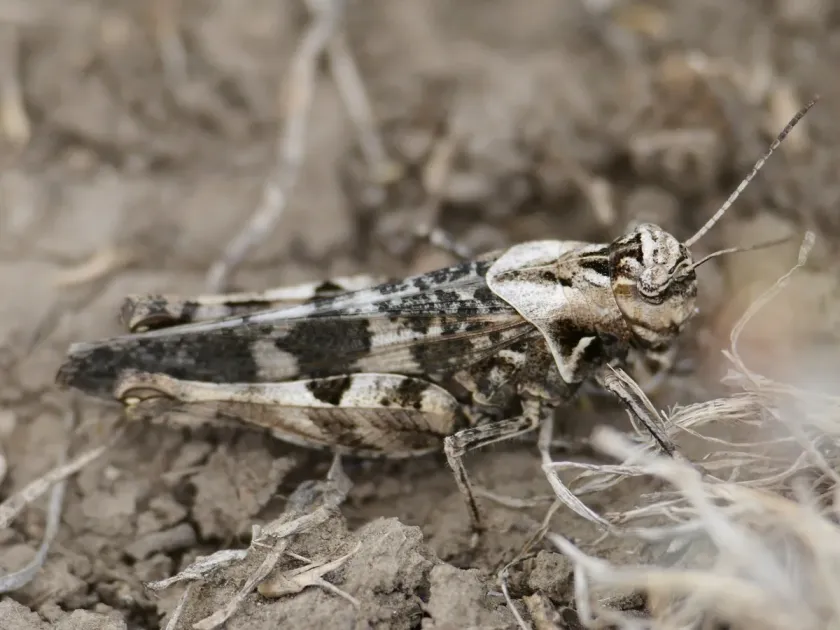
The variable grasshopper (Celes variabilis) belongs to the order Orthoptera and the family Acrididae. These insects are medium-sized, with males typically measuring 15–20 mm and females 22–30 mm in length.
As the name suggests, their body coloration is highly variable. Depending on the environment, they can appear grey, brown, or even greenish-black, allowing them to blend seamlessly with the dry soils and stubble of their habitats.
A key identifying feature is found on their hind wings: they possess a bright blue base bordered by a dark band. This striking color pattern is only visible during flight, acting as a clear diagnostic mark when the insect takes off.
The head features a distinct conical shape, and the pronotum has a noticeable keel that is slightly raised anteriorly. These morphological traits are essential for accurate identification of the species in agricultural fields.
These grasshoppers prefer arid, open habitats such as steppes, fallow lands, and roadsides. They are highly thermophilic, meaning they are most active during warm, sunny days when they seek out areas with sparse vegetation to bask.
What it damages
The variable grasshopper is a generalist herbivore (polyphage) that poses a significant threat to grain and legume crops. During outbreaks, they can cause severe economic damage to wheat, barley, oats, millet, and corn fields.
Both older nymphs and adults exhibit intense feeding behavior, consuming foliage, stems, and reproductive organs. In cases of high density, they can strip plants down to the main veins, causing total yield loss in affected areas.
The impact on grain development is particularly critical when the pests feed on young panicles and ears. This prevents grain filling and results in substantial harvest reductions, both in quantity and quality of the yield.
Legume crops like alfalfa and clover are also highly susceptible to their feeding. By destroying leaf biomass, they reduce the quality and yield of fodder, which directly affects livestock operations relying on these fields.
Furthermore, the damage caused by these insects often exacerbates plant stress, making crops more vulnerable to secondary fungal or bacterial infections through the open wounds left on plant tissues by their mandibles.
When it appears
This species is monovoltine, completing only one generation per year. They overwinter in the egg stage. Females deposit their eggs in the soil within protective cases called egg pods, usually 2–5 cm below the surface.
Egg-laying occurs in late summer and early autumn. The pods are highly resilient, allowing the eggs to survive cold winter temperatures and frozen soil conditions, which ensures the persistence of the population.
Larval emergence typically begins in the spring, usually in May, when soil and air temperatures reach optimal levels. The insects undergo five nymphal stages (instars) over a period of approximately 30–45 days.
Adult grasshoppers start appearing in June and July. This is the peak period for feeding and reproduction. Their high mobility during this stage allows them to spread across fields and find optimal host plants for their nutrition.
By late August or September, the lifecycle concludes as adults finish their reproductive cycle and die. The population remains dormant in the soil until the next spring, when the cycle repeats.
Signs of infestation
The most obvious sign of an infestation is the sudden movement of swarms when walking through a field. If present in large numbers, the grasshoppers will be seen jumping in waves as they are disturbed.
Visually, damaged plants display jagged, irregular edges on leaves. In severe infestations, the appearance of defoliated stems with only central veins remaining is a classic indicator of high grasshopper pressure.
One can also find remnants of grasshopper frass on the soil surface within the infested areas. Searching for empty egg pods in the soil of nearby uncultivated lands can help confirm if the area is a breeding ground.
Increased bird activity is another indirect sign. Flocks of birds frequently visit fields with high grasshopper populations, as these insects provide a significant food source for them during the summer months.
Inspecting the field in the early morning hours is ideal. Since the insects are less active when temperatures are lower, it is easier to assess their population density and identify the extent of the damage before they become too mobile.
Control measures
Cultural control is the first line of defense. Deep plowing of fields after harvest is highly effective, as it destroys the egg pods by exposing them to desiccation, frost, and natural predators, preventing the next generation from emerging.
Maintaining clean borders and eliminating weeds on roadsides and fallow patches reduces the availability of suitable oviposition sites. A weed-free field environment significantly decreases the success rate of the grasshopper population.
Chemical control should be implemented when the population exceeds the economic threshold (typically 2–5 nymphs per square meter). Applying insecticides, such as pyrethroids or organophosphates, is most effective on early-stage nymphs.
Biological control using entomopathogenic fungi like Beauveria bassiana offers an environmentally friendly alternative to chemical pesticides. These biological agents can effectively suppress populations, especially under favorable humidity conditions.
Regular field monitoring is crucial for integrated pest management. Early detection of hotspots allows for targeted localized treatments, preventing the spread of the infestation to the entire crop and reducing the need for widespread pesticide use.
Taxonomy
- Latin name
- Celes variabilis
- Order
- Orthoptera (locusts)
- Family
- Acrididae
- EPPO code
- CELXVA
Discussion
No discussions yet — be the first.