
Catantops
Catantops
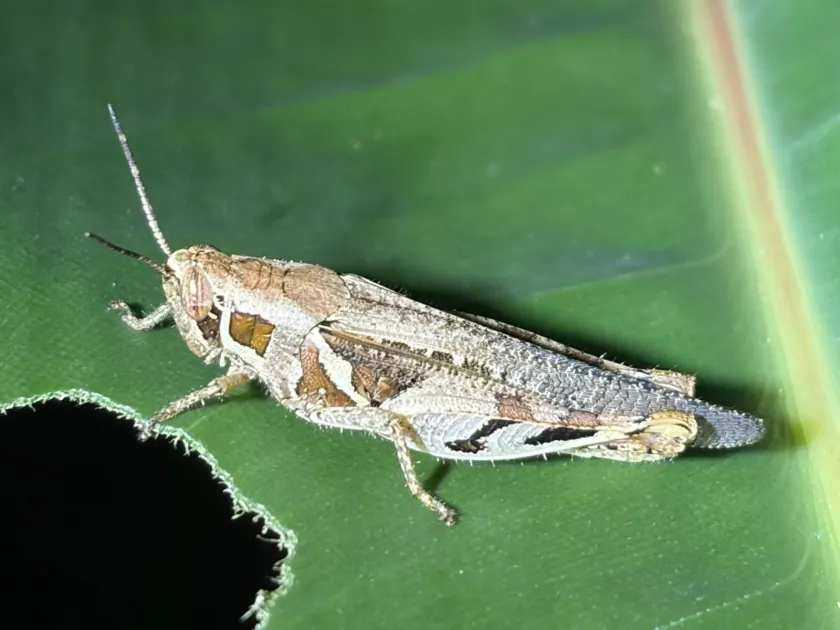
Description
How to identify
Catantops is a genus of grasshoppers belonging to the family Acrididae (order Orthoptera). These insects are widely distributed across various tropical and subtropical regions, particularly in Africa and Asia.
The adult grasshoppers are characterized by a robust body structure and strong, enlarged hind legs adapted for jumping across long distances.
Their coloration typically ranges from brownish to olive green, providing excellent camouflage within grasslands and agricultural crops.
Adult insects generally measure between 25 and 40 millimeters, with sizes varying based on the specific species and environmental conditions.
Taxonomists identify members of the genus Catantops primarily through the distinctive structure of their pronotum and the specific markings found on their hind femora.
What it damages
Catantops are considered significant polyphagous pests, meaning they feed on a wide variety of both cultivated crops and wild vegetation.
They pose a serious threat to cereal crops, including maize, millet, and sorghum, which often serve as their primary food sources during outbreak years.
Leguminous crops, such as soybeans and peanuts, are also highly susceptible, with insects often stripping entire leaves from the plants.
In orchards and horticultural areas, these grasshoppers may attack young shoots and tender leaves, which weakens the plants and reduces yield potential.
Beyond cultivated fields, their ability to feed on numerous weed species allows populations to persist in fallow areas until crops become available.
When it appears
The biology and lifecycle of Catantops are closely linked to rainfall patterns and regional temperature fluctuations in tropical climates.
The emergence of nymphs usually coincides with the beginning of the rainy season, ensuring that juvenile stages have access to abundant, nutritious vegetation.
Development proceeds through egg, nymph, and adult stages, with the number of generations per year depending on environmental stability.
High temperatures combined with moderate moisture levels create optimal conditions for rapid growth and population explosions.
During severe dry spells, these insects may enter a period of diapause or migrate to irrigated agricultural land to survive.
Signs of infestation
The most common sign of infestation is ragged, uneven feeding on leaf margins, often leaving only the main veins intact.
During high-density outbreaks, complete defoliation can occur, which severely impacts the plant's photosynthetic capacity and can lead to total crop loss.
Large groups of nymphs can often be observed moving across fields in swarms, systematically destroying vegetation as they progress.
Frass (insect excrement) found on the leaves and soil surface is a clear indicator of heavy pest pressure in the early stages of infestation.
Stems of infected plants often become structurally compromised and prone to lodging, which complicates mechanized harvesting operations.
Control measures
Effective management of Catantops relies on consistent field monitoring to detect nymphs at early growth stages before damage becomes irreversible.
Chemical control using contact and stomach insecticides is the primary method for managing large outbreaks on commercial farms.
Cultural practices, such as deep plowing, can help destroy egg pods laid in the upper layers of the soil, thereby reducing the next generation's numbers.
Biological control using entomopathogenic fungi is increasingly used as an eco-friendly alternative to minimize the impact on beneficial insects.
- Maintain field hygiene by removing surrounding weed hosts.
- Apply insecticides at the first sign of nymphal activity.
- Utilize bait-based control methods in localized areas.
Taxonomy
- Latin name
- Catantops
- Order
- Orthoptera (locusts)
- Family
- Acrididae
- EPPO code
- CANPSP
Discussion
No discussions yet — be the first.