
Mediterranean shield bug
Carpocoris mediterraneus
Description
How to identify
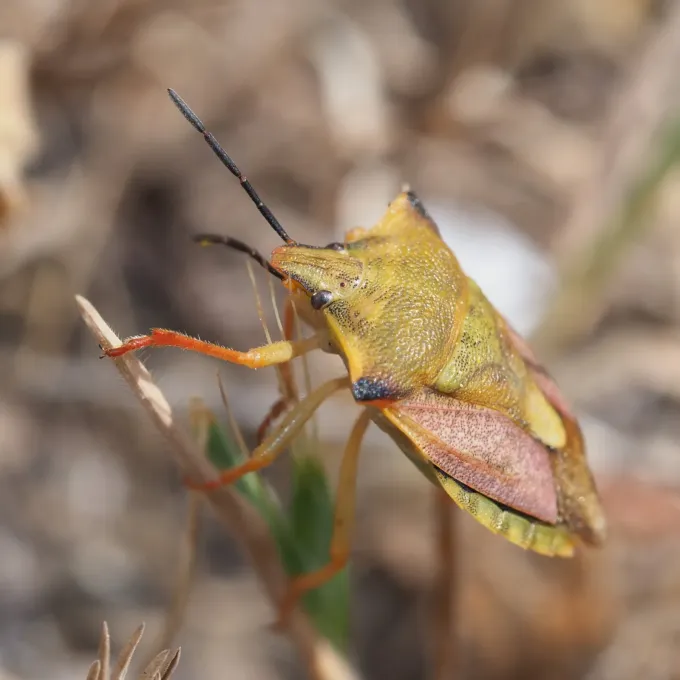
The Mediterranean shield bug (Carpocoris mediterraneus) is a true bug belonging to the order Hemiptera and the family Pentatomidae. These insects are easily recognized by their distinct, shield-shaped body.
The coloration of the adult bug typically ranges from yellowish-brown to reddish, with numerous dark punctures covering the dorsal surface. The pronotum has pointed or angulated edges, a key diagnostic feature for this species.
The head is triangular with a pair of five-segmented antennae. Like other members of its family, it possesses a beak-like proboscis, which is folded against the underside of the body when not in use.
Nymphs undergo five instars before reaching the adult stage. They lack fully developed wings and often exhibit slightly different coloration patterns compared to adults, gradually increasing in size with each molt.
Adults are capable of flight, which allows them to migrate efficiently between various habitats throughout the growing season in search of host plants and suitable conditions for reproduction.
What it damages
The Mediterranean shield bug is a polyphagous pest, meaning it feeds on a wide range of plant species. It causes damage to both wild vegetation and various agricultural crops.
Its primary targets include vegetables from the Solanaceae family, various legumes, and certain grain crops. The bug feeds on sap, targeting developing fruits, stems, and flower buds.
When feeding, the bug injects saliva containing enzymes into the plant tissue. This process leads to localized tissue necrosis, spotting, and, in many cases, fruit deformation or premature drop.
For cereal crops, feeding on the developing head can result in shriveled grains and reduced yield quality. The damage sustained makes the crops less marketable and potentially lowers their nutritional value.
Furthermore, these insects are known to transmit various plant diseases. The puncture wounds created during feeding serve as entry points for viral and fungal pathogens, potentially causing secondary infections.
When it appears
The bug overwinters in the adult stage. They seek shelter in leaf litter, debris, under the bark of trees, or in dense vegetation to survive the cold winter months.
As temperatures rise in the spring, typically above 12-15 degrees Celsius, the bugs emerge from hibernation. Initial feeding occurs on wild herbs and early-season grasses.
Mating and egg-laying typically begin in late spring and early summer. Females deposit eggs in clusters, usually on the underside of leaves to protect them from environmental stressors.
Population levels often peak during the mid-to-late summer months. This period coincides with the maturation of many crops, providing an abundant food source for the growing bug population.
By late autumn, as day length decreases and temperatures drop, the bugs begin to search for overwintering sites, signaling the end of the active feeding season in agricultural areas.
Signs of infestation
The primary indicators of infestation include chlorotic spots on leaves and necrotic lesions on fruits. These spots are the direct result of the bug's probing and feeding activities.
Fruits may exhibit irregular dimpling or become distorted, known as "cat-facing" in some crops. Heavy infestations can lead to substantial yield losses due to fruit malformation.
A distinctive, pungent odor is often present in infested areas. Shield bugs possess scent glands that release chemicals as a defense mechanism, which can be detected when plants are disturbed.
The presence of egg clusters on the undersides of leaves is a clear sign of an active infestation. The eggs are barrel-shaped and usually laid in neat, organized rows.
Small dark droplets, which are the excrement of the bugs, may also be visible on the surface of leaves and fruit, serving as a sign of their feeding presence on the plant.
Control measures
Cultural management is essential. Controlling weeds in and around fields is one of the most effective ways to reduce potential habitats and food sources for the bugs.
Deep fall tillage or plowing can destroy overwintering sites in the soil and crop residues, significantly reducing the population of bugs that will emerge the following spring.
Chemical control using insecticides may be necessary during periods of high pest pressure. It is crucial to choose selective products and follow application rates to ensure effectiveness.
For smaller gardens, manual collection of adults and egg clusters during the early morning hours, when the bugs are less active, can be an effective non-chemical solution.
- Weed management on field borders.
- Regular monitoring of crop development.
- Use of appropriate insecticides.
- Promotion of natural biological control agents.
Taxonomy
- Latin name
- Carpocoris mediterraneus
- Order
- Hemiptera (bugs, aphids, leafhoppers)
- Family
- Pentatomidae
- EPPO code
- CARRME
Discussion
No discussions yet — be the first.