
Carpocoris
Carpocoris
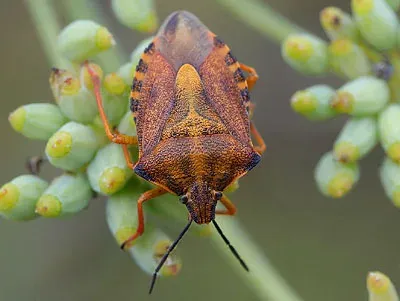
Description
How to identify
The genus Carpocoris belongs to the family Pentatomidae, order Hemiptera. These insects are commonly known as shield bugs due to the distinctive shape of their bodies.
Adults typically measure between 10 and 13 mm in length. Their coloration ranges from yellowish-brown to reddish-brown, usually featuring dense dark punctuations.
The head is broad, and the pronotum often exhibits sharp lateral angles. Like other true bugs, they possess piercing-sucking mouthparts for extracting plant sap.
Eggs are typically deposited in clusters on the underside of leaves and have a barrel-like shape, often appearing pale or whitish in color.
Overwintering occurs in the adult stage within leaf litter, under bark, or among dry vegetation in field margins and meadows.
What it damages
Carpocoris species are polyphagous, feeding on a wide range of host plants including cereals, legumes, various vegetables, and numerous wild grasses.
The most significant damage occurs during the grain filling or fruit development stages. The bugs pierce tissues to extract sap, causing deformation and necrosis.
Injured grains suffer from reduced weight and impaired germination capacity; flour produced from damaged wheat often exhibits poor baking quality.
In vegetables like tomatoes and peppers, feeding spots appear as pale discolored areas, leading to yellowing, cell death, and fruit malformation.
High population densities can cause substantial yield losses, particularly in fields adjacent to hedgerows or uncultivated land where they thrive.
When it appears
Overwintering adults emerge in early spring once ambient temperatures consistently rise above 10–12 degrees Celsius.
Egg-laying activity is extended, typically peaking between May and June. Depending on the latitude, the species may have one or two generations per year.
Peak activity for both adults and nymphs is observed during the warm summer months when they actively migrate into agricultural crops.
As temperatures drop in the autumn, their metabolic activity slows down significantly as they search for suitable overwintering sites.
The complete life cycle from egg to adult takes approximately six to eight weeks, influenced heavily by regional climatic conditions.
Signs of infestation
Detection is primarily achieved through visual inspection, where adults and various nymphal stages can be found on stems, leaves, and developing fruits.
Key symptoms include the presence of necrotic spots on fruits, which often turn into depressions or pits as the fruit matures and expands.
Yellowing, leaf curling, and premature senescence in localized areas are common indicators that the plant is being fed upon by a colony of bugs.
In cereal crops, damaged heads show signs of tissue collapse, which is often visible as stunted development in specific sections of the ear.
A strong, unpleasant odor released by the bug's thoracic glands when disturbed is a characteristic sign of their presence in the field.
Control measures
Effective management requires an integrated approach that combines cultural practices with targeted chemical applications when thresholds are exceeded.
Cultural control includes the removal of weeds and alternative hosts around the field perimeter, which significantly reduces the early season population.
Crop rotation and timely harvesting prevent the population from becoming established and spreading further into larger crop areas.
When monitoring indicates a high population density, application of registered pyrethroid or organophosphate insecticides is necessary.
- Monitor field edges for early migration of adults.
- Apply insecticides early in the nymphal stage for better efficacy.
- Utilize biological control agents where applicable to minimize chemical impact.
Taxonomy
- Latin name
- Carpocoris
- Order
- Hemiptera (bugs, aphids, leafhoppers)
- Family
- Pentatomidae
- EPPO code
- CARRSP
Discussion
No discussions yet — be the first.