
Eucalyptus psyllid
Cardiaspina albitextura
Description
How to identify
The Eucalyptus psyllid (Cardiaspina albitextura) is a small insect species belonging to the family Psyllidae, commonly referred to as jumping plant lice.
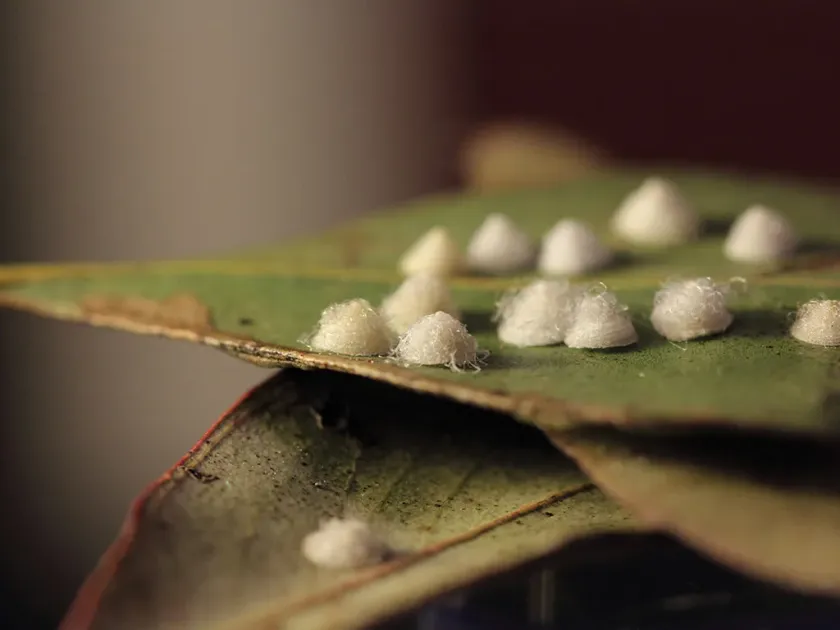
The species is distinguished by the unique behavior of its larvae, which construct protective white, lace-like structures on the leaf surface known as lerps.
Adult psyllids are winged insects capable of jumping, which allows them to move quickly between host trees when disturbed or searching for feeding sites.
The life cycle encompasses several developmental stages: eggs, five larval instars (nymphs), and the winged adult stage, with the rate of development driven by local temperatures.
Identification is primarily based on the presence of these distinct white larval covers and the specific damage patterns left on the leaves of host trees.
What it damages
This pest is highly host-specific, primarily feeding on various species of Eucalyptus trees, preferring young and succulent foliage for development.
Nymphs extract sap from the phloem of leaves, causing direct physiological stress and significant nutrient loss to the host plant.
Severe infestations lead to chlorosis and premature leaf drop, which can significantly reduce the photosynthetic capacity of the entire canopy.
Secondary damage occurs as the trees become weakened, making them susceptible to opportunistic pathogens and wood-boring insects that thrive on stressed timber.
Economic damage is substantial in forestry and nurseries, as the infestation causes stunted growth, reduced wood volume, and occasionally the death of young saplings.
When it appears
Psyllid activity typically peaks during the warmer months, coinciding with the flush of new growth on eucalyptus trees, which provides high-quality food for nymphs.
In regions with mild or mediterranean climates, the breeding cycle can be continuous throughout the year, with multiple generations overlapping.
The dispersal of winged adults is highly dependent on warm and dry weather conditions, which favor active flight and colonization of new tree stands.
During cooler winter periods, the population growth slows down, but the insects often overwinter in sheltered areas of the bark or remaining foliage.
Monitoring efforts are most effective during the spring and early summer when the first generations of the season begin to build their lerps.
Signs of infestation
The most diagnostic sign of an infestation is the presence of white, lattice-like lerps on the underside or upper surface of the eucalyptus leaves.
Leaves affected by high psyllid densities often display yellowing, curling, and deformation, leading to a thin and patchy canopy appearance.
Honeydew secretion, a byproduct of the insect's feeding, often promotes the growth of sooty mold, giving the leaves a dark and dirty appearance.
Observing the canopy from below can reveal early-stage infestations where the foliage appears slightly discolored even before major leaf drop occurs.
Disturbing a branch often results in a swarm of small adult psyllids taking flight, providing a clear indication of a heavy infestation present on the tree.
Control measures
Biological control is the most sustainable management strategy, utilizing predatory ladybirds, lacewings, and parasitoid wasps to keep populations in check.
Chemical intervention should be restricted to high-value trees or severe nursery outbreaks, utilizing systemic insecticides to target the sap-sucking nymphs.
Good silvicultural practices, including proper irrigation and soil management, enhance tree vigor, allowing the eucalyptus to better withstand psyllid pressure.
Regular surveillance programs help in early detection, allowing managers to isolate affected areas before the pest spreads to the entire plantation.
In cases of severe outbreak, removing and destroying heavily infested branches can effectively reduce the local population density of the pest.
Taxonomy
- Latin name
- Cardiaspina albitextura
- Order
- Hemiptera (bugs, aphids, leafhoppers)
- Family
- Aphalaridae
- EPPO code
- CRDIAL
Discussion
No discussions yet — be the first.