
Camnula
Camnula
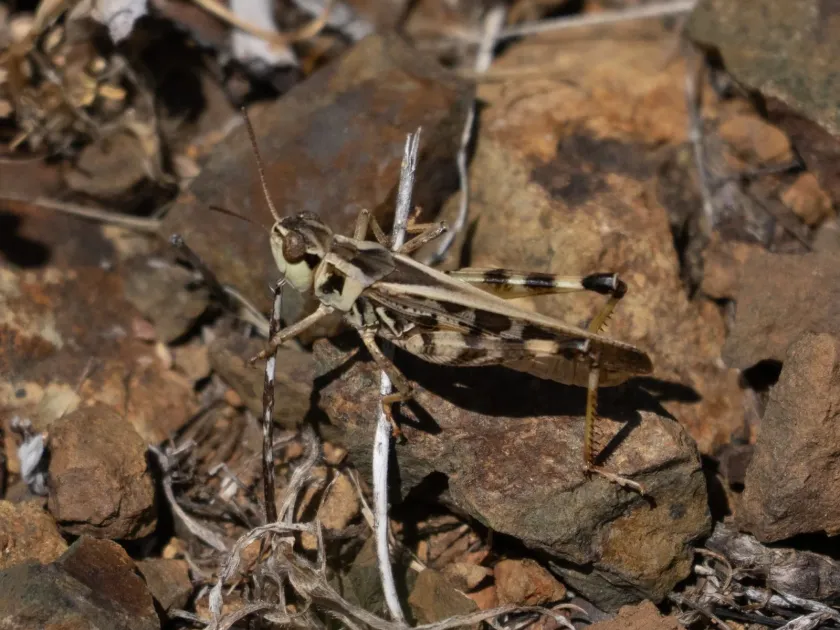
Description
How to identify
The Camnula, specifically the species Camnula pellucida, commonly known as the clear-winged grasshopper, belongs to the family Acrididae (short-horned grasshoppers) within the order Orthoptera. This insect is of medium size, characterized by yellowish-brown coloration with distinctive dark patches on the wings, which feature clear, transparent sections.
Adults possess well-developed wings, enabling them to travel significant distances in search of food. Nymphs (juveniles) physically resemble the adults but are smaller and lack fully developed wings during their earlier growth stages.
Identifying this species requires a close examination of the forewings, where the longitudinal veins exhibit a specific pattern. These pests are highly mobile and frequently congregate in dense swarms, which makes them easier to detect during field scouting.
The lifecycle encompasses an egg stage, five nymphal instars, and the adult stage. Unlike many other grasshopper species, the clear-winged grasshopper demonstrates a pronounced tendency to shift from a solitary lifestyle to a swarming, gregarious phase when population densities reach a critical threshold.
For accurate identification, agronomists are advised to utilize insect sweep nets during the early morning hours, when the insects are less active and tend to congregate in the lower canopy of the vegetation.
What it damages
Camnula is a polyphagous pest, meaning it has the ability to consume almost any green plant material. Crops at particular risk include small grains such as wheat, barley, oats, and corn, as well as native and improved pasturelands.
This pest is not restricted to commercial crops and actively feeds on wild grasses, causing substantial losses to the livestock industry. When outbreaks occur, the population can completely destroy yields over large areas in a very short timeframe.
In addition to destroying vegetative mass, nymphs and adults feed on the seed heads of grains, leading to significant yield losses immediately prior to harvest. Heavy feeding leads to decreased photosynthetic activity, plant weakening, and eventual mortality.
The destructiveness of Camnula is exacerbated by its ability to migrate from one area to another as food sources become depleted. This makes it a highly dangerous pest for agricultural enterprises located near undisturbed grassland or steppe habitats.
Damage symptoms typically appear as deep, ragged feeding patterns on leaves and stems, and in cases of high population density, total defoliation of the plants occurs.
When it appears
The lifecycle of the clear-winged grasshopper is closely linked to regional climate conditions, primarily within the temperate zones of North America. These insects overwinter exclusively in the egg stage, deposited in the soil a few centimeters deep within specialized egg pods.
The hatching of nymphs occurs in the spring once soil temperatures reach critical levels, typically spanning from late May through June. The nymphal development passes through five instars, each characterized by molting and growth.
The mass emergence of adults usually occurs in mid-summer, specifically during July and August. This period corresponds to the peak of pest activity and the most significant movement of the insects across the landscape.
Egg-laying for the next generation commences toward the end of summer and continues until the first autumn frosts. Females select firm, sun-warmed soil patches with sparse vegetation as ideal sites for depositing their eggs.
Thus, the primary window of threat for crops occurs from June through August, requiring rigorous field monitoring by agronomists throughout the entire summer season.
Signs of infestation
The first sign of an infestation is the appearance of bare patches in fields where plants appear chewed or clipped at the base. The presence of nymphal swarms is easily spotted when walking through a field, as they jump or fly in mass quantities.
A tell-tale signal is the abundance of fecal pellets on the soil surface, which serves as an indicator of high pest concentration. During morning and evening hours, the sound of stridulation (the chirping characteristic of the species) can often be heard.
During plant inspections, one can observe nymphs across all levels, from the lower leaves to the top of the grain heads. Furthermore, the mass arrival of birds and other natural predators in the fields serves as a biological indicator of a grasshopper outbreak.
Damage is typically focal in the early season and spreads rapidly as the population matures and food sources are exhausted in a specific area. Fields may initially look drought-stressed, but close inspection reveals the physical signs of mechanical feeding.
Monitoring field margins is essential, as these areas are the primary entry points for migrating pests coming from neighboring non-crop zones.
Control measures
The cornerstone of managing Camnula is prevention and early detection of breeding sites. Regular autumn monitoring of egg pod density in the soil is highly recommended to predict the following year's population levels.
Agronomic methods include deep plowing of fields at the end of the season, which destroys egg pods and exposes eggs to lethal cold temperatures. Furthermore, early mowing of weeds around field borders helps limit sites for nymphal development.
Chemical control remains the most direct and effective strategy. When thresholds are exceeded (typically over 5-10 nymphs per square meter), broad-spectrum insecticides such as pyrethroids or organophosphates are utilized.
- Applying barrier treatments around field perimeters to prevent swarm migration.
- Utilizing biological control agents, such as formulations containing entomopathogenic fungi (e.g., Beauveria bassiana).
- Encouraging natural predators such as birds and predatory insects within the agricultural landscape.
All chemical protection measures must be conducted in strict compliance with pesticide regulations and with consideration for pollinator activity periods to avoid detrimental impacts on the local ecosystem.
Taxonomy
- Latin name
- Camnula
- Order
- Orthoptera (locusts)
- Family
- Acrididae
- EPPO code
- CAMNSP
Discussion
No discussions yet — be the first.