
Watenwyl’s grasshopper
Calliptamus wattenwylianus
Description
How to identify
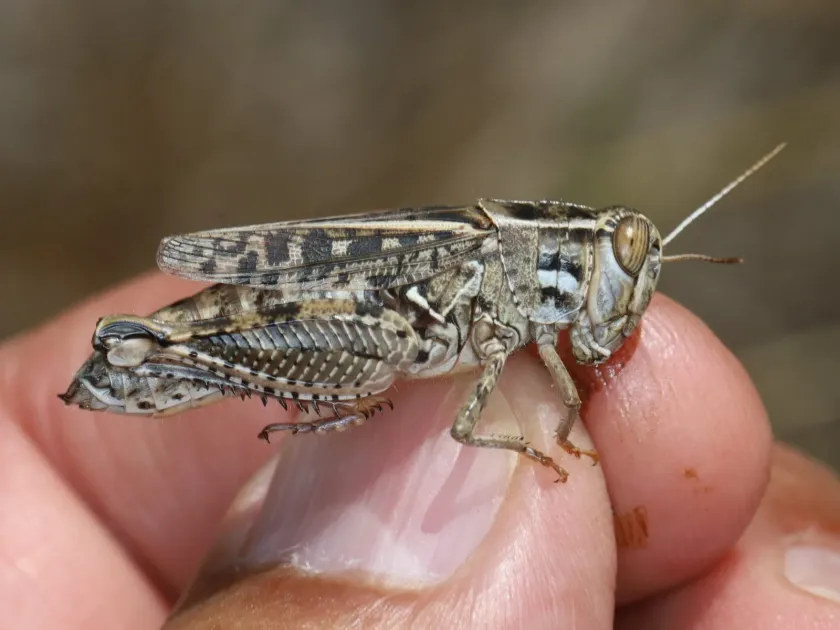
Watenwyl’s grasshopper (Calliptamus wattenwylianus) is a member of the Acrididae family. It is a medium-sized insect known for its robust jumping legs and well-developed mouthparts designed for chewing vegetation.
The coloration of this species is typically brown, grey, or yellowish-brown, which provides excellent camouflage against dry, arid soils. Adults generally reach a length of 20 to 35 mm, making them noticeable in the field.
This grasshopper possesses well-developed wings, allowing it to migrate across agricultural lands when food sources become scarce. It prefers open, sunny environments with sparse vegetation, which is typical for arid and semi-arid regions.
The life cycle progresses through egg, nymph, and adult stages. Nymphs undergo several molts, increasing in size and eventually developing fully functional wings, which characterizes their transition into the adult stage.
Unlike some gregarious locust species, Watenwyl’s grasshopper often exhibits a solitary behavior but can become a significant problem when population densities increase due to favorable weather conditions.
What it damages
As a polyphagous insect, Watenwyl’s grasshopper consumes a wide variety of plants. It frequently damages cereal crops, legumes, and various vegetable species, posing a threat to agricultural productivity.
Both nymphs and adults contribute to crop destruction. They consume leaf tissue, stems, and sometimes reproductive parts of plants, leading to severe yield losses in infested fields if left uncontrolled.
The most significant impact occurs during the early stages of plant growth. Young seedlings can be completely defoliated, resulting in crop failure and the need for expensive replanting efforts in the affected areas.
Feeding damage weakens the plant, making it more susceptible to secondary infections, such as fungal pathogens and bacterial rot. This indirect damage often worsens the overall health of the entire crop stand.
During dry years, when natural vegetation dries up, these insects are forced to migrate into irrigated fields. This concentration of pests leads to rapid destruction of cultivated crops in a very short timeframe.
When it appears
The seasonal activity of Watenwyl’s grasshopper is closely tied to climatic patterns. The species overwinter in the soil as eggs, protected by a hard, pod-like structure known as an egg pod.
Hatching of the nymphs occurs in the spring, typically when soil temperatures rise. This timing is critical, as it often overlaps with the emergence of young crop seedlings, providing immediate food for the nymphs.
Nymphal development occurs through late spring and early summer. During this period, the grasshoppers are active and undergo several molts, feeding intensively on any available green vegetation.
Adults emerge in mid-summer, increasing the range of activity and dispersal throughout the fields. This is the peak season for population spread and mating, which continues until the arrival of cooler weather.
As autumn approaches, females search for suitable soil conditions to lay their eggs. These eggs will remain dormant through the winter until the cycle repeats in the following spring.
Signs of infestation
The primary sign of infestation is the presence of irregular, ragged leaf edges. As feeding progresses, large sections of the foliage disappear, leaving only the tougher veins of the leaves.
Another clear indicator is the sudden jumping of insects when walking through the field. High levels of jumping activity are a reliable sign that the local population density has reached a concerning level.
In cases of severe infestation, you may observe bare patches in the field where seedlings have been completely eaten to the ground level, which is common in early stages of the crop season.
The presence of frass (excrement) on leaves or on the soil surface under the plants confirms active feeding. In hot weather, insects may cluster on exposed dirt paths or sunlit edges of the field.
A visible wave of damage spreading from the borders into the center of the field suggests migration. Prompt observation of these patterns is essential for determining the scope of the pest problem.
Control measures
Effective management of Watenwyl’s grasshopper requires an integrated approach. Early detection via regular field scouting is the most effective way to prevent significant economic damage to crops.
Tillage practices, particularly deep autumn plowing, are highly effective in destroying overwintering eggs in the soil. This reduces the number of nymphs that will emerge the following spring.
Maintaining clean field borders by removing weeds and wild grasses reduces the sites available for egg-laying and provides fewer alternatives for the insects to survive until they migrate into crops.
When populations exceed economic thresholds, chemical intervention is necessary. Contact and systemic insecticides are effective, particularly when applied to the borders of fields where the insects first gather.
- Monitor fields consistently, especially during the spring hatching period.
- Implement crop rotation to disrupt the insect's feeding cycle.
- Promote the presence of natural predators, such as birds and insect parasitoids.
- Apply insecticides early, targeting younger nymphs before they can migrate or reproduce.
Taxonomy
- Latin name
- Calliptamus wattenwylianus
- Order
- Orthoptera (locusts)
- Family
- Acrididae
- EPPO code
- CALUWA
Discussion
No discussions yet — be the first.