
Italian locust
Calliptamus italicus
Description
How to identify
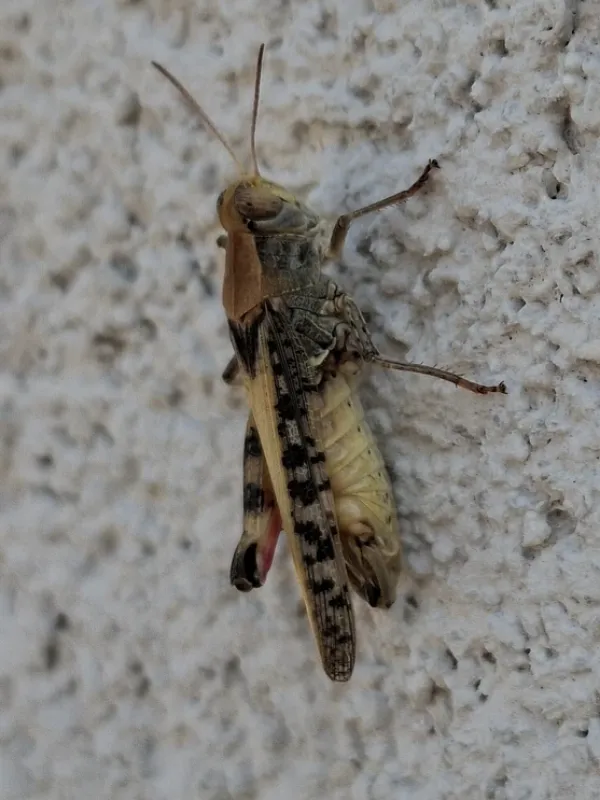
The Italian locust (Calliptamus italicus) belongs to the order Orthoptera and the family Acrididae. Adult insects typically reach a length between 28 and 40 mm.
Their coloration is cryptic, ranging from gray to brownish with darker spots, allowing them to blend perfectly with soil and dry vegetation. Their hind wings feature a distinct pinkish or reddish base, which is visible during flight.
The nymphs undergo five instars, progressively increasing in size and developing adult characteristics. Adults have a strong, clearly defined keel on the pronotum, which is a key diagnostic feature.
Females lay eggs in pods deposited in the upper layer of the soil. Each pod contains dozens of eggs protected by a hardened, frothy secretion that ensures survival during harsh conditions.
Males are generally smaller than females and have a more slender body. In years of high abundance, these insects can form swarms, significantly increasing their impact on agricultural landscapes.
What it damages
This pest is a polyphage and causes substantial damage to various agricultural crops. It frequently attacks cereals, including wheat, barley, and millet.
It also poses a severe threat to industrial crops such as sunflowers, sugar beets, alfalfa, soybeans, and various vegetable species in kitchen gardens.
When populations are high, locusts can completely strip leaves, stems, and even tender root tissues, often leading to total crop failure or massive yield losses.
In sunflower fields, they are known to damage the flower heads, which prevents proper seed formation and significantly reduces the market value of the crop.
Swarms are highly migratory, capable of moving across large distances and devastating entire fields in a matter of days during the peak of their activity.
When it appears
The Italian locust has a univoltine life cycle, meaning it produces one generation per year. They overwinter exclusively as eggs inside soil pods.
Nymphs typically hatch in the spring as soon as soil temperatures reach an optimal level, which usually coincides with the early vegetative stage of cereal crops.
Adult insects appear by mid-summer, generally in June or July. This period marks the peak of their feeding activity and the formation of swarms.
Mating and egg-laying occur in late summer, as the insects seek out well-drained, sunny, and loose soil patches to deposit their pods for the next season.
Weather patterns heavily influence their population dynamics; hot, dry summers promote faster development and higher survival rates for the nymphs.
Signs of infestation
Early signs of infestation include small, bare patches on the field where young nymphs have aggressively consumed the vegetation.
Disturbance of the field, such as walking through the crop, will reveal jumping insects, which serves as a primary indicator for closer population monitoring.
Plants will display ragged leaf edges or stripped laminae, leaving only the primary veins behind, which is a classic symptom of orthopteran feeding.
Localized aggregations of the locusts in more humid or lush parts of the field suggest the presence of a developing colony that requires immediate attention.
The presence of empty or intact egg pods in the soil after harvest is a vital sign for predicting the pressure of this pest for the upcoming season.
Control measures
Deep autumn plowing is an effective mechanical control method, as it exposes the egg pods to freezing temperatures and predators, reducing the next year's population.
Maintaining clean field margins and eliminating weed reservoirs along roadsides are essential practices to limit nesting and feeding sites for the locusts.
Chemical control remains the most reliable strategy during outbreaks. Applications are most effective when targeted at the early nymphal stages of the locusts.
Continuous monitoring using population surveys or pheromone traps helps farmers make informed decisions about when to apply insecticide treatments.
In cases of significant population spikes, integrated pest management (IPM) techniques, including habitat management and chemical intervention, should be employed.
Taxonomy
- Latin name
- Calliptamus italicus
- Order
- Orthoptera (locusts)
- Family
- Acrididae
- EPPO code
- CALUIT
Discussion
No discussions yet — be the first.