
Italian locust
Calliptamus barbarus
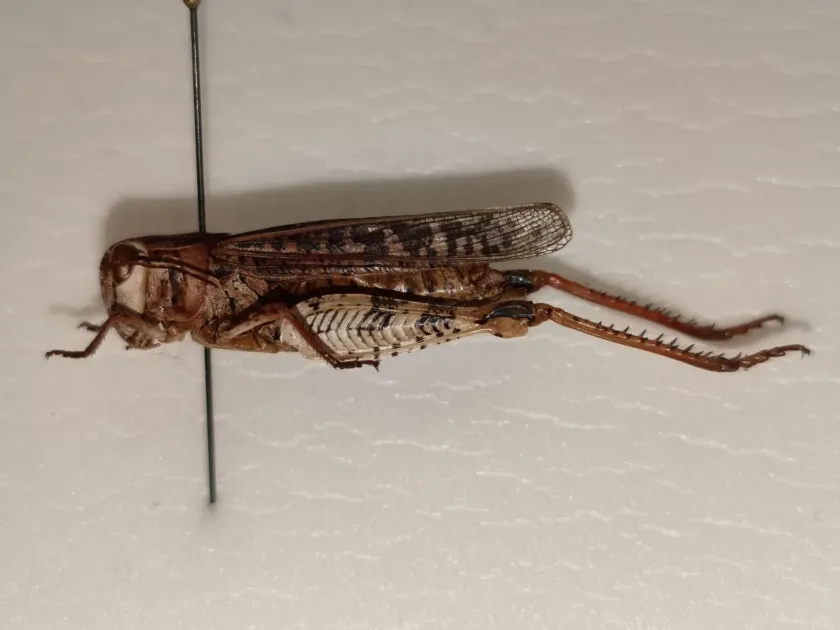
Description
How to identify
The Italian locust (Latin: Calliptamus barbarus) is a species of grasshopper belonging to the Acrididae family. It is a robust insect adapted to life in diverse terrestrial environments.
Adults typically possess a coloration ranging from grayish-yellow to brownish, which provides excellent camouflage against dry soils and sparse vegetation.
Females are significantly larger than males. A diagnostic feature of this species is the vibrant pink or red coloration found on the inner side of their hind femurs and wing bases.
These insects are primarily ground-dwelling, capable of jumping long distances and engaging in strong, sustained flight when disturbed or searching for food.
The nymphs undergo five distinct developmental stages (instars) before reaching maturity. They resemble adults but lack functional wings and are smaller in size.
What it damages
The Italian locust is a highly polyphagous pest capable of causing massive damage to a wide range of agricultural crops and wild plants.
Its primary hosts include various cereal crops such as wheat, barley, oats, corn, millet, and sorghum, which can be completely defoliated during outbreaks.
Leguminous plants like alfalfa, clover, soybeans, and peas are also frequently targeted, leading to significant losses in both biomass and nutritional value.
Vegetable gardens and orchards are also at risk, as the locusts can consume young shoots, leaves, and fruits, often causing irreparable damage to seedlings.
During massive outbreaks, these locusts can devastate entire fields, especially in dry and hot years when natural food sources become limited.
When it appears
The species overwinters in the egg stage. Eggs are laid in the soil during autumn, protected by a hardened, pod-like structure known as an ootheca.
Nymphs typically emerge in late spring, usually around May, once the soil temperature is sufficient to trigger the end of the embryonic diapause.
The nymphal development phase lasts for approximately 35–45 days, during which they molt five times before transforming into winged adults.
Adult insects are present from June through late summer. This is their most active period for feeding, mating, and searching for suitable egg-laying sites.
The Italian locust completes one generation per year in temperate climates, with the lifecycle concluding as the adults die off following egg deposition in the fall.
Signs of infestation
The most evident sign of an infestation is the presence of ragged or completely consumed foliage, leaving only the central veins of the leaves intact.
Upon inspecting a field, one can observe the locusts jumping away from the vegetation. Dense populations often emit a distinct chirping sound during hot afternoons.
Damage often begins in localized patches, particularly on field edges or areas with thinner crop density, before spreading across the entire field.
High levels of frass (excrement) accumulation on leaves and soil surface are also reliable indicators of heavy feeding activity by nymphs or adults.
- Severely defoliated plants and bare stalks.
- Damage to spikes, tassels, or other reproductive plant parts.
- Visible patches of damaged, dying crops in the field.
- Presence of insect activity during the hottest daylight hours.
Control measures
Deep autumn plowing is a fundamental agricultural practice that destroys egg pods in the soil, exposing them to predators and freezing temperatures.
Maintaining clean field margins and eradicating weeds is essential, as these uncultivated areas often serve as primary breeding and nursery grounds.
Chemical control is effective when applied early, targeting the young nymphal stages with insecticides from the pyrethroid or organophosphate groups.
Creating insecticide barrier strips around known infestation hotspots can help prevent the migration of locusts into highly valuable crop areas.
Biological control methods, such as encouraging the presence of natural enemies like predatory birds or entomopathogenic fungi, play a vital role in long-term suppression.
Taxonomy
- Latin name
- Calliptamus barbarus
- Order
- Orthoptera (locusts)
- Family
- Acrididae
- EPPO code
- CALUBA
Discussion
No discussions yet — be the first.