
Italian locust
Calliptamus
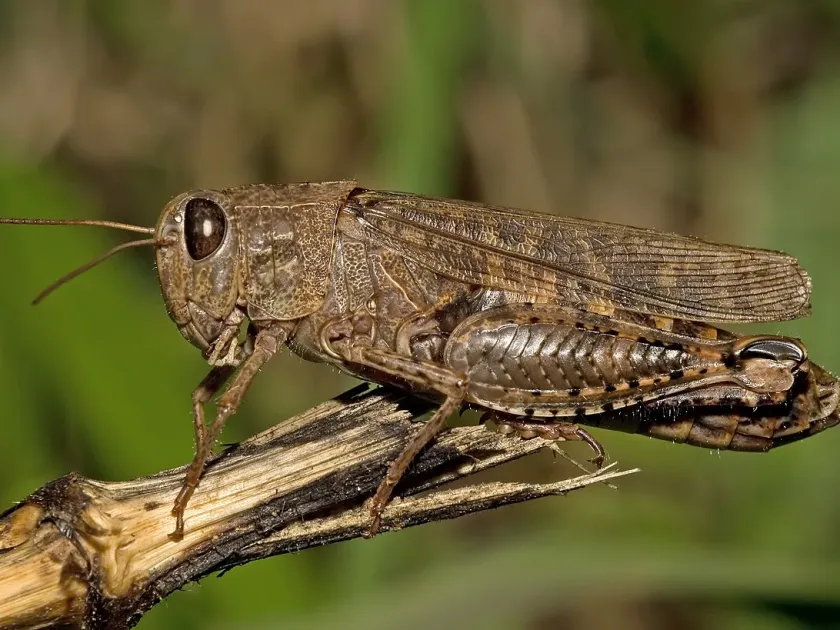
Description
How to identify
The Italian locust (Calliptamus italicus) belongs to the order Orthoptera and the family Acrididae, representing a serious threat to vegetation.
Adult insects typically measure between 25 and 40 mm in length, possessing a variable coloration ranging from greyish-brown to yellow-brown, which provides camouflage.
A diagnostic feature for identification is the bright red or pink coloration of the hind tibiae, which is clearly visible when the insect moves or takes flight.
They possess well-developed wings, often with a slight pinkish tint at the base, allowing them to perform significant dispersal flights across agricultural landscapes.
The life cycle involves egg-laying in the soil, where eggs are encased in protective cylinders known as pods, which remain in the ground throughout the winter.
What it damages
The Italian locust is a polyphagous pest, meaning it consumes a wide variety of plants, making it a major economic threat in agriculture.
It severely damages cereal crops, including wheat, barley, rye, and maize, often consuming both the foliage and the developing grain heads.
Technical crops like sunflowers, sugar beets, soy, and alfalfa are also highly susceptible to heavy infestations during their active growing seasons.
Vegetable crops and melons frequently suffer significant yield losses, especially in regions experiencing hot and dry summer conditions.
In cases of mass outbreaks, the locust can strip entire fields of green biomass, leaving behind only the tougher stalks and causing complete crop failure.
When it appears
The life cycle begins in spring as the soil warms up, allowing nymphs to emerge from the overwintering egg pods buried in the soil.
During spring and early summer, nymphs undergo five developmental stages (instars) while feeding voraciously on available green vegetation.
Adults typically emerge by mid-summer, usually in July, when they become fully capable of flight and intensive mating behavior.
The adult stage lasts until the onset of autumn frosts, during which time the females focus on laying eggs to ensure the next generation's survival.
The species completes one generation per year, making the autumn egg-laying period a vital stage for population density management.
Signs of infestation
Early signs of an infestation include small patches of chewed or ragged leaves on the edges of fields or near fallow land where nymphs often gather.
Presence can be confirmed by observing large numbers of nymphs jumping through the canopy of the crop as one walks through the field.
Adult locusts can be identified by their distinctive stridulation and the frequency of individuals taking flight when disturbed during sunny days.
Physical damage often manifests as shredded leaf margins, with the locusts moving inward from the field borders and consuming entire plants.
The formation of dense hopper bands is the most critical sign, indicating that a large population is moving systematically to destroy all edible plant matter.
Control measures
Effective management begins with cultural practices, such as deep autumn tillage, which disrupts the soil and destroys the egg pods to prevent hatching.
Monitoring non-cropped areas, such as road verges, pastures, and field edges, is essential for identifying and treating outbreaks before they spread to crops.
Chemical control involving approved insecticides is necessary when the number of individuals exceeds the economic threshold for damage.
Applying contact and systemic insecticides such as pyrethroids or organophosphates helps in rapidly reducing locust populations in infested zones.
Integrated Pest Management (IPM) strategies, including biological control options and habitat manipulation, should be employed to reduce chemical reliance over time.
Taxonomy
- Latin name
- Calliptamus
- Order
- Orthoptera (locusts)
- Family
- Acrididae
- EPPO code
- CALUSP
Discussion
No discussions yet — be the first.