
Pear sucker
Cacopsylla pyrisuga
Description
How to identify
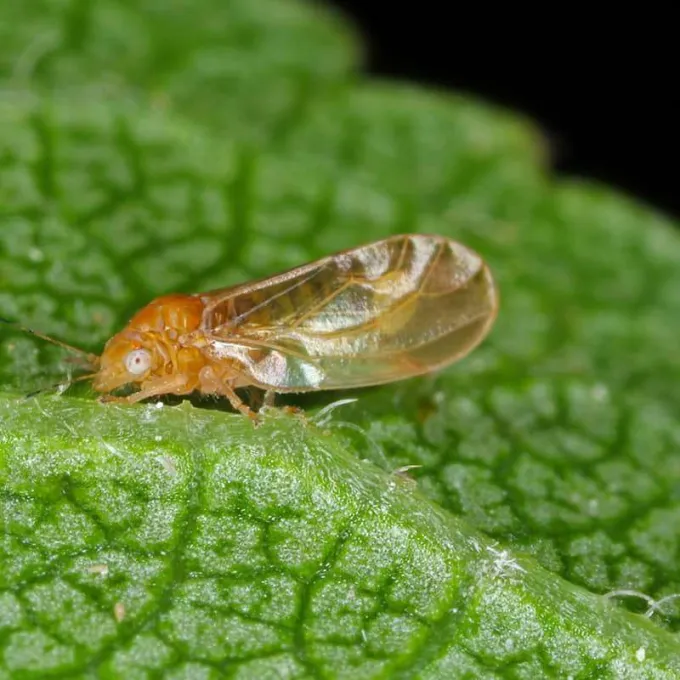
The Pear sucker (Cacopsylla pyrisuga) is a sap-sucking insect belonging to the order Hemiptera and the family Psyllidae. Adults measure approximately 3.5–4 mm in length and are equipped with strong hind legs adapted for jumping.
Their coloration is variable, shifting from greenish-yellow in the spring to darker brown shades as the season progresses. They overwinter as adults, finding shelter in bark crevices or under leaf litter.
Eggs are typically laid near buds or on young shoots. They are initially pale but darken to an orange-yellow hue as the embryo develops within the shell.
Nymphs undergo several instars, appearing flattened and often covered by the honeydew they secrete. These nymphs are the primary cause of damage in orchards.
The life cycle is tightly synchronized with the phenology of pear trees, allowing the pest to exploit the tree's growth cycles for optimal feeding and reproduction.
What it damages
The primary host for this pest is the pear tree. By extracting large volumes of sap from leaves, petioles, and fruit stalks, the insects significantly deplete the tree's energy reserves.
Severe infestations lead to leaf curling, chlorosis, and premature senescence of the foliage. Growth of new shoots is often stunted or deformed due to the toxic saliva injected by the pest.
Honeydew, a sticky waste product excreted by the nymphs, coats the leaves and fruit, providing an ideal substrate for the growth of sooty mold, which blocks sunlight and hinders photosynthesis.
Fruit quality is severely impacted; pears often become deformed, stunted, and blemished by the black fungal layer, making them unsuitable for market or consumption.
Chronic infestations compromise the overall vitality of the tree, reducing its resistance to environmental stresses such as drought or severe winter temperatures.
When it appears
Adult Pear suckers emerge from hibernation in early spring as soon as temperatures exceed 5°C. They immediately congregate on tree branches to feed and mate.
The egg-laying period coincides with the green-tip and flowering stages of the pear tree, making this an essential window for implementing initial control measures.
Nymphal activity peaks after flowering as they settle on the undersides of leaves. Several generations can occur throughout the growing season, leading to population explosions.
Dry, hot weather often accelerates the life cycle, leading to high population densities during mid-summer months.
As autumn approaches, adults seek overwintering sites, marking the end of the active feeding period and the beginning of the preparation for dormancy.
Signs of infestation
The most recognizable sign is the presence of honeydew, which creates a shiny, sticky coating on leaves and young stems, often attracting ants.
A black, sooty appearance on leaves and fruit indicates the presence of sooty mold, which develops on the honeydew and confirms an established pest population.
Visible leaf rolling and stunted shoot development are classic indicators that the trees are being actively fed upon by colonies of nymphs.
Fruit deformity, including reduced size and surface spotting, is a common symptom of significant damage occurring during the fruit development stage.
A quick inspection of the underside of leaves or the base of buds will often reveal the presence of nymphs, which will scatter or jump when disturbed.
Control measures
Cultural control is vital: pruning to open the tree canopy improves air circulation and increases the effectiveness of spray applications, while bark cleaning can reduce overwintering populations.
Encouraging natural predators such as ladybirds, lacewings, and predatory bugs is an effective strategy for long-term ecological balance in the orchard.
Chemical control should be timed correctly, targeting early nymph stages before they produce significant amounts of protective honeydew.
- Application of mineral oils for early spring control.
- Systemic insecticides during periods of high nymphal activity.
- Use of yellow sticky traps for monitoring population levels.
An integrated approach, combining monitoring, biological control, and timely pesticide application, is necessary to maintain pear tree health and productivity.
Taxonomy
- Latin name
- Cacopsylla pyrisuga
- Order
- Hemiptera (bugs, aphids, leafhoppers)
- Family
- Psyllidae
- EPPO code
- PSYLPY
Discussion
No discussions yet — be the first.