
Pear psylla
Cacopsylla pyricola
Description
How to identify
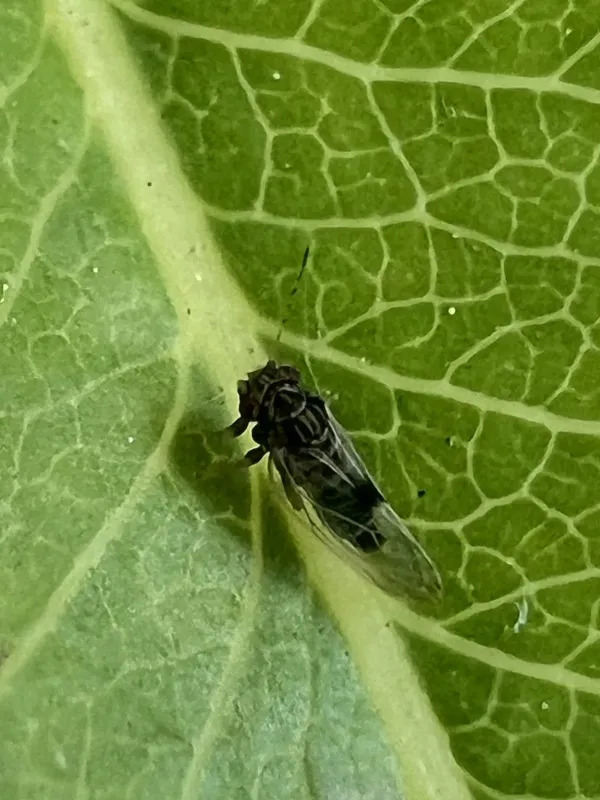
The pear psylla, scientifically known as Cacopsylla pyricola, is a small insect belonging to the family Psyllidae. Adults resemble tiny cicadas, reaching about 3 mm in length.
They possess transparent wings held roof-like over the body. Their coloration varies from pale green or yellow in the summer to dark brown during the overwintering phase.
Nymphs go through five distinct developmental stages, often referred to as instars. They are typically found covered in their own sticky honeydew secretions.
Eggs are small, oval-shaped, and usually deposited in clusters near the buds, petioles, or leaf veins during the early spring growth period.
This insect is recognized by its significant mobility, as both adults and nymphs have the ability to jump rapidly when disturbed on the host plant.
What it damages
Cacopsylla pyricola specifically targets pear trees. It feeds by inserting its mouthparts into the plant tissue to extract nutrients from the phloem.
The feeding process causes stunted shoot growth and leaf curling. Furthermore, the saliva injected by the insect contains toxins that cause necrotic spots.
Excessive feeding leads to a decline in tree vigor, resulting in reduced fruit set and poor tree development over successive growing seasons.
The honeydew produced by the nymphs coats the leaves and fruit, serving as a medium for the growth of sooty mold fungus, which discolors the pear skin.
Severe infestations can lead to premature leaf drop and the production of small, deformed fruits that are unsuitable for commercial sale.
When it appears
Adults overwinter in protected areas, such as bark crevices or leaf litter, and become active as soon as temperatures rise in the early spring.
The first generation begins laying eggs during the bud swell stage. Multiple generations can occur per year, depending on regional weather patterns.
Activity peaks during warm, dry periods when the insect's reproductive cycle accelerates, leading to rapid colonization of the orchard foliage.
During the summer, the presence of these insects is marked by constant activity on both the upper and lower surfaces of pear leaves.
As autumn approaches and temperatures drop, adults move toward their overwintering sites to survive the cold winter months until the cycle restarts.
Signs of infestation
The presence of sticky honeydew on foliage is the most common early sign of an infestation, often accompanied by a shiny appearance on the leaves.
Black sooty mold growth on leaves and fruit is a clear indicator that the psylla population has reached levels that require immediate management.
Yellowing, curling, and wilting of new succulent shoots indicate heavy feeding pressure from nymphs clustered in these vulnerable growing points.
Fruit quality deterioration, specifically the appearance of dark, unsightly spots caused by the sooty mold, affects the aesthetic value of the harvest.
Visual confirmation of adults jumping from branches when tapped with a stick is a reliable way to assess the current population density in the trees.
Control measures
Cultural control measures include removing loose bark and eliminating debris around the base of the trees where overwintering adults tend to congregate.
Dormant oil applications before bud burst are highly effective at smothering eggs and overwintering adults, providing a necessary head start for the season.
Chemical control using systemic insecticides is recommended during the green cluster stage or as soon as nymphs are observed on the young foliage.
Resistance management is crucial; therefore, rotating between insecticides with different modes of action is necessary to maintain long-term efficacy.
Promoting beneficial insects such as lacewings, lady beetles, and predatory bugs provides a natural suppression mechanism for pear psylla populations.
Taxonomy
- Latin name
- Cacopsylla pyricola
- Order
- Hemiptera (bugs, aphids, leafhoppers)
- Family
- Psyllidae
- EPPO code
- PSYLPC
Discussion
No discussions yet — be the first.