
Pear sucker
Cacopsylla pulchella
Description
How to identify
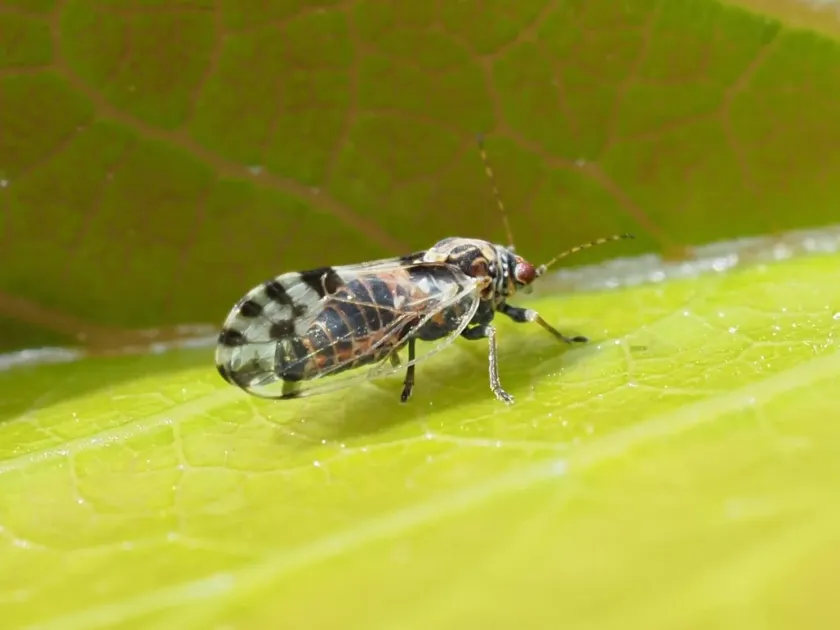
The pear sucker, or pear psyllid (Cacopsylla pulchella), is a small hemipteran insect belonging to the family Psyllidae. Adults typically measure between 3 to 4 millimeters and possess delicate, transparent wings.
These insects are characterized by their powerful jumping legs, which allow them to escape predators quickly. Their coloration varies by generation, shifting through shades of yellow, green, and brown.
The nymphs are flattened and often stationary, secreting a sticky substance known as honeydew. This substance provides a protective coating that shields them from desiccation and natural enemies.
Eggs are small and oval-shaped, typically deposited by females near the buds or on the bark. They change color from pale to bright orange as the embryo develops within the shell.
Proper identification requires close examination, as the species shares many characteristics with other psyllids in the genus Cacopsylla, making expert knowledge essential for accurate field diagnosis.
What it damages
Pear trees (Pyrus) are the primary host for this pest. The damage is caused by both adults and nymphs feeding on the phloem of young leaves, shoots, and flower clusters.
Continuous sap extraction weakens the tree, disrupting its nutrient distribution and leading to stunted growth. This loss of vitality makes the tree more susceptible to other secondary infections.
A major indirect threat is the production of honeydew, which acts as a growth medium for sooty mold. This fungus covers the leaf surface, severely hindering photosynthesis.
The reduction in photosynthetic capacity leads to premature leaf drop and poor bud formation. Consequently, the tree struggles to survive the winter and produce sufficient blossoms for the following season.
Fruit development is also severely impacted, resulting in small, deformed, and unmarketable pears that show signs of early ripening or rot due to the overall weakness of the tree.
When it appears
Overwintering adults survive in sheltered locations such as bark crevices or leaf litter. They emerge in early spring as temperatures rise, signaling the start of the new annual cycle.
The first generation usually coincides with bud break, making the tree particularly vulnerable during this initial stage of growth. Rapid population expansion occurs as the season progresses.
Depending on weather conditions, multiple generations can occur throughout the growing season. Warm and dry weather is particularly conducive to fast development cycles.
Populations often peak in late spring or early summer. While biological control agents can help, heavy infestations in mid-summer require proactive management to prevent significant crop damage.
As autumn approaches and leaves begin to fall, adults migrate to their overwintering sites. They enter a state of diapause, remaining dormant until the return of spring conditions.
Signs of infestation
Early warning signs include the curling and yellowing of young leaves. The sticky honeydew residue on the undersides of leaves is a clear indicator of a psyllid infestation.
Increased ant activity on the tree is a strong secondary signal, as ants are attracted to the sugary honeydew excreted by the nymphs and adults.
The emergence of sooty mold, appearing as dark, dusty patches on foliage and branches, indicates that the population has been established for a significant amount of time.
Flower blossoms may fail to develop or appear deformed. This loss of potential fruit significantly reduces the total yield and quality of the harvest throughout the season.
If disturbing the branches results in a flurry of small, jumping insects, this indicates a high infestation level that requires immediate intervention to mitigate further spread.
Control measures
Systemic insecticides applied during the pre-bloom period are highly effective. Targeting the early stages of the life cycle prevents the establishment of large, unmanageable populations.
Biological control involves preserving populations of predators, such as lacewings, lady beetles, and anthocorid bugs, which naturally regulate psyllid numbers in balanced orchard ecosystems.
Horticultural practices, including cleaning the tree trunks of loose bark and pruning away infested branches, help destroy the overwintering sites of the pest.
Good orchard sanitation, such as removing and destroying fallen leaves in the autumn, reduces the habitat available for adults to survive the winter months.
Monitoring using colored sticky traps is an essential tool for arborists. It allows for the precise timing of control measures, ensuring maximum impact while minimizing chemical usage.
Taxonomy
- Latin name
- Cacopsylla pulchella
- Order
- Hemiptera (bugs, aphids, leafhoppers)
- Family
- Psyllidae
- EPPO code
- CCPSPU
Discussion
No discussions yet — be the first.