
Plum psyllid
Cacopsylla pruni
Description
How to identify
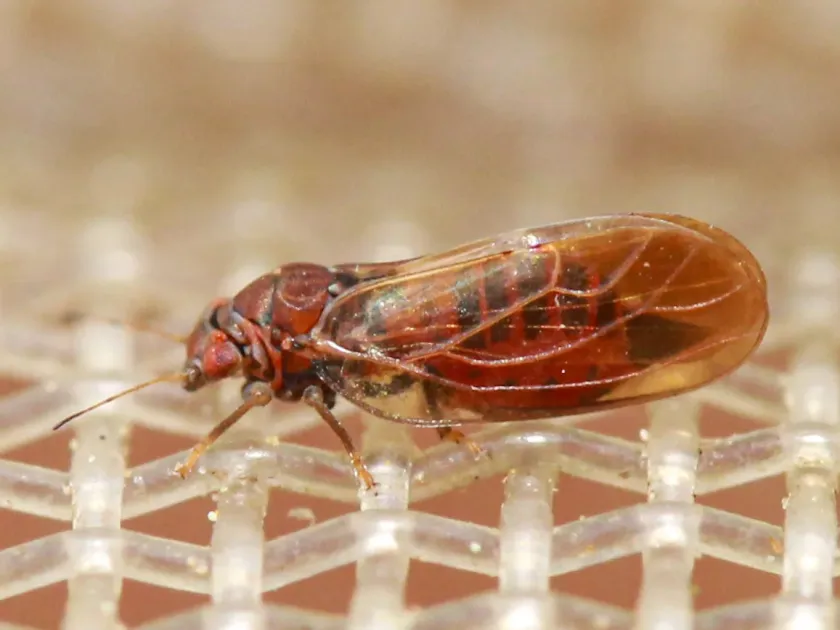
The plum psyllid (Cacopsylla pruni) is a tiny jumping insect belonging to the family Psyllidae, order Hemiptera. Adult insects typically measure 3-4 mm in length and exhibit variable colors ranging from yellowish-green to brown.
Adults overwinter in tree bark crevices, dense foliage, or nearby conifers. When temperatures rise above 8-10°C in early spring, they emerge and migrate to plum and other stone fruit trees to feed and mate.
Females deposit eggs near the buds, and once hatched, the nymphs undergo five stages of development. During these stages, they are protected by a waxy secretion that makes them difficult to eliminate with contact-only pesticides.
This pest is highly mobile, with adults jumping away when disturbed. Their life cycle is synchronized with the phenology of their host plants, allowing them to cause damage as soon as vegetative growth starts.
While there is only one generation per year, the high reproductive rate of Cacopsylla pruni allows populations to build up rapidly, necessitating active monitoring throughout the spring season.
What it damages
The plum psyllid primarily targets Prunus species, including plums, damsons, apricots, and peaches. Both nymphs and adults extract plant sap, significantly weakening the overall tree health.
Feeding leads to severe leaf curling, chlorosis, and stunted development of young shoots. This damage is particularly detrimental to young nursery trees, which may fail to develop properly under high infestation.
Crucially, Cacopsylla pruni acts as the primary vector for phytoplasmas, which cause the "witches' broom" disease. This condition is incurable and leads to tree decline, reduced yields, and eventual orchard death.
The excretion of honeydew by the nymphs encourages the growth of sooty mold, which blocks photosynthesis and reduces the aesthetic and commercial quality of the fruit.
Persistent feeding reduces the tree’s cold tolerance and nutrient reserves, leading to poor bud set in the following year and decreased overall productivity of the orchard.
When it appears
Activity begins in early spring, usually when daytime temperatures consistently reach 8-10°C. Emergence is timed with the opening of buds on susceptible fruit trees.
The nymphal stage, which causes the most significant damage, coincides with the flowering and fruit-setting period. This is the optimal window for applying control measures.
During the summer, adults disperse throughout the canopy. While their feeding activity is less visible than that of the nymphs, they continue to stress the tree until they move to overwintering sites in autumn.
As autumn approaches, adults seek shelter in protected environments, including tree bark or evergreens. Effective management includes minimizing these overwintering habitats whenever possible.
Monitoring should be most intense from the "green tip" stage of bud development until the late spring, as this timeframe represents the highest risk of infestation and disease transmission.
Signs of infestation
Visible curling and deformation of leaves are the most apparent signs of infestation. Foliage often appears yellowish and stunted compared to healthy trees nearby.
The presence of sticky honeydew on leaves and branches is a strong indicator of an active colony. This honeydew often turns black due to the secondary growth of sooty mold fungus.
Careful inspection of the leaf undersides reveals the presence of nymphs, which look like small, waxy, white or greenish particles moving slowly across the surface.
A sudden increase in ant activity on the tree trunks and branches often points to the presence of psyllids, as ants are attracted to the sweet honeydew secretions.
Widespread dropping of young fruit and the cessation of terminal shoot growth are late-stage symptoms that indicate severe infestation levels within the orchard.
Control measures
Effective management of the plum psyllid involves an integrated approach combining cultural practices with targeted insecticide applications during critical periods.
- Apply systemic insecticides during the pre-blossom stage to protect young buds.
- Remove and destroy branches showing signs of "witches' broom" to reduce pathogen spread.
- Maintain optimal tree vigor through balanced fertilization and irrigation.
- Encourage beneficial predators such as lacewings, ladybirds, and predatory bugs in the orchard.
- Monitor adult populations using yellow sticky traps to time control efforts accurately.
Rotation of chemical agents with different modes of action is vital to prevent the development of resistance within the psyllid population. Always ensure that the timing of chemical applications adheres to pre-harvest intervals.
Targeting the nymphs before they develop into adults is the most successful strategy to limit both direct feeding damage and the spread of phytoplasmal diseases.
Taxonomy
- Latin name
- Cacopsylla pruni
- Order
- Hemiptera (bugs, aphids, leafhoppers)
- Family
- Psyllidae
- EPPO code
- PSYLPR
Discussion
No discussions yet — be the first.