
Pear psyllid
Cacopsylla propinqua
Description
How to identify
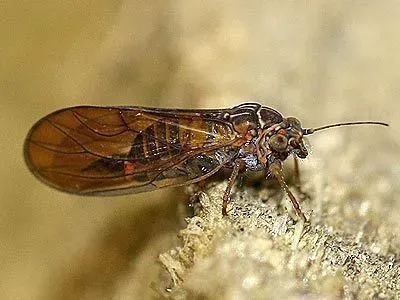
The pear psyllid, scientifically known as Cacopsylla propinqua, is a small hemipteran insect belonging to the Psyllidae family. Adults are roughly 3 mm long and possess clear wings, making them look somewhat like tiny cicadas.
Their color changes seasonally, with overwintering adults appearing darker, often reddish-brown or black. Summer generations are usually lighter, ranging from green to pale orange, helping them blend with new foliage.
Eggs are small, oval-shaped, and usually laid in clusters on young shoots, buds, or leaf stems. They transition through five nymphal stages, growing progressively in size and changing in appearance.
The last nymphal instar typically shows visible wing pads. These insects are equipped with specialized mouthparts designed for piercing plant tissue and sucking out sap.
They have strong hind legs that allow them to jump away quickly when disturbed, which is why they are often referred to as jumping plant lice.
What it damages
Pear trees are the primary host for this pest. The psyllids target developing tissues, including buds, blossoms, and tender leaves, which are rich in nutrients.
Feeding results in stunted growth, yellowing (chlorosis), and leaf curling. Trees suffer from reduced photosynthesis, which leads to weakened overall vigor and reduced fruit production.
A major indirect threat is the production of "honeydew," a sugary substance excreted by nymphs. This creates a perfect substrate for the growth of sooty mold, which blocks sunlight from leaf surfaces.
Fruits on infested trees may become deformed, scarred, or drop prematurely. The damage to the fruit's skin quality significantly reduces its commercial value.
Long-term infestations can result in significant branch dieback or even the total death of younger trees if not managed correctly during the peak growing season.
When it appears
The life cycle begins in early spring as temperatures rise above 5°C. Overwintering adults move from their hiding spots to the pear buds to feed and begin mating.
The first generation usually emerges just as the tree begins to leaf out. Multiple generations are produced throughout the summer months, often leading to overlapping stages.
Hot and dry weather conditions generally accelerate the development of the generations. During such periods, population densities can increase rapidly within a few weeks.
In mid-summer, population pressure is usually highest, making this the critical window for monitoring the health of the orchard foliage.
As autumn arrives and temperatures drop, adults enter their dormant state. They seek refuge under loose bark or in leaf litter to survive the winter months.
Signs of infestation
Early warning signs include the curling and yellowing of young leaves and a notable decrease in the length of new terminal shoot growth.
The presence of sticky honeydew on foliage and stems is the most obvious indicator of a pear psyllid infestation. It often gives the leaves a glistening appearance.
A black, powdery layer covering leaves indicates the development of sooty mold, signaling that the infestation has reached a significant level of severity.
Heavy presence of ants on the branches is a strong secondary indicator, as they are attracted to and protect the honeydew-producing psyllids.
Significant blossom drop or shriveling of the flower clusters often occurs in the early spring, indicating that the buds have been targeted by the pests.
Control measures
Effective management begins with dormant season sprays, such as horticultural oils, to kill overwintering adults before they can start laying eggs.
Regular orchard hygiene, including pruning to remove infested shoots and cleaning bark to eliminate overwintering sites, is crucial for population reduction.
During the growing season, systemic insecticides should be applied based on economic thresholds to avoid unnecessary chemical stress on the trees.
Encouraging beneficial insects, such as lady beetles, lacewings, and predatory bugs, provides natural control and helps keep the population in check.
- Monitor traps to track the migration of adults in early spring.
- Ensure adequate tree spacing to allow for good airflow and light penetration.
- Avoid excessive nitrogen fertilization, which promotes succulent growth favored by psyllids.
- Use selective biological controls when monitoring confirms high nymphal density.
Taxonomy
- Latin name
- Cacopsylla propinqua
- Order
- Hemiptera (bugs, aphids, leafhoppers)
- Family
- Psyllidae
- EPPO code
- CCPSPR
Discussion
No discussions yet — be the first.