
Apple sucker
Cacopsylla melanoneura
Description
How to identify
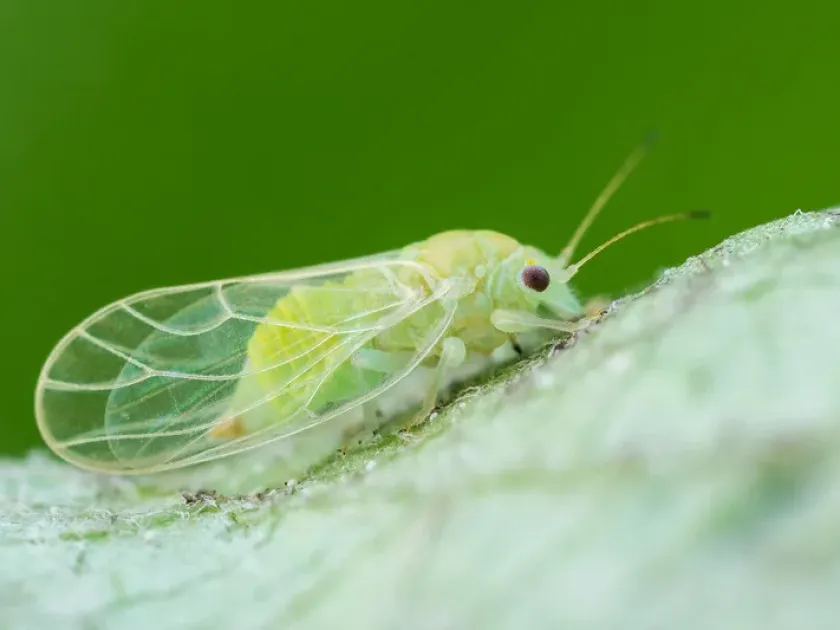
The apple sucker, scientifically known as Cacopsylla melanoneura, is a small insect belonging to the family Psyllidae. These insects, commonly called jumping plant lice, are typically 3 to 4 mm long and possess transparent wings.
Adults exhibit color variations ranging from light green to brown, which allows them to blend into the bark and foliage of host trees. They are characterized by strong, hind legs designed for jumping, which they use as an primary escape mechanism.
The nymphs undergo five distinct developmental stages, known as instars, progressively increasing in size. They are flattened in shape, often display yellowish or green hues, and are frequently covered in protective waxy secretions.
The eggs of this pest are extremely small, oval-shaped, and transition from white to a bright orange-yellow color. Females deposit these eggs near buds and in bark crevices, where they remain throughout the winter until spring.
Field identification is best performed during the bud burst stage. During this time, the nymphs emerge from their eggs and begin to congregate on the succulent parts of the developing buds and young leaves.
What it damages
The primary hosts for Cacopsylla melanoneura are apple trees, though they may occasionally affect pear trees in mixed orchards. Both adults and nymphs cause damage by feeding on the plant sap.
By piercing the plant tissues of buds and leaves, the pest causes significant physiological stress. This leads to the curling, yellowing, and premature abscission of leaves, which undermines the tree's overall vigor and fruit production capacity.
A major symptom of an infestation is the production of "honeydew," a sticky, sugar-rich excrement. This substance creates an ideal environment for the growth of sooty mold, which manifests as a black, unsightly coating on foliage and fruit.
When the infestation occurs early in the season, it can destroy the flower buds, causing them to dry up and fall off without opening. This directly results in lower crop yields and significant economic loss for commercial orchards.
Furthermore, the weakened condition of the trees makes them more susceptible to secondary infections and environmental stressors. Persistent feeding also stunts the development of young shoots, altering the tree's growth pattern.
When it appears
The lifecycle of the apple sucker is highly synchronized with the phenology of its host plants. Adults typically enter diapause in the autumn and seek shelter in bark crevices, hedges, or woodland areas to survive the winter.
As spring approaches and temperatures rise, adults emerge and begin feeding on early growth. Mating occurs shortly thereafter, and egg-laying begins as the buds start to swell in late winter or early spring.
The nymphs hatch in perfect alignment with the green-tip or bud-burst stage of the apple tree. This synchronization is critical for their survival, as they require tender, young plant tissues to establish their initial feeding sites.
The developmental period from egg to adult takes approximately 30 to 45 days. In most regions, this species produces only one generation per year, which simplifies the timing for management interventions.
Once the adult stage is reached in late spring or early summer, the insects often migrate away from the apple trees to alternative host plants in nearby wild areas, where they spend the summer months before returning to the orchard in autumn.
Control measures
Effective management begins with orchard hygiene. Scraping away loose, dead bark during the winter can significantly reduce the number of overwintering sites for the adults, thus lowering the initial spring population.
Biological control is a crucial component of integrated pest management. Encouraging natural predators, such as ladybird beetles, lacewings, and predatory mites, can keep the apple sucker population below damaging thresholds.
Chemical control is most effective when applied at the green-tip stage or immediately following petal fall. The use of systemic insecticides helps reach the insects even when they are hidden within curled or damaged foliage.
Application technology is vital; thorough coverage of the entire tree canopy is necessary for success. Operators must ensure that both the upper and lower surfaces of leaves are treated to effectively reach the colonies of nymphs.
Monitoring using sticky traps or branch tapping methods is recommended to assess population density accurately. Timely application based on these findings ensures maximum efficacy while minimizing the overuse of chemical inputs.
Taxonomy
- Latin name
- Cacopsylla melanoneura
- Order
- Hemiptera (bugs, aphids, leafhoppers)
- Family
- Psyllidae
- EPPO code
- PSYLME
Discussion
No discussions yet — be the first.