
Psyllid
Cacopsylla
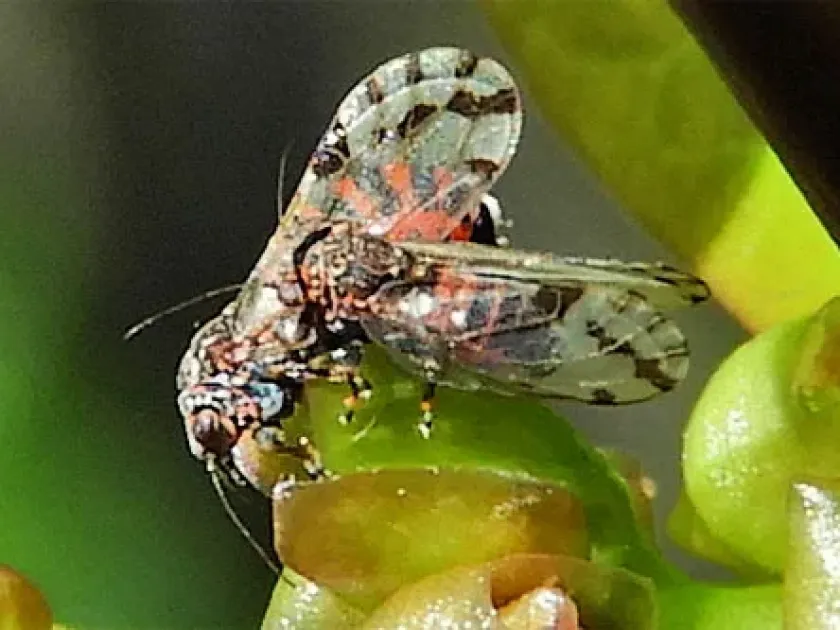
Description
How to identify
Psyllids, often called jumping plant lice (genus Cacopsylla), belong to the family Psyllidae, order Hemiptera. They are tiny insects characterized by their ability to jump.
Adults possess two pairs of wings held roof-like over the abdomen and robust hind legs adapted for leaping when they feel threatened by predators.
Nymphs undergo five stages of development; they are wingless, often flattened, and covered with waxy secretions that protect them from desiccation.
The coloration of these insects varies between species and seasons, providing effective camouflage against the bark or foliage of host plants.
Accurate identification usually requires microscopic examination of the head structure, wing venation, and genitalia of the specimens.
What it damages
Psyllids primarily target fruit trees, with the pear psylla and apple sucker being two of the most significant pests in commercial orchards.
Both adults and nymphs feed by inserting their piercing-sucking mouthparts into the succulent tissues of buds, leaves, and young shoots.
This persistent feeding habit depletes the plant's resources, leading to stunted growth, leaf yellowing, and potential limb dieback in severe cases.
Psyllids are also notorious vectors for phytoplasma diseases, which can cause severe systemic infections, tree decline, and eventual mortality.
The copious amounts of honeydew they excrete encourage the growth of sooty mold, which negatively impacts photosynthesis and fruit marketability.
When it appears
Adult psyllids overwinter in protected areas, such as bark crevices, leaf litter, or under orchard debris, becoming active at the first signs of spring.
Egg-laying typically coincides with the swelling of fruit buds, as nymphs require tender, succulent tissues for their initial development.
Developmental rates are heavily dependent on temperature; warm, humid springs can significantly accelerate the generation time of the population.
Depending on the climatic zone, Cacopsylla species can complete multiple generations per year, leading to overlapping life stages in late summer.
As autumn temperatures drop, the insects enter diapause, migrating to their overwintering sites to survive the cold winter months.
Signs of infestation
Early symptoms include bud abortion and the failure of blossoms to open, often resulting in complete yield loss on heavily infested branches.
The presence of sticky, shiny honeydew droplets on the undersides of leaves or on twigs is a diagnostic sign of active nymphal feeding.
Affected leaves tend to curl, crinkle, and turn yellow, while severely damaged shoots show significant bending and reduced internode length.
- Dark, sticky sooty mold patches on leaves and fruit skins.
- Massive jumping activity when infested branches are disturbed.
- Premature leaf drop and generalized tree weakness.
- Increased presence of ants tending to the psyllid colonies.
Deformed fruit with necrotic spots can also indicate long-term psyllid infestation during the fruit development stage.
Control measures
Dormant season oil applications are highly effective at suppressing overwintering populations by suffocating eggs and adults before they emerge.
During the growing season, strategic use of systemic insecticides or insect growth regulators helps manage population explosions if thresholds are reached.
Orchard sanitation, including the removal of old, loose bark and autumn leaf litter, reduces the available overwintering niches for the pests.
Biological control agents, such as lacewings, lady beetles, and predatory hemipterans, should be encouraged to maintain natural population balance.
Monitoring using yellow sticky traps allows orchardists to time interventions precisely, ensuring maximum efficacy while minimizing chemical impact.
Taxonomy
- Latin name
- Cacopsylla
- Order
- Hemiptera (bugs, aphids, leafhoppers)
- Family
- Psyllidae
- EPPO code
- CCPSSP
Discussion
No discussions yet — be the first.