
Red-tailed hawk
Buteo jamaicensis
Description
How to identify
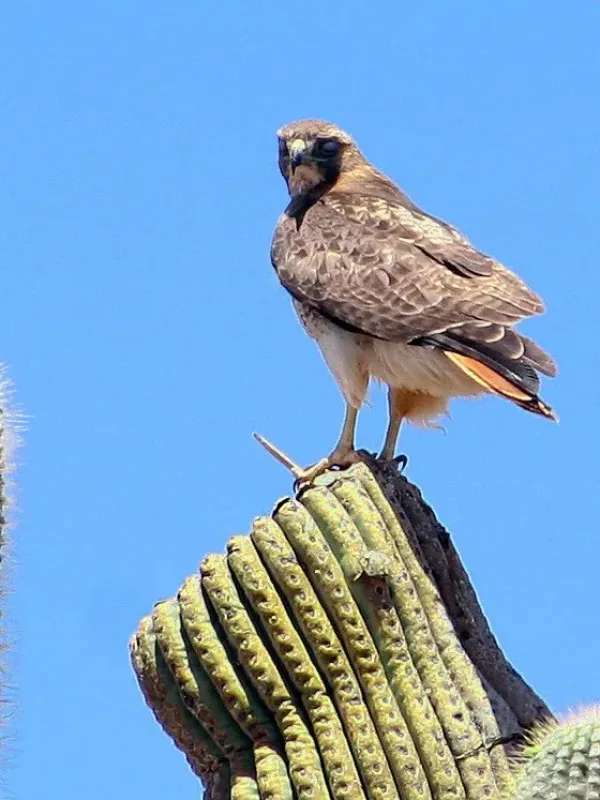
The Red-tailed hawk (Buteo jamaicensis) belongs to the order Accipitriformes and the family Accipitridae. It is a large, broad-winged raptor commonly recognized by its short, fan-shaped tail that displays a distinct brick-red color in adults.
The plumage of this species is highly variable, ranging from white to dark brown. A common diagnostic feature in flight is the presence of a dark band on the undersides of the wings, often referred to as a "patagial mark."
These hawks are frequently observed perched on high vantage points such as utility poles, fence posts, or tall trees overlooking agricultural fields. With a wingspan often exceeding 1.2 to 1.5 meters, they are master soarers.
Females are generally larger and heavier than males. Their vocalization, a harsh, raspy scream, is a common sound in their habitat and is frequently used in media to represent the sound of various raptors.
Their life cycle involves territorial behavior during the breeding season. They construct large stick nests in tall trees or on man-made structures, where they raise their young, necessitating a constant supply of food from the surrounding area.
What it damages
The Red-tailed hawk is not a direct pest of agricultural crops, as it is a strict carnivore. It does not consume seeds, fruits, or green vegetation, and therefore causes no direct harvest damage to crops.
However, it can be perceived as a nuisance on farms that maintain open-range poultry. Raptors may target young chicks or small livestock, which presents a management challenge for farmers trying to protect their animals.
In field settings, the presence of these hawks is generally beneficial. They are highly efficient predators of field mice, voles, gophers, and other rodents that cause significant damage to grain crops and irrigation systems.
Incidental damage can occur to agricultural infrastructure, such as power lines or irrigation equipment, where birds perch or attempt to nest. These instances are usually infrequent and localized to specific structures.
Overall, they serve as biological control agents. By regulating rodent populations, they prevent the over-multiplication of pests that would otherwise consume a significant portion of agricultural production.
Control measures
To protect poultry from raptor predation, the most effective solution is the installation of overhead netting. This creates a physical barrier that prevents hawks from reaching domestic birds while keeping the raptors safe.
Acoustic deterrents can be utilized to discourage hawks from frequenting specific high-value areas. Devices that play predator calls or irregular alarms can be effective, provided that the settings are varied to prevent habituation.
Visual deterrents, including holographic tape, reflective streamers, or predator effigies, can assist in managing bird movement. These tools are most effective when deployed temporarily before and during critical crop development stages.
Practicing proper field hygiene, such as managing tall grasses and brush near farm buildings, reduces the habitat available for rodents, which in turn reduces the attractiveness of the area to hawks.
It is important to emphasize that Red-tailed hawks are protected by law in many regions. Non-lethal control and conservation-oriented management are the only legally and ethically sound approaches for any modern agricultural operation.
Taxonomy
- Latin name
- Buteo jamaicensis
- Family
- Accipitridae
- EPPO code
- BUTEJA
Discussion
No discussions yet — be the first.