
Common buzzard
Buteo
Description
How to identify
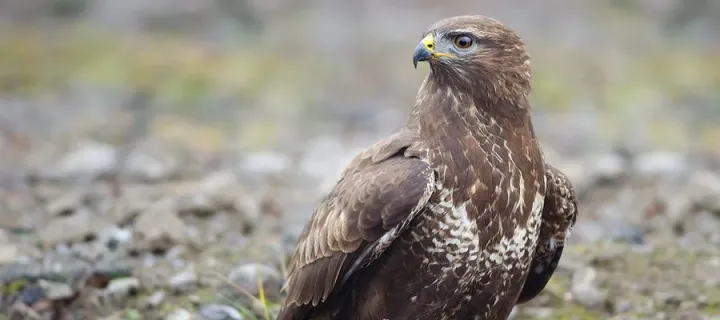
The Common buzzard (Buteo buteo) is a bird of prey belonging to the family Accipitridae. It is a medium-sized raptor widely distributed across Europe and Asia.
These birds possess broad, rounded wings and a short tail, which are distinct features for identification during soaring flight. Their plumage is highly variable in color.
Adult buzzards typically reach a wingspan of approximately 110 to 130 centimeters. They are often seen perched on high vantage points scanning for movement.
Their flight pattern is slow and steady, often consisting of circular soaring, which allows them to cover large areas of agricultural land effectively.
The beak and talons of the Common buzzard are specialized for hunting small vertebrates, reflecting their ecological role as apex predators in farmland habitats.
What it damages
The Common buzzard is not an agricultural pest. It does not consume crops, grains, fruits, or any other part of cultivated plants.
Its role in agroecosystems is highly beneficial. By predating on small mammals, the buzzard provides a significant service in suppressing rodent populations.
Rodents such as voles and mice are major pests that cause extensive damage to grain crops and pastures. The buzzard acts as a natural biological control agent.
Unlike insect pests, which multiply exponentially, predatory birds provide a sustainable pressure that helps stabilize rodent numbers in rural landscapes.
There is absolutely no evidence that the Common buzzard harms agricultural productivity. On the contrary, its presence supports the health of the agroecosystem.
When it appears
Buzzards are most active in agricultural areas during the spring and summer breeding seasons when demand for food is high for both adults and their chicks.
Post-harvest periods in late summer and autumn provide optimal conditions for hunting, as the lack of dense vegetation exposes rodents on the fields.
These birds may remain in agricultural areas throughout the year, depending on the severity of the winter and the availability of their primary prey.
Seasonal migration patterns are dictated by climatic conditions, but in many temperate zones, they are constant residents near farmlands.
The presence of buzzards on farmland is a year-round phenomenon that ensures consistent ecological monitoring of small mammal populations.
Control measures
There are no control measures for the Common buzzard because it is a beneficial species protected by law in many jurisdictions across the globe.
Agro-management strategies should focus on conservation rather than control, specifically protecting nesting sites located in wooded areas surrounding croplands.
It is crucial to avoid the use of toxic rodenticides, as these chemicals can accumulate in the buzzard's system through secondary poisoning when they consume pests.
Farmers are encouraged to install artificial perches to attract buzzards, which serves as an effective and eco-friendly method for integrated pest management.
The ultimate goal for agronomists is to foster a balanced ecosystem where natural predators like the Common buzzard thrive alongside sustainable agriculture.
Taxonomy
- Latin name
- Buteo
- Family
- Accipitridae
- EPPO code
- BUTESP
Discussion
No discussions yet — be the first.