
Rough stink bug
Brochymena quadripustulata
Description
How to identify
The rough stink bug (Brochymena quadripustulata) belongs to the Pentatomidae family of the order Hemiptera.
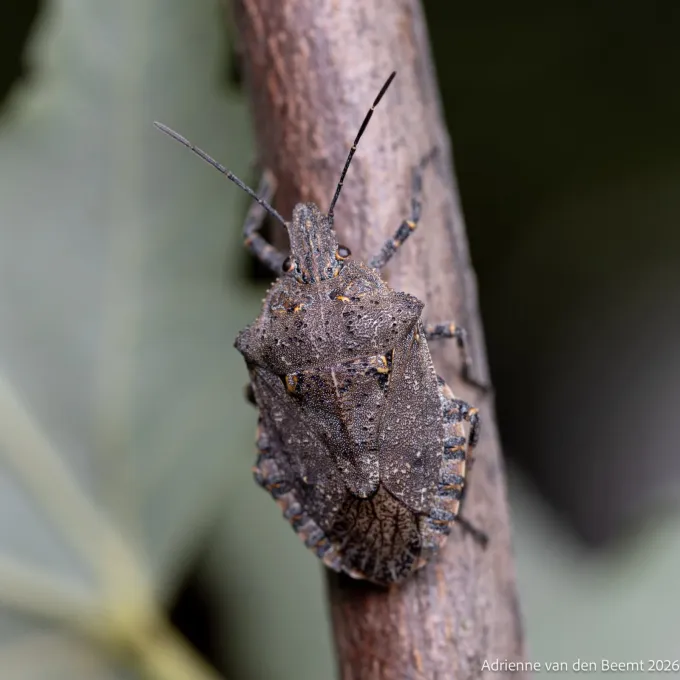
Adults possess a distinctive camouflaging color pattern, featuring shades of gray, brown, and tan, which allows them to blend perfectly into tree bark.
The body length of an adult typically ranges from 12 to 15 mm. The head has an elongated shape, and the pronotum is equipped with jagged edges.
Unlike many other shield bugs, this species has a unique, rugged appearance that is often described as camouflaged due to the texture of its chitinous exoskeleton.
Nymphs go through several developmental stages, gradually changing their color from bright orange-black patterns to the duller shades seen in adults.
What it damages
This pest is a polyphage, causing significant damage to a wide range of fruit and forest trees by feeding on sap from young shoots, leaves, and fruits.
Major economic damage is often observed on apple, pear, and peach trees, as well as on various oak species growing in proximity to orchards.
During feeding, the bug injects digestive enzymes into plant tissues, causing localized necrosis, malformation, and tissue degradation.
Young fruits are severely affected; after being pierced by the bug's proboscis, they often cease growing, become deformed, and drop prematurely.
In cases of high infestation, the bug can significantly weaken trees, making them more susceptible to secondary fungal and bacterial infections.
When it appears
The life cycle begins with adults overwintering in protected sites, such as leaf litter, under tree bark, or in dry vegetation debris.
In early spring, when temperatures remain consistently warm, the bugs emerge from hibernation and begin feeding on newly developing buds.
Females lay eggs in small clusters on the undersides of leaves, and nymphs emerge within one to two weeks, starting their feeding cycles.
Active feeding and reproduction continue throughout the summer months, with one or occasionally two generations developing per season depending on the climate.
By autumn, as light levels and temperatures drop, adults seek shelter for hibernation, entering a state of diapause until the next spring season.
Signs of infestation
The first signs of infestation include small, pale necrotic spots on young leaves that eventually coalesce into larger damaged areas.
Fruit damage typically manifests as depressed pits or "pockmarks," where the underlying flesh becomes corky, hardened, and bitter.
Careful inspection of branches often reveals the bugs themselves, which rely on their cryptic coloration to remain immobile when disturbed.
The presence of dark excrement spots on leaves and branches is another strong indicator of a high pest population within the tree canopy.
Heavy infestations frequently lead to widespread fruit drop, resulting in substantial yield losses for commercial orchard growers.
Control measures
Cultural control methods involve cleaning the orchard of plant debris, fallen leaves, and loose tree bark, which serve as overwintering sites.
Hand-picking insects during early morning hours is an effective method of control, as bugs are less active and easier to capture at lower temperatures.
Biological control involves promoting the presence of natural enemies in the garden, such as predatory bugs and specialized parasitic wasps.
Chemical applications of insecticides are recommended only when populations exceed economic thresholds, preferably using broad-spectrum contact products.
It is essential to time spray applications to coincide with the emergence of nymphs, as they are most vulnerable to treatments during their early developmental stages.
Taxonomy
- Latin name
- Brochymena quadripustulata
- Order
- Hemiptera (bugs, aphids, leafhoppers)
- Family
- Pentatomidae
- EPPO code
- BROCQU
Discussion
No discussions yet — be the first.