
Brachystola magna
Brachystola magna
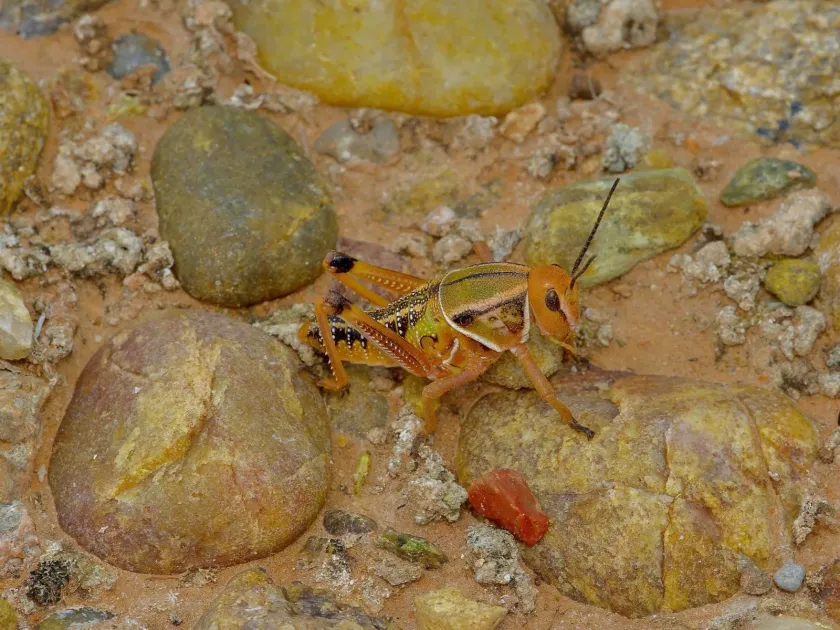
Description
How to identify
Brachystola magna, commonly known as the plains lubber grasshopper, is a large, flightless species within the family Romaleidae. Adults typically grow to lengths of 5–7 cm, featuring a robust body shape and small, non-functional wing pads.
The coloration of this species is typically a blend of gray, green, or brown, providing excellent camouflage against soil and dry forage vegetation, which makes them difficult to spot in the field.
They possess very strong hind legs, designed for powerful jumps, and a large head with strong mandibles that allow them to consume large quantities of tough plant material.
Since they cannot fly, the movement of this species is limited to walking and jumping, which results in localized but often severe damage patterns in agricultural landscapes.
The plains lubber is well-adapted to semi-arid environments, favoring open prairies, rangelands, and the edges of cultivated fields where they can find both food and shelter.
What it damages
This grasshopper is a voracious polyphagous insect that feeds on a wide variety of plant species, causing significant economic loss in farming regions.
Major crops affected include sunflowers, various grains, alfalfa, and beans. When populations are high, they can completely strip a young crop field in a relatively short period.
They are particularly destructive to early-stage crops, where the loss of leaf area significantly impacts the plant's ability to photosynthesize and recover.
Besides agricultural crops, they compete heavily with livestock for available grazing grass on pastures, reducing the overall feed capacity of the land.
Their feeding habits often leave plants skeletal, causing not only yield loss but also making the weakened plants more susceptible to environmental stress and pathogens.
When it appears
The life cycle begins with eggs that remain dormant in the soil throughout the winter months, typically hatching in late spring as temperatures rise.
Nymphs go through several developmental stages (instars) during the summer, during which they grow rapidly and become increasingly hungry and mobile.
Adults emerge mid-summer and remain active until the first hard autumn frosts, with the peak of their destructive feeding activity occurring in late July and August.
Reproduction takes place in late summer, where females deposit eggs in the soil, ensuring the survival of the next generation through the following winter.
Due to their annual life cycle, monitoring needs to be intensive during the spring and summer months to catch early-stage nymphal development before they disperse widely.
Signs of infestation
The most common sign of a Brachystola magna infestation is the appearance of ragged, irregular edges on leaves along the margins of fields.
As the infestation progresses, leaves may become entirely defoliated, leaving only the midribs and stems, which is a clear indicator of heavy grasshopper feeding.
Physical inspection of the field margins during the cool morning or late evening hours often reveals the presence of large adults or nymphs resting on stems.
The presence of large amounts of frass (fecal pellets) at the base of the plants or on the soil surface is a strong indicator of an active pest population.
Field managers should look for patches of dying or severely eaten plants that start at the field edges and slowly spread inwards as the insects move.
Control measures
Effective management starts with cultural control, such as plowing field borders and fallow lands to disrupt the soil where eggs are laid.
Weed management is critical, as tall weeds along ditches and fences provide the perfect harbor and initial food source for nymphs during their early development.
If population densities exceed economic thresholds, insecticide application targeting field perimeters is generally the most effective way to protect the main crop.
Biological controls, including the use of entomopathogenic fungi, are sometimes viable in areas with high humidity, though results can be inconsistent.
- Regular field scouting and population monitoring.
- Mowing field perimeters to reduce cover and food for nymphs.
- Application of perimeter insecticide barriers to prevent migration into the crop.
Taxonomy
- Latin name
- Brachystola magna
- Order
- Orthoptera (locusts)
- Family
- Acrididae
- EPPO code
- BRASMA
Discussion
No discussions yet — be the first.