
Slender millipede
Boreoiulus tenuis
Description
How to identify
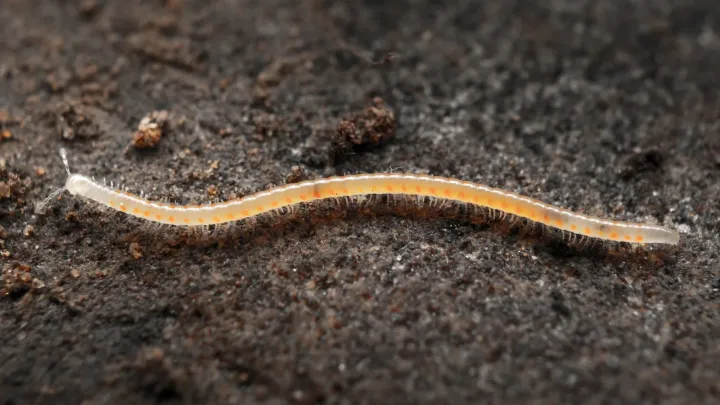
The slender millipede (Boreoiulus tenuis) belongs to the order Diplopoda and the family Blaniulidae. It is a small soil-dwelling invertebrate, typically ranging from 7 to 12 millimeters in length.
Visually, the organism resembles a thin, thread-like structure, often leading to confusion with wireworms (larvae of click beetles). Its body is cylindrical, semi-transparent, or yellowish-white, which allows it to move easily through soil layers.
A key identifying feature is the presence of numerous pairs of legs, with two pairs per body segment, except for the first few segments. The lack of a heavily chitinized exoskeleton makes this pest highly susceptible to dehydration.
Millipedes lead a secretive, nocturnal lifestyle, dwelling in the top layers of soil rich in organic matter. They avoid direct sunlight and dry conditions, preferring moist environments to maintain their body water balance.
Reproduction occurs underground, where females lay eggs in small earthen cells. The development cycle consists of several larval stages, with the number of body segments and pairs of legs increasing progressively after each molt.
What it damages
This pest is a polyphage and targets a wide range of agricultural crops. Vegetables such as sugar beets, potatoes, carrots, and onions, as well as young grain seedlings, are particularly vulnerable to attack.
Millipedes feed on the subterranean parts of plants: seeds, emerging sprouts, roots, and tubers. This activity leads to significant thinning of crops and the total destruction of young seedlings.
The danger is most critical during the germination stage. Millipedes bore into the seed coat to consume the embryo, effectively preventing the development of a viable plant and causing large gaps in the field.
In mature roots and tubers, millipedes leave deep, winding channels. These wounds serve as entry points for secondary infections like fungal and bacterial rots, which cause rapid decay and total loss of produce.
Greenhouse environments are particularly susceptible to infestations. The combination of consistently high humidity and abundant organic debris creates ideal conditions for massive millipede population growth.
When it appears
Peak activity of the slender millipede is observed during the spring season when soil temperatures rise and moisture levels are ideal for their movement through the upper soil horizon.
A second, smaller population peak often occurs in the autumn. Increased soil moisture during this time encourages the millipedes to feed intensively before entering their overwintering stage.
During the summer months, especially in arid or hot conditions, activity levels drop significantly. The pests migrate into deeper, damper soil layers to wait out the unfavorable climate.
The life cycle is closely tied to thermal conditions. They thrive in temperatures between +15 and +20 degrees Celsius, provided the soil substrate maintains high humidity.
The slender millipede overwinters as adults or late-stage larvae deep in the soil, within crop residues, or in compost heaps, ensuring their survival even through freezing winters.
Signs of infestation
The first sign of an infestation is typically the emergence of patchy or thin crop stands. Digging up non-germinated seeds will reveal small, characteristic puncture marks or hollowed-out tissue.
Roots and tubers will show distinct deep ulcers or tunnels. The edges of these wounds often appear dark or discolored due to the secondary development of pathogenic microorganisms introduced by the pests.
Presence can be confirmed using "bait traps." Burying pieces of raw potato or carrot in the topsoil for a few days will attract the millipedes, allowing for an accurate count of the pest population.
A specific, pungent odor can sometimes be detected when millipedes are disturbed, serving as a biological alarm. Additionally, manual excavation during evening hours often reveals the pests.
Stunted plant growth and yellowing of the foliage, occurring without visible signs of pests on the leaves, are classic symptoms indicating the presence of harmful root-feeding millipedes.
Control measures
The primary control strategy is cultural management. It is crucial to practice crop rotation and remove all plant residues from the field, as these provide a habitat and food source for the millipedes.
Deep autumn plowing is effective as it exposes the pests to surface conditions, where they often succumb to low temperatures or desiccation during the winter months.
Liming acidic soils makes the environment less favorable for slender millipedes. Adjusting the pH level is a simple, proactive way to deter these pests from populating specific fields.
In cases of severe infestation, especially in greenhouses, seed treatment with systemic insecticides or soil drenching with authorized chemical agents can be employed for immediate protection.
Biological control options include the use of entomopathogenic nematodes. These microscopic organisms effectively target soil-dwelling pests without posing a risk to the surrounding environment or beneficial soil fauna.
Taxonomy
- Latin name
- Boreoiulus tenuis
- Family
- Blaniulidae
- EPPO code
- BLANTE
Discussion
No discussions yet — be the first.