
Spotted snake millipede
Blaniulus
Description
How to identify
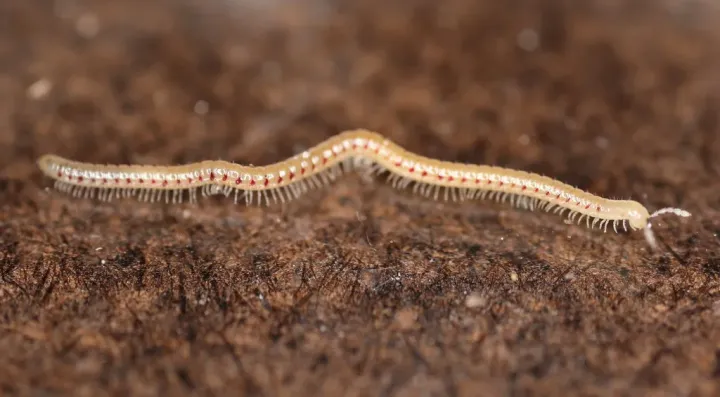
The spotted snake millipede (Blaniulus guttulatus) belongs to the order Julida and the family Blaniulidae. These creatures are characterized by an elongated, cylindrical body that can reach lengths of up to 20 mm.
Their bodies are pale yellow or whitish in color. A defining characteristic that allows for easy identification is the presence of distinctive bright red or brownish spots on the sides of each body segment.
Equipped with numerous pairs of legs, these millipedes are highly agile and capable of navigating through soil crevices and tunnels, reaching deep into the root zones of plants.
They are fundamentally moisture-dependent organisms. They thrive in environments rich in organic matter and high humidity, which are essential for their survival and reproductive success.
The lifecycle involves eggs deposited in the soil. Upon hatching, the larvae undergo multiple molting stages before reaching sexual maturity, constantly feeding on available plant material throughout this process.
What it damages
The spotted snake millipede is a notorious polyphagous pest that targets the underground parts of a wide range of crops, including sugar beets, carrots, potatoes, radishes, and various seedlings.
Significant damage occurs during the germination phase. The millipedes feed on seeds and sprouting embryos, leading to poor emergence rates and the need for costly reseeding of agricultural fields.
When feeding on mature roots and tubers, they create deep, numerous pits and cavities. These wounds often become focal points for fungal and bacterial infections, leading to rapid rot and decay.
The primary concern is the total loss of commercial value for root vegetables, as infested produce becomes unmarketable and susceptible to further storage rot once harvested.
In high-density infestations, these pests can cause up to 50% damage in vulnerable crops, particularly in damp soil conditions or fields where organic fertilizer has been heavily applied.
When it appears
Activity typically begins in early spring, once soil temperatures rise above 5–8 degrees Celsius. This period is critical as the millipedes emerge from their overwintering sites.
During hot and dry summer months, they migrate deeper into the soil profile to reach cooler and moister strata, effectively entering a state of reduced surface activity.
Activity levels rise again in the autumn as cooler temperatures and rainfall increase moisture at the soil surface, providing the millipedes with ideal conditions for feeding.
They overwinter as both adults and late-stage larvae, burying themselves deep in the soil or hiding within clusters of debris and plant material until spring arrives.
Mild and damp winter conditions are highly conducive to their survival, often resulting in larger population numbers and increased pressure on crops during the subsequent growing season.
Signs of infestation
The first indicator of an infestation is uneven plant emergence, where seeds fail to sprout because they have been partially or entirely consumed in the ground.
Upon examination, affected root vegetables exhibit small, deep, and often dark-edged holes. These holes are clear entry points for decay organisms, causing the root to darken and soften.
Plants may show symptoms of distress, including stunted growth, leaf yellowing, and sudden wilting, despite regular irrigation, indicating that the root system is under attack.
Soil-dwelling adults or larvae are often found clustered around damaged tubers or seeds, which can be confirmed by digging slightly into the root zone of wilted plants.
Using vegetable traps is an effective method to monitor their presence: bury slices of carrot or potato 5–10 cm deep in the soil and inspect them periodically for feeding activity.
Control measures
Good agricultural practices are essential for control. Deep autumn plowing disrupts overwintering sites and exposes the millipedes to predators and harsh weather conditions.
Crop rotation and the avoidance of fresh manure application just before sowing are critical strategies, as fresh organic matter attracts and supports millipede populations.
Liming the soil to adjust pH levels can be effective, as these pests generally prefer slightly acidic and moist conditions and do not thrive in more alkaline environments.
Seed treatment with systemic insecticides is a standard preventive measure that protects young seedlings during their most vulnerable stage of development.
In cases of severe infestation, the application of granular soil insecticides during planting can provide a necessary layer of protection to minimize yield loss.
Taxonomy
- Latin name
- Blaniulus
- Family
- Blaniulidae
- EPPO code
- BLANSP
Discussion
No discussions yet — be the first.