
Melaleuca psyllid
Boreioglycaspis melaleucae
Description
How to identify
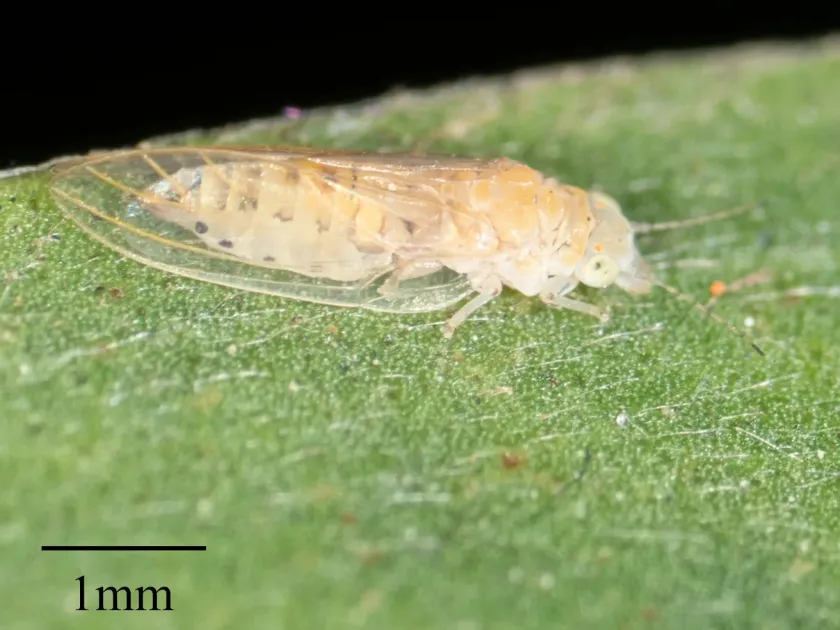
The Melaleuca psyllid (Boreioglycaspis melaleucae) is a small insect belonging to the order Hemiptera and the family Psyllidae. These insects are known for their ability to jump, a characteristic feature of psyllids that helps them move rapidly across host plants.
Adult psyllids feature wings that fold tent-like over their bodies when at rest. Their coloration is typically light yellow to greenish, providing effective camouflage against the foliage of their host trees.
The nymphs are distinct due to the production of white, waxy filaments that cover their bodies. These fluffy, cotton-like masses are highly visible and serve as a primary indicator for field identification of the pest.
The life cycle involves an egg stage, five nymphal instars, and an adult stage. Both nymphs and adults rely on plant sap as their primary food source, which they extract using their piercing-sucking mouthparts.
While originally studied as a biological control agent for invasive Melaleuca in certain regions, it is now widely recognized as a permanent inhabitant that can occasionally affect the health of ornamental Melaleuca varieties.
What it damages
The primary host for this insect is Melaleuca quinquenervia and closely related species in the Myrtaceae family. The insect's survival and reproductive success are tightly linked to the presence of these trees.
Damage is caused by the extraction of phloem sap from leaves and tender shoots. This constant drain of nutrients deprives the tree of essential sugars and minerals required for growth and development.
The physical damage to the plant tissue often results in distorted, stunted, or discolored leaves. Severe infestations can lead to significant foliage loss and the weakening of the entire tree structure.
In addition to direct feeding damage, the insects excrete honeydew, a sugary substance that coats the leaves. This creates an ideal environment for sooty mold to grow, further blocking sunlight and inhibiting photosynthesis.
Trees subjected to prolonged feeding by large psyllid populations often show reduced vigor, slow growth rates, and an increased susceptibility to secondary stress factors or diseases.
When it appears
The Melaleuca psyllid population dynamics are heavily influenced by environmental conditions, particularly temperature and humidity. Warm, humid climates are optimal for year-round reproduction.
In regions with consistent warmth, such as southern Florida, the insect can complete multiple generations in a single year, often with overlapping stages of development.
Population peaks typically coincide with the spring and summer flushes of new plant growth, which provide the most nutritious and accessible tissues for feeding nymphs.
The duration of the life cycle is inversely proportional to temperature; faster development occurs during hotter periods, leading to rapid population explosions if natural controls are absent.
Winter survival depends on local climate; while cold can suppress populations, the presence of sheltered microclimates often allows for the persistence of the insect until warmer temperatures return.
Signs of infestation
The most reliable sign of an infestation is the presence of white waxy, cotton-like fibers on the underside of leaves or within the leaf axils, which house the developing nymphs.
The accumulation of sticky honeydew on the foliage surface is a clear indicator of pest activity. Over time, this substance attracts soot-colored fungal growth, turning leaves black.
Visible changes to leaf structure, such as curling, yellowing, or abnormal thickening, signify long-term feeding stress caused by the psyllid colonies.
Observing adult psyllids jumping or flying when tree branches are lightly shaken is an effective way to confirm the presence of the insect in a landscape setting.
General canopy thinning, branch tip dieback, and early leaf drop are characteristic symptoms of severe or chronic infestations that require management intervention.
Control measures
Biological control is the most sustainable approach, as the Melaleuca psyllid has specific natural enemies, including several species of parasitoid wasps that keep populations in check.
In ornamental settings where immediate control is needed, systemic insecticides are the most effective. These chemicals travel through the vascular system of the tree, targeting the insects as they feed.
Contact insecticides may be used but are less effective against nymphs, as the protective waxy layer shields them from direct spray, necessitating precise timing during the adult stage.
Good horticultural practices, including proper irrigation, mulching, and balanced fertilization, are essential for maintaining tree vigor and helping the plant resist psyllid damage.
Sanitation measures, such as pruning and disposing of heavily infested branches, can help reduce the local population density and mitigate the spread of the insect to nearby healthy trees.
Taxonomy
- Latin name
- Boreioglycaspis melaleucae
- Order
- Hemiptera (bugs, aphids, leafhoppers)
- Family
- Aphalaridae
- EPPO code
- BORGME
Discussion
No discussions yet — be the first.