
Eucalyptus psyllid
Boreioglycaspis
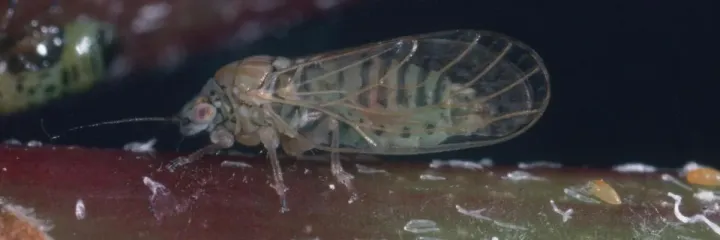
Description
How to identify
The Eucalyptus psyllid (scientific name Boreioglycaspis) is a member of the Aphalaridae family within the order Hemiptera. These small insects are typically 3–4 mm in size.
Adults possess transparent wings with intricate venation and highly developed hind legs, allowing them to jump effectively when disturbed by external factors.
The nymphs go through five distinct developmental stages. A defining feature is their ability to produce protective white, waxy, cotton-like filaments on their bodies.
These white waxy masses are the most prominent visual indicator that a tree is infested, acting as a shield against predators and environmental stress.
Females lay eggs on young leaves in chains or clusters, ensuring that the emerging nymphs have immediate access to the sap required for their development.
What it damages
This pest is highly host-specific, primarily attacking various species of the Eucalyptus genus, causing significant physiological distress to the plants.
The psyllids feed by inserting their mouthparts into the leaf tissue to extract sap, which deprives the plant of vital nutrients and disrupts photosynthesis.
Heavy infestations lead to leaf chlorosis, curling, and eventually premature leaf drop, which stunts the growth of younger or more vulnerable trees.
The insects excrete honeydew, a sugary substance that promotes the growth of sooty mold, coating leaves in a black, unsightly layer that reduces aesthetic value.
Continuous damage leads to loss of tree vigor, reduced annual growth rates, and can make the host plant more susceptible to secondary diseases or pests.
When it appears
The activity of the Eucalyptus psyllid is highly dependent on temperature, with warm, dry spring and summer conditions facilitating rapid population growth.
In regions with mild winters, the life cycle of the insect can continue throughout the year without significant dormancy, allowing for year-round development.
Peak population numbers usually coincide with the flushing of new leaves, as these tissues are the most palatable and nutrient-rich for the developing nymphs.
Multiple generations can be produced within a single season, enabling the population to explode quickly if natural control factors are not present.
Adult psyllids are active flyers and take advantage of warm, calm weather to disperse and colonize neighboring eucalyptus trees in the vicinity.
Signs of infestation
The most recognizable symptom is the presence of white, woolly, wax-based filaments covering the underside of the leaves where the nymphs are feeding.
Leaves often show signs of curling and discoloration, turning from healthy green to yellow or brown as the damage from feeding progresses.
- Sticky honeydew residues covering foliage and stems.
- Development of dark sooty mold on the leaf surface.
- Distortion and stunted development of new terminal shoots.
- Premature yellowing and leaf shedding.
- Presence of jumping insects when tree branches are shaken.
Careful inspection of the foliage will reveal clusters of nymphs tucked under their protective wax coverings, often hidden from casual observation.
Control measures
Biological control is considered the most sustainable long-term solution, particularly the introduction of natural parasitoids like wasps from the Encyrtidae family.
In high-value ornamental or nursery settings, systemic insecticides applied as soil drenches or trunk injections are effective in managing the population.
Sanitation is key; pruning and removing heavily infested branches can help reduce the local population density and curb the spread of the pest.
Improving overall tree health through adequate irrigation and balanced fertilization strengthens the tree's natural defenses against heavy insect colonization.
Monitoring programs using yellow sticky traps are essential for early detection, allowing growers to initiate management strategies before infestations reach critical levels.
Taxonomy
- Latin name
- Boreioglycaspis
- Order
- Hemiptera (bugs, aphids, leafhoppers)
- Family
- Aphalaridae
- EPPO code
- BORGSP
Discussion
No discussions yet — be the first.