

Greenhouse whitefly
Trialeurodes vaporariorum
Description
How to identify
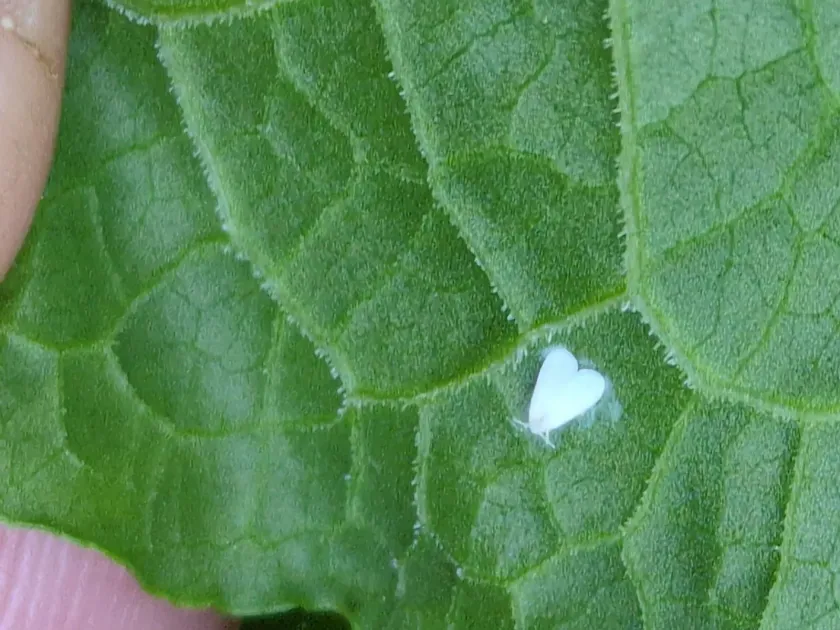
The greenhouse whitefly (Trialeurodes vaporariorum) is a small sap-sucking insect belonging to the family Aleyrodidae. Adult insects are about 1.5 mm long, with four wings covered in a white, powdery wax.
The lifecycle includes several stages: egg, nymph (four instars), and adult. First-instar nymphs are known as "crawlers" and are the only mobile juvenile stage before they settle down to feed.
These insects thrive in greenhouse environments where consistent temperatures allow for continuous reproduction throughout the year, making them a persistent threat to commercial agriculture.
Their high reproductive rate, where a single female can lay hundreds of eggs, facilitates rapid population spikes, especially in protected environments like glasshouses and polytunnels.
Being so small and preferring the underside of leaves, they often go unnoticed until a significant population has already established itself, requiring early detection methods.
What it damages
This pest is a major polyphage, attacking a vast range of plants. Key host crops include common cucumber, tomato, fodder beet, alfalfa, common hop, apple, plum, and peach.
Damage occurs when both adults and nymphs pierce leaf tissues to extract sap. This continuous feeding weakens the plant, stunts growth, and drastically reduces overall crop yield.
Whiteflies excrete honeydew, a sticky sugary substance. This secretion promotes the growth of sooty mold, which creates a black, unsightly film that interferes with the plant’s ability to photosynthesize.
Severe infestations cause yellowing of leaves (chlorosis), leaf distortion, and premature leaf drop, rendering the plant unable to support fruit development effectively.
Furthermore, the whitefly is a vector for several plant viruses, which can cause mosaic diseases and further diminish the quality and quantity of the harvest.
When it appears
In temperature-controlled greenhouses, the whitefly remains active year-round. Population growth is most rapid during warm months when temperatures consistently range between 20°C and 25°C.
In outdoor environments, they become a seasonal nuisance during the summer months, often migrating from greenhouse infestations or arriving on infected nursery stock.
Humidity also plays a critical role in their development; higher humidity levels in greenhouses often correlate with faster generation times and increased population pressure.
As outdoor temperatures drop in the autumn, populations typically decline; however, they easily survive in structures, ensuring their presence for the following growing season.
Preventative measures must be active from the very beginning of the season to ensure that immigrant populations do not gain a foothold in the growing area.
Signs of infestation
The most recognizable sign is the presence of small white insects flying in short bursts when an infected plant is disturbed or shaken, revealing their presence under the leaves.
Leaves will become coated with sticky honeydew, which may eventually turn black due to the accumulation of sooty mold growth covering the foliage surface.
Plants show clear signs of distress: foliage turns yellow, curls up, and loses its vitality, leading to an overall stunted appearance of the crop.
Under close inspection, the underside of the leaves will reveal flat, pale, oval-shaped nymphs attached to the plant surface, looking like tiny translucent scales.
The presence of ants is often a secondary indicator, as they are attracted to the sweet honeydew excreted by the whitefly colonies and often protect them from predators.
Control measures
Integrated pest management (IPM) is essential. Cultural controls include maintaining weed-free environments, crop rotation, and strict sanitation of greenhouse facilities after each harvest.
Yellow sticky traps are highly recommended for both monitoring population numbers and physically reducing the number of adult whiteflies in the environment.
Biological control methods are very effective in protected crops, specifically using natural enemies like the parasitic wasp Encarsia formosa to parasitize the whitefly nymphs.
Chemical control should be used as a last resort, utilizing systemic insecticides. It is critical to rotate between different active ingredients to prevent the development of resistant strains.
- Use sticky yellow traps for early detection.
- Introduce parasitic wasps or predators for biological control.
- Apply systemic insecticides, rotating chemical classes to prevent resistance.
In brief
11
Damages crops
Content graph
Damages crops · 11
Content graph
Connections · Greenhouse whitefly
Most often together:
Marketplace
Products · 10


Death To Beetles
«Нанджин Ессенс Файн-Кемікал Ко. Лтд» (Китай)
Insecticides
0
0
·
1.6K
9 offers
7.23 €per 1 l
Buy


Proti Kolorada
«Нанджин Ессенс Файн-Кемікал Ко. Лтд» (Китай)
Insecticides
0
0
·
1K
2 offers
2.74 €per 1 l
Buy
Harpoon
«Нанджин Ессенс Файн-Кемікал Ко. Лтд» (Китай)
Insecticides
0
0
·
860
1 offer
66.85 €per 1 l
Buy

Biology
Taxonomy
- Latin name
- Trialeurodes vaporariorum
- Order
- Hemiptera (bugs, aphids, leafhoppers)
- Family
- Aleyrodidae
- EPPO code
- TRIAVA
Community
Discussion
No discussions yet — be the first.