
Aleurocanthus
Aleurocanthus
Description
How to identify
Aleurocanthus is a genus of insects belonging to the Aleyrodidae family (whiteflies) within the order Hemiptera. These are significant agricultural pests, morphologically distinct from common greenhouse whiteflies due to the darker, often blackish, appearance of their larval stages.
Adults typically feature dark, almost black wings, frequently marked with distinctive light-colored patterns. Their bodies are covered in a protective waxy secretion, which acts as a shield against environmental stressors and chemical treatments.
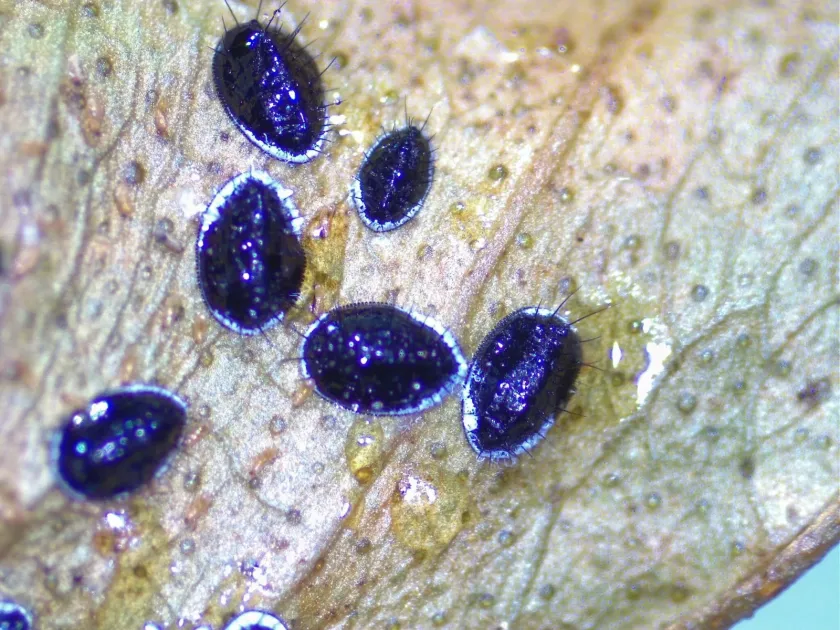
The first-instar larvae, or crawlers, are mobile, but subsequent larval stages remain sedentary. They develop a tough, spiny black protective scale, which gives them the appearance of small, dark flakes on the leaf surface.
Expert identification often requires microscopic examination of the larval skins, as morphological traits of the adults can be quite similar across various species within the genus.
The genus includes highly invasive species, such as Aleurocanthus spiniferus and Aleurocanthus woglumi, which are major subjects of quarantine regulations in many parts of the world.
What it damages
These pests primarily target evergreen woody plants, with a strong preference for citrus trees, including lemons, oranges, and grapefruits. They also infest crops such as grapes, mangoes, coffee, and various ornamental shrubs.
They typically colonize the underside of leaves, congregating in high densities. During severe infestations, these colonies may spread to the upper surfaces of leaves and even onto young, tender stems.
The damage is caused by the insects sucking sap from the plant tissues, which causes foliage yellowing, leaf curling, premature fruit drop, and a significant reduction in overall tree vigor and yield.
A hallmark of their infestation is the heavy excretion of honeydew, a sticky substance that covers the foliage and stems of the host plant.
This honeydew serves as an ideal substrate for the growth of sooty mold, a black fungus that covers the leaves, interferes with photosynthesis, and significantly degrades the market quality of the fruit.
When it appears
The life cycle of Aleurocanthus is highly dependent on temperature, as the genus is tropical and subtropical in origin. They thrive in temperatures ranging between +25°C and +30°C.
The development cycle consists of an egg stage, three larval stages, a puparium stage, and the adult stage. Females typically lay eggs in spiral patterns on the underside of young leaves.
In warmer climates, the pest can complete 5–6 generations per year, creating challenges for effective population control. The total development time for a single generation can range from 30 to 60 days.
Activity peaks during the active growing season of the host plants, as new, succulent shoot growth is preferred by the insects for feeding and reproduction.
In temperate zones, the pest cannot survive outdoors during winter; populations are typically confined to greenhouses, nurseries, or indoor environments where stable warm conditions are maintained.
Signs of infestation
The first signs of an infestation are the appearance of distinct black spots on the leaves, which, upon closer inspection, reveal themselves as clusters of sedentary larvae.
Heavily infested foliage begins to lose color, curls at the edges, and may drop prematurely, leading to sparse canopy growth and reduced foliage density.
The presence of sticky honeydew on leaves and stems, often accompanied by a black, velvety sooty mold coating, are clear indicators that an Aleurocanthus colony is present.
When the branches are disturbed, the adults may take flight, appearing as small, dark, moth-like insects flitting around the canopy.
- Yellowing and curling of leaves.
- Visible black larval scales on the underside of leaves.
- Sticky honeydew residues.
- Development of black sooty mold.
- Reduced plant growth and fruit quality.
Control measures
Strict quarantine measures are the primary defense, including the inspection of imported nursery stock and restrictions on the movement of plant materials from infested zones.
Biological control plays a crucial role, utilizing natural enemies such as parasitoid wasps (e.g., Encarsia perplexa) to keep pest populations at manageable levels.
Chemical control involves the use of systemic insecticides that are absorbed by the plant. Regular applications are essential, as the waxy larval scales provide significant resistance to contact-based sprays.
The application of mineral or horticultural oils can be effective by softening or penetrating the protective waxy layer, thereby suffocating the larvae and enhancing the efficacy of subsequent insecticide treatments.
Cultural practices, such as pruning infected branches to improve canopy aeration and ensuring proper plant nutrition, help increase the natural resilience of the host plants.
Taxonomy
- Latin name
- Aleurocanthus
- Order
- Hemiptera (bugs, aphids, leafhoppers)
- Family
- Aleyrodidae
- EPPO code
- ALECSP
Discussion
No discussions yet — be the first.