
Ticto barb
Barbus ticto
Description
How to identify
The Ticto barb (scientific name: Barbus ticto) is a small freshwater fish belonging to the family Cyprinidae. Originating from Asia, these fish typically grow to a size of about 7–10 centimeters.
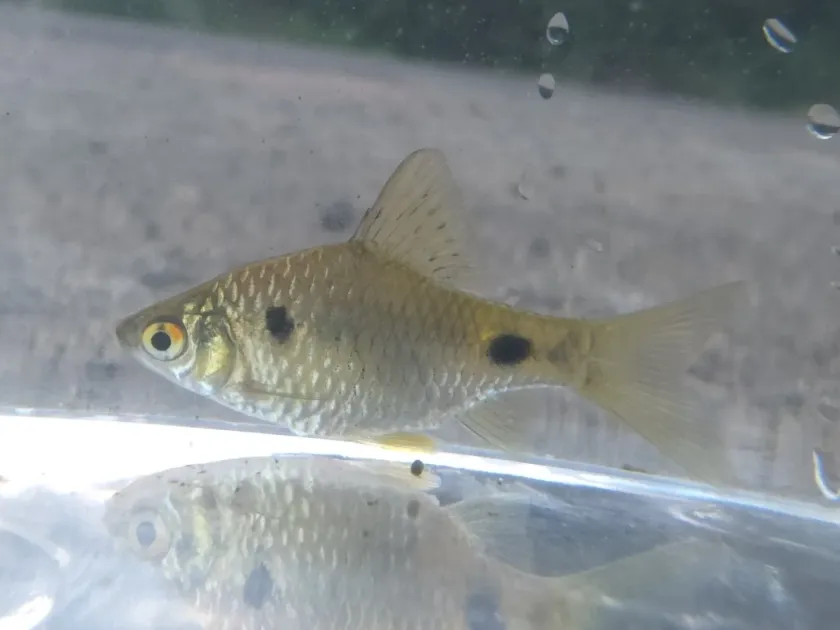
Visually, they are characterized by a silver-yellow body with distinct black spots near the caudal peduncle and behind the gill covers. During the spawning period, males display a striking crimson or red coloration.
These fish have a streamlined, active body shape typical of barbs, which allows them to move rapidly throughout all levels of an aquarium. They are highly social and thrive in groups.
In a home aquarium setting, Ticto barbs are constantly exploring their environment. Their high metabolism and active nature necessitate a steady intake of various food sources.
When aquarium conditions do not provide sufficient vegetable matter in their diet, these fish naturally turn to the available aquatic flora, often causing significant damage to the tank's greenery.
What it damages
The primary damage caused by Ticto barbs involves the consumption of delicate, soft-leaved aquatic plants. They exhibit a preference for young, tender foliage which is easily shredded.
Plants with broad or soft leaves are particularly susceptible. The barbs peck at the leaf edges, leaving behind unsightly holes, jagged margins, and shredded tissue that ruins the plant's health.
Young shoots and growth points are often the first targets. Continuous nibbling halts the plant's growth cycle, eventually leading to the death of the specific plant specimen.
Beyond direct feeding, the constant movement of a barb school through dense vegetation can cause mechanical breakage of fragile stems, uprooting plants from the substrate.
The accumulation of dead or damaged plant fragments often leads to increased organic load in the water, which can contribute to poor water quality and the development of algae.
Signs of infestation
The earliest signs of Ticto barb damage include small holes or ragged edges on the leaves of plants, particularly on new growth that is still developing.
Affected plants often show a marked decrease in growth rate or stagnation. Stems may appear bare, and damaged leaves may turn yellow or translucent due to the constant stress.
Direct observation of the fish is the most reliable sign. One may notice the barbs hovering around specific plants and systematically picking at the leaf surfaces.
Floating bits of shredded leaves on the water surface or trapped in the filtration system indicate that the plants are being physically destroyed by the fish population.
Loss of structural integrity in the aquarium scape, where stems are snapped or leaves appear heavily grazed, confirms that the barbs have converted the plants into a food source.
Control measures
To control this behavior, it is essential to ensure that the Ticto barbs have a diet rich in vegetable content, such as blanched lettuce, cucumber, or specialized plant-based fish flakes.
The most effective strategy is to stock the aquarium with tough, hardy plants like Anubias or Java Fern, which are generally unpalatable to these barbs due to their thick texture.
Increasing the frequency of feeding can satisfy the hunger of the school and reduce the likelihood of them foraging on the aquarium's decorative plants.
If damage persists, partitioning sections of the aquarium or removing the most vulnerable plant species temporarily can allow the vegetation time to recover.
- Supplement the diet with fresh vegetable matter daily.
- Choose plant species with thick, leathery leaves.
- Maintain a consistent feeding schedule to prevent hunger.
- Monitor the school's activity levels and density.
Taxonomy
- Latin name
- Barbus ticto
- Family
- Cyprinidae
- EPPO code
- BARUTI
Discussion
No discussions yet — be the first.