
Great oak longhorn beetle
Barbus barbus
Description
How to identify
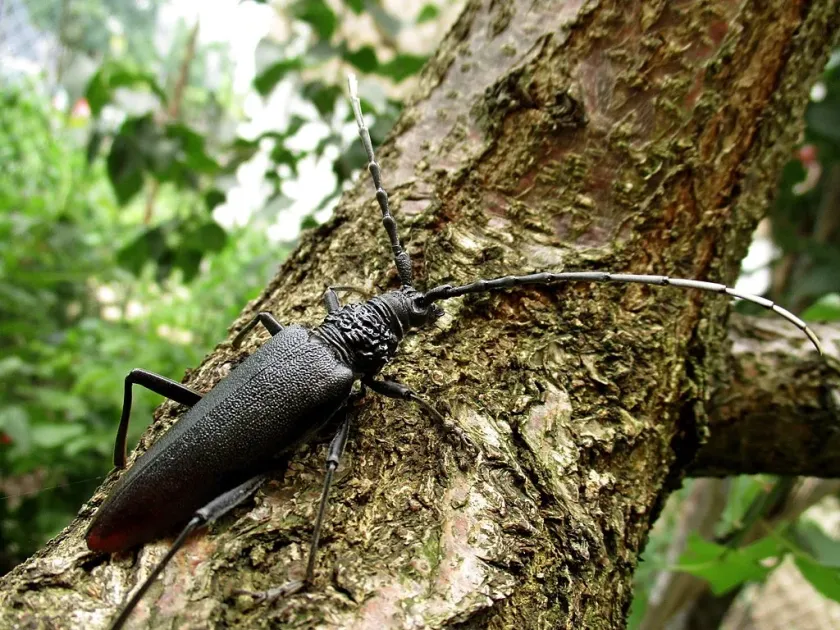
The great oak longhorn beetle (scientific name Cerambyx cerdo) is a prominent member of the Cerambycidae family. It is one of the largest beetles in Europe, with adults reaching lengths of up to 55 mm.
Adult beetles are characterized by their dark brown or black coloration and a distinctive metallic sheen. The antennae of the males are exceptionally long, often extending well beyond the tip of the abdomen.
The body is robust with elongated elytra that taper toward the rear. These physical characteristics make the species easy to distinguish from other smaller wood-boring beetles.
Larvae are large, legless grubs with cream-colored bodies and highly sclerotized mandibles. They are specifically adapted to tunnel through hard woody tissues.
As part of the order Coleoptera, this insect occupies an important niche in forest ecosystems, functioning as both a decomposer and a serious pest of living trees.
What it damages
The primary hosts for this beetle are various oak species, including Quercus robur. However, it can also infest other deciduous trees like elms, poplars, and willows.
Larval feeding causes severe damage as they bore wide, irregular galleries deep into the heartwood. This activity disrupts the tree's vascular system, causing structural instability.
Prolonged infestation weakens the tree, making it susceptible to secondary pathogens, such as wood-decay fungi, which further degrade the wood quality.
In forest management, the great oak longhorn beetle is regarded as a technical pest. It significantly reduces the commercial value of lumber by creating large galleries.
Severely infested trees may suffer from leaf yellowing, branch dieback, and eventually death, especially during periods of environmental stress.
When it appears
Adult beetles typically emerge from their larval chambers in early summer, with the peak flight period occurring in June and July.
Mating and egg-laying happen shortly after emergence. Females deposit their eggs into crevices or damaged areas on the bark of suitable host trees.
The life cycle of this species is quite long, usually spanning 3 to 5 years. The vast majority of this time is spent in the larval stage hidden within the tree trunk.
Pupation takes place in the spring within a specialized chamber carved out by the larva in the wood. This stage lasts for several weeks before the adult beetle emerges.
Overwintering occurs primarily as larvae inside the wood, where they are protected from extreme external temperatures and predators.
Signs of infestation
The most visible sign of an infestation is the presence of large, oval-shaped exit holes on the bark of the tree, typically 1–2 cm in diameter.
Heaps of coarse, sawdust-like frass can often be found at the base of the tree or caught in bark fissures, indicating active tunneling by larvae inside.
Signs of decline, such as thinning crowns, yellowing foliage, or the presence of dead branches, suggest that the tree's health is severely compromised.
Audible crunching sounds emanating from the trunk may occasionally be heard, as the powerful larvae feed on the wood tissues inside.
Over time, the tree may exhibit sunken areas or bark cracks where internal galleries have caused localized collapse or structural weakening.
Control measures
Sanitation is the most effective control strategy. Infested trees must be identified and removed from the site to prevent further colonization of nearby healthy trees.
The use of trap trees, which are left in strategic locations to attract females for egg-laying, can help manage populations in parklands or forest areas.
Promoting overall tree vigor through proper irrigation, mulching, and avoiding mechanical injuries helps minimize the attractiveness of trees to this pest.
Chemical control is generally ineffective due to the beetle's cryptic lifecycle. Pesticides are rarely used on a large scale for this specific species.
- Regular inspection of old-growth oak trees.
- Removal and destruction of infested wood materials.
- Encouraging natural predators like woodpeckers.
- Applying tree wound sealants to minimize entry points for females.
Taxonomy
- Latin name
- Barbus barbus
- Family
- Cyprinidae
- EPPO code
- BARUBA
Discussion
No discussions yet — be the first.