
Balea perversa
Balea perversa
Description
How to identify
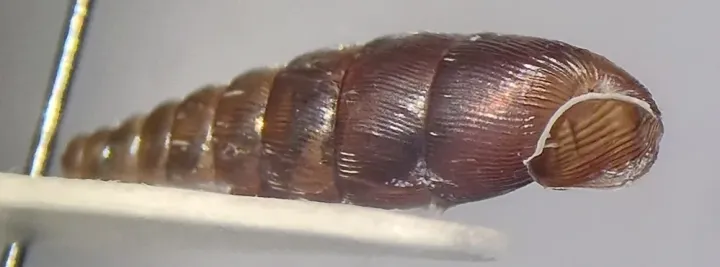
Balea perversa is a small land snail belonging to the Clausiliidae family. Its most distinctive feature is the sinistral (left-handed) shell, a trait that sets it apart from the vast majority of other land gastropods.
The shell is slender, spindle-shaped, and typically measures between 7 and 10 millimeters in height. Its coloration is usually a brownish-horn hue, which allows it to blend seamlessly into the bark of trees.
Unlike many other snail species, Balea perversa is predominantly arboreal. It is highly adapted to life on tree trunks and branches, where it spends most of its life cycle.
Systematically, it belongs to the order Stylommatophora. It possesses a highly efficient radula used for scraping lichens, algae, and tender plant tissues from surfaces.
The species is quite resilient and can adapt to various microclimates, provided there is enough humidity and shade to support its survival and reproduction.
What it damages
The primary damage caused by Balea perversa involves the scraping of tender bark on young saplings, buds, and leaves. This feeding behavior creates wounds that can weaken the plant.
Most affected are fruit trees, ornamental shrubs, and young forest trees. By removing the protective bark layer, these snails facilitate the entry of fungal and bacterial pathogens.
In nursery settings, damage to the young shoots can stunt growth and significantly reduce the aesthetic and commercial value of the plants.
Consistent feeding by a large population can lead to a decline in plant vigor, making the host plant more susceptible to environmental stress and other diseases.
Early spring damage to developing buds is particularly concerning as it can lead to reduced fruit production or permanent deformation of the tree structure.
When it appears
The activity of these snails is highly dependent on environmental moisture. They are most active during the spring and autumn months when rainfall is frequent.
During dry summer spells, Balea perversa enters a state of estivation. They attach themselves firmly to the bark and seal the shell opening to prevent water loss.
The peak of pest activity occurs on overcast, damp days when the snails roam freely across the canopy to feed on various surfaces.
Hibernation occurs in protected locations such as deep crevices in the bark, under leaf litter, or in the soil near the base of the tree.
Activity usually resumes early in the spring as soon as ambient temperatures rise and humidity levels become sufficient for their survival.
Signs of infestation
The presence of this pest is often indicated by visible slime trails left behind on bark and branches, which shimmer when dried.
Physical signs of damage include fine, rough-looking patches or small pits on young shoots where the epidermis has been scraped away by the snail's radula.
Close inspection of the tree bark during humid weather or immediately after rain often reveals the presence of the snails themselves.
- Shimmering, dried slime trails along the tree trunk.
- Superficial scraping marks on tender new shoots.
- Presence of empty, left-handed shells in bark crevices.
- Aggregation of snails on lichen-covered surfaces.
In cases of high infestation, one might notice a localized loss of lichen cover on branches, accompanied by the presence of small snail populations.
Control measures
The most effective cultural control is maintaining clean trees by gently removing dead or peeling bark where snails seek shelter during the day.
Pruning and thinning the canopy improve air circulation, which reduces the overall humidity in the tree and creates an environment less favorable for the snails.
Mechanical barriers, such as copper bands or sticky barriers placed around the trunks of young trees, can effectively prevent the snails from reaching the buds.
If population levels are high, the use of molluscicides containing iron phosphate is recommended, as these are effective and generally safer for beneficial insects and wildlife.
Removing garden debris and leaf litter around the base of trees is crucial, as these materials provide essential overwintering and daytime refuges for the pest.
Taxonomy
- Latin name
- Balea perversa
- Order
- Molluscs
- Family
- Clausiliidae
- EPPO code
- BLEAPE
Discussion
No discussions yet — be the first.