
Bagrada bug
Bagrada hilaris
Description
How to identify
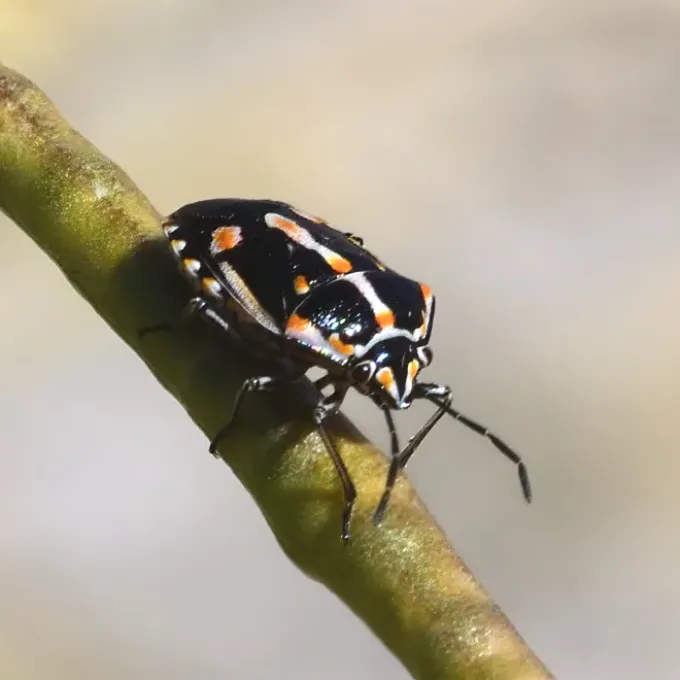
The Bagrada bug (Bagrada hilaris) is a member of the Pentatomidae family, commonly known as a painted bug due to its distinct, vibrant coloration.
Adults are small, shield-shaped insects measuring roughly 5 to 7 millimeters in length, characterized by a black body with orange, yellow, or white markings.
The eggs are barrel-shaped and typically laid in clusters on leaves or in the soil, transitioning from a creamy white to a dark orange color as they mature.
Nymphs undergo several molting stages, starting as reddish-orange insects and gradually developing the bold, geometric patterns of the adult stage.
This pest is highly prolific and thrives in warm, dry climates, allowing it to complete multiple generations within a single growing season.
What it damages
The Bagrada bug is a notorious pest of cruciferous crops, including broccoli, cauliflower, cabbage, kale, radish, and mustard greens.
Beyond its preference for brassicas, it is known to feed on other crops such as corn, sorghum, potatoes, legumes, and various ornamental plants.
The damage is caused by the bug piercing plant tissues and extracting sap, simultaneously injecting toxic saliva that results in tissue necrosis.
Young seedlings are particularly vulnerable and can be completely destroyed by mass feeding, which often stunts growth or causes the plant to wither and die.
In mature crops, infestation results in distorted leaves, yellowing, and significantly reduced yields due to the loss of photosynthetic efficiency.
When it appears
Bagrada bugs typically become active during early spring when temperatures start to rise, moving from their winter refuge to emerging host plants.
Population surges are most frequent during the hot, dry summer months, as these conditions are optimal for their reproductive cycle and rapid growth.
In regions with mild winters, the insect remains active year-round, posing a constant threat to any susceptible crop currently in the field.
They are highly mobile pests and often invade fields in large swarms, which can result in sudden and devastating damage to specific areas of a crop.
As temperatures decline in late autumn, the bugs seek shelter beneath debris or within soil cracks to hibernate until the following spring.
Signs of infestation
The initial signs of infestation include tiny white or yellow spots on the foliage, often referred to as stippling, resulting from the bugs' feeding activity.
Affected tissues often develop dark necrotic patches, leading to leaf wilting, curling, and eventual scorching of the leaf margins.
A key indicator of an infestation is the presence of the bugs themselves, which are often found in clusters on the undersides of leaves or around the base of stems.
Stunted growth and a "blasted" appearance of the apical meristem or terminal growth are common markers of heavy infestation in young transplants.
Severe infestations manifest as large areas of yellowing or scorched foliage that can easily be mistaken for water stress or herbicide injury.
Control measures
Cultural control is essential, focusing on the removal of wild cruciferous weeds that serve as reservoirs for Bagrada bug populations during the off-season.
The use of row covers or physical barriers during the seedling establishment phase is highly effective at preventing the bugs from accessing young plants.
Chemical control involving systemic insecticides is often necessary in commercial production, though timing is critical due to the pests' high mobility.
Thorough field sanitation, including the destruction of crop residues immediately after harvest, significantly reduces the overwintering population.
- Monitoring crop perimeters for early detection of migrating swarms.
- Implementing trap crops to divert the bugs away from the primary cash crop.
- Utilizing biological controls or entomopathogenic fungi where applicable.
Taxonomy
- Latin name
- Bagrada hilaris
- Order
- Hemiptera (bugs, aphids, leafhoppers)
- Family
- Pentatomidae
- EPPO code
- BAGRHI
Discussion
No discussions yet — be the first.