
Australian plague locust
Austracris guttulosa
Description
How to identify
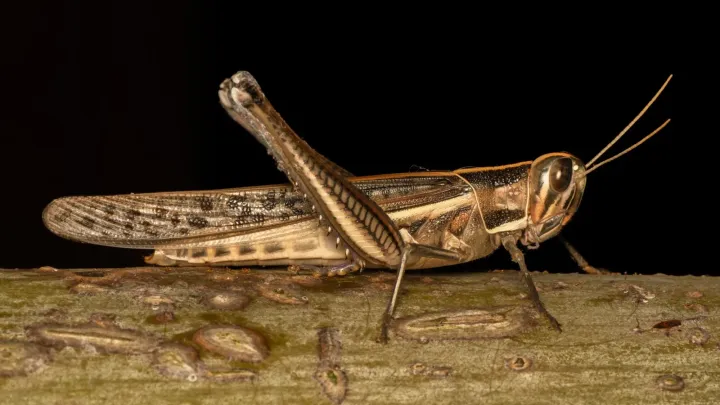
The Australian plague locust (Austracris guttulosa) belongs to the order Orthoptera, family Acrididae. This large insect can reach 5–7 centimeters in body length.
The coloration of the adults ranges from light brown to olive, providing excellent camouflage among dry vegetation. A distinctive feature includes specific spots on the forewings and the unique shape of the pronotum.
Unlike some gregarious species, this pest shows phenotypic plasticity depending on population density. During outbreak years, individuals become darker and show increased activity.
The life cycle includes the egg stage, five nymphal instars, and the adult stage. Females lay their eggs in the soil, forming pods protected by a specialized secretion.
Development is highly dependent on temperature and soil moisture, which dictates the population dynamics for a given season.
What it damages
This pest is a polyphage, feeding on a wide range of crops and wild grasses. Major damage is inflicted on grain crops such as wheat, barley, and sorghum.
The locust also attacks pastures, causing significant losses in the livestock sector. During outbreaks, insects can completely destroy crops over large areas.
Young nymphs mainly feed on tender plant shoots, while adults are capable of eating tougher stems and cereal leaves. The impact is magnified by the high density of swarms.
In addition to consuming biomass, the locust causes mechanical damage to the reproductive organs of plants, leading to a catastrophic decline in yields.
Frequent infestations lead to the total loss of marketable produce, rendering fields unsuitable for harvesting or grazing.
When it appears
Emergence typically coincides with favorable weather conditions following adequate rainfall. In Australia, peak activity usually occurs during the summer months.
Nymphs begin to emerge en masse from soil egg pods once the ground warms to specific temperatures. Monitoring fields during this window is critical.
The adult phase lasts throughout the warmer months of the year. Adult migrations can cover significant distances in search of fresh food sources.
The number of generations per season depends on regional climatic conditions. Usually, there is one generation, but extended autumns may allow for a partial second generation.
As temperatures drop, activity decreases, adults perish, and the eggs overwinter in the soil, waiting for spring conditions to hatch.
Signs of infestation
The first sign of infestation is the appearance of "windows" in leaves and chewed leaf edges. The locust begins feeding at the field margins and moves inward.
The presence of large numbers of nymphs on roads and field edges often precedes major crop damage. Insects tend to aggregate in low-lying areas with higher moisture.
The auditory background — the stridulation (chirping) produced by adults — is a clear indicator of a high population density in the area.
The presence of frass (excrement) on the soil surface beneath plants indicates the long-term presence of insects at the site.
Finding egg pods in dry, firm soil during field inspections is a critical indicator of potential threats for the upcoming season.
Control measures
The primary method of control is timely population monitoring using traps and field visual surveys. Early detection of nymphs allows for localized treatment.
- Application of contact and systemic insecticides during the early nymphal stages.
- Biological control measures, including the use of entomopathogenic fungi to reduce population numbers.
- Agrotechnical practices: deep tillage of soil after egg-laying to physically destroy the pods.
- Aerial application of pesticides when locust density reaches critical thresholds over large areas.
Maintaining crop rotation and high-level agronomic management is essential to reduce the field's attractiveness to this pest.
Taxonomy
- Latin name
- Austracris guttulosa
- Order
- Orthoptera (locusts)
- Family
- Acrididae
- EPPO code
- AUSTGU
Discussion
No discussions yet — be the first.