
Australian plague locust
Austracris
Description
How to identify
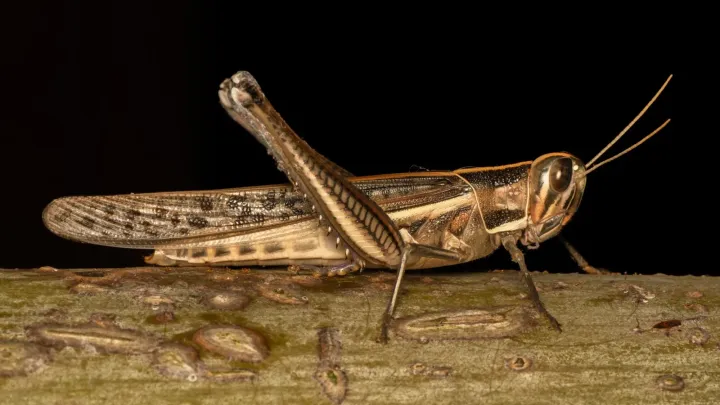
The Australian plague locust, scientifically known as Austracris guttulosa, belongs to the order Orthoptera and the family Acrididae. It is a robust, large-bodied insect characterized by strong wings capable of sustained long-distance migration.
Adult insects typically range from 5 to 7 cm in length. Their coloration varies from green to brown, providing effective camouflage against various vegetation types ranging from arid grasses to lush crops.
The life cycle proceeds through several nymphal stages, known as instars. With each successive molt, the nymphs grow larger and gradually develop wing pads that eventually transform into fully functional wings in the adult stage.
A distinctive behavioral trait of this species is its phase polyphenism, meaning it can shift from a solitary lifestyle to a gregarious (swarming) phase. During the swarming phase, they form massive, destructive bands and clouds.
The biological development is heavily dependent on regional climate patterns. Specifically, adequate soil moisture during egg-laying is essential for the successful incubation and emergence of the next generation.
What it damages
As a highly polyphagous pest, the Australian plague locust causes severe damage to a broad spectrum of crops. Primary targets include cereals, pastures, forage grasses, and various vegetable cultivations.
When swarms occur, they can completely strip a wheat or barley field of its foliage in a matter of hours. The insects consume everything above the ground, often leaving only the stems, leading to total crop failure.
The impact on the livestock industry is equally devastating. By consuming extensive pastureland, they create severe feed shortages, forcing farmers to destock or purchase expensive supplementary fodder.
Orchards and vineyards are also susceptible. The locusts feed on leaves, young bark, and sometimes buds, which weakens the trees and leads to significant yield losses for multiple seasons.
Beyond direct consumption, the contamination of agricultural products with fecal matter makes the remaining forage unpalatable and often unusable for fodder production, complicating post-harvest processes.
When it appears
The emergence and activity cycles of this pest are closely tied to rainfall events. The primary growth period occurs during the warm season, which supports the rapid development of nymphs and subsequent adult maturation.
Peak adult activity is typically observed from late spring through summer. Migratory swarms are most likely to develop once the locusts reach sexual maturity and localized food sources begin to dry out.
Eggs are deposited in moist soil. Following rainfall, the emergence of nymphs usually aligns with the peak vegetative growth of major crops, ensuring a high survival rate due to the abundance of food.
Depending on the climatic conditions and the duration of the wet season, the species can complete one or more generations per year, necessitating constant surveillance during the growing season.
Monitoring efforts by agronomists are most intense during the nymphal stages, as this represents the optimal window for preventive control measures before the insects develop full flight capabilities.
Signs of infestation
The earliest sign of infestation is the discovery of bands of juvenile nymphs. These clusters of insects move across the ground, and their presence is often noted on field edges or roadsides where they feed.
Damage symptoms include irregular holes in leaves, shredded leaf margins, or entirely defoliated plants. Upon inspection, one can identify distinct patches where the density of locusts is high, which often expand rapidly.
The presence of adult swarms is unmistakable, often heard as a distinct buzzing sound of millions of wings. Their arrival can lead to a sudden and massive shadowing effect over affected areas.
Accumulation of fecal pellets under plants is a definitive indicator of an active and hungry population. Large quantities of these droppings are visible evidence of the high population density.
During cooler morning hours, the locusts are less mobile and tend to congregate on stems and foliage, making this the most effective time for field scouting and population count estimates.
Control measures
Effective control relies heavily on early detection and targeted intervention against nymphal bands. Applying systemic insecticides during early stages prevents the locusts from reaching their migratory adult phase.
Biological control agents, such as formulations based on entomopathogenic fungi, have proven effective in maintaining populations in humid conditions, providing a sustainable alternative to chemical usage.
Agronomic management includes fallowing or deep plowing of known egg-laying sites. This mechanical disturbance destroys egg pods, exposing them to heat and predators, thereby reducing population recruitment.
Creating buffer zones with non-host plant species around sensitive crops can sometimes delay or divert the movement of small bands, providing time for more targeted chemical applications.
- Satellite monitoring and drone surveys for early swarm detection.
- Localized application of contact or systemic pesticides.
- Integrated pest management (IPM) involving natural predators.
- Strategic grazing management to reduce attractant vegetation.
Taxonomy
- Latin name
- Austracris
- Order
- Orthoptera (locusts)
- Family
- Acrididae
- EPPO code
- AUSTSP
Discussion
No discussions yet — be the first.