
Aulocara elliotti
Aulocara elliotti
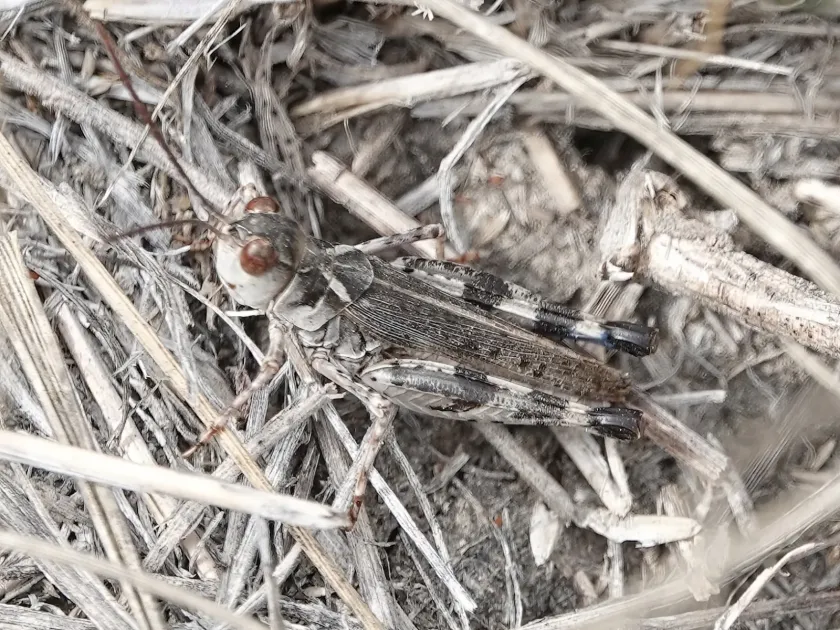
Description
How to identify
Aulocara elliotti, commonly known as the Elliott's bunchgrass locust, belongs to the order Orthoptera and the family Acrididae. It is a medium-sized, stout-bodied grasshopper that is well-adapted to life in open grassland environments.
The coloration of the adults typically ranges from gray to brown, providing excellent camouflage against dry soil and withered vegetation. Their wings are well-developed, allowing them to perform long-distance flights when searching for food or suitable egg-laying sites.
Females are significantly larger than males and possess a robust ovipositor designed for laying egg pods into the compacted soil. Like other grasshoppers, they have tympanal organs for hearing and powerful hind legs adapted for jumping.
The nymphs go through several instars, gradually increasing in size and developing morphological features of the adults. Throughout their development, they look like smaller, wingless versions of the adult form.
This species is a typical inhabitant of the North American plains and prairies, thriving in arid, open landscapes with sparse but nutritious vegetation.
What it damages
This pest primarily causes damage to cereal crops such as wheat, barley, and oats, as well as native rangelands. Aulocara elliotti is capable of forming dense populations that can rapidly defoliate large areas of vegetation.
Both nymphs and adults feed on the foliage of grasses, often preferring leaf blades and succulent stems. When population density is high, they can completely strip a field, leaving only the toughest vascular tissue behind.
Significant damage often occurs during drought conditions. As natural forage dries up, these grasshoppers are forced to migrate from their native habitats into neighboring agricultural fields to survive.
Infestation of cereal crops at the early growth stages can cause thinning of the stand and a dramatic reduction in final grain yield. In severe cases, total defoliation results in the death of the plants.
Rangelands suffer from reduced productivity when these insects consume the forage intended for livestock, creating significant economic challenges for ranchers.
When it appears
The lifecycle of Aulocara elliotti is strictly synchronized with seasonal environmental cues. The species overwinters exclusively in the egg stage, with the eggs encased in protective pods buried in the soil.
Spring development begins once the soil warms sufficiently, triggering the emergence of first-instar nymphs. The timing of this emergence is highly dependent on local temperatures and soil moisture levels.
The nymphal stage lasts for several weeks, during which the insects pass through five successive instars. This is the period when they cause the most intense damage to growing crops and pastures.
Adults typically appear by mid-summer. They continue to feed aggressively and eventually engage in mating to ensure the survival of the next generation.
Egg-laying takes place in late summer and early autumn, after which the adult population declines rapidly as temperatures drop and the first frosts arrive.
Signs of infestation
The most obvious sign of infestation is the presence of large numbers of jumping insects within the crop field. Upon close inspection, the vegetation will show characteristic ragged edges on the leaves where feeding has occurred.
In cases of heavy infestation, one might observe bare patches in fields where the vegetation has been almost entirely consumed. The presence of the pest is also often accompanied by the distinct sound of stridulation during daylight hours.
- Ragged or missing leaf blades on cereal crops.
- The presence of fecal pellets (frass) on soil and leaf surfaces.
- Discovery of buried egg pods in the upper soil profile during scouting.
- Mass movement or flushing of insects when walking through the field.
Grasshoppers are less active during the early morning and late evening, often concentrating near the base of the plants, making them easier to spot during these times.
Increased activity of birds, such as hawks or larks, feeding in a specific field is a strong indicator that a significant population of grasshoppers is present.
Control measures
Managing Aulocara elliotti requires an integrated approach that combines cultural practices with chemical interventions. Monitoring egg-laying sites during the previous year is crucial for early detection.
Cultural control measures, such as deep autumn tillage, can physically destroy egg pods, exposing them to desiccation and natural predators. Managing weed populations along field edges helps reduce the pest's reservoir habitats.
When the economic injury level is reached, the application of broad-spectrum insecticides, such as pyrethroids or organophosphates, is necessary. Treatments are most effective when targeted at early-instar nymphs.
The use of biological control agents, including entomopathogenic fungi or bacteria, is being explored as an environmentally friendly alternative, though their efficacy depends heavily on humidity and temperature.
Proactive monitoring of rangelands and field margins allows for early intervention, preventing massive migration events and preserving crop yields.
Taxonomy
- Latin name
- Aulocara elliotti
- Order
- Orthoptera (locusts)
- Family
- Acrididae
- EPPO code
- AULCEL
Discussion
No discussions yet — be the first.