
Japanese scale insect
Aulacaspis yabunikkei
Description
How to identify
The Japanese scale insect Aulacaspis yabunikkei is a small insect belonging to the family Diaspididae, order Hemiptera. Adult females are protected by a dense, waxy, circular or pear-shaped scale, which usually has a light, whitish or yellowish color, making them highly visible on dark bark.
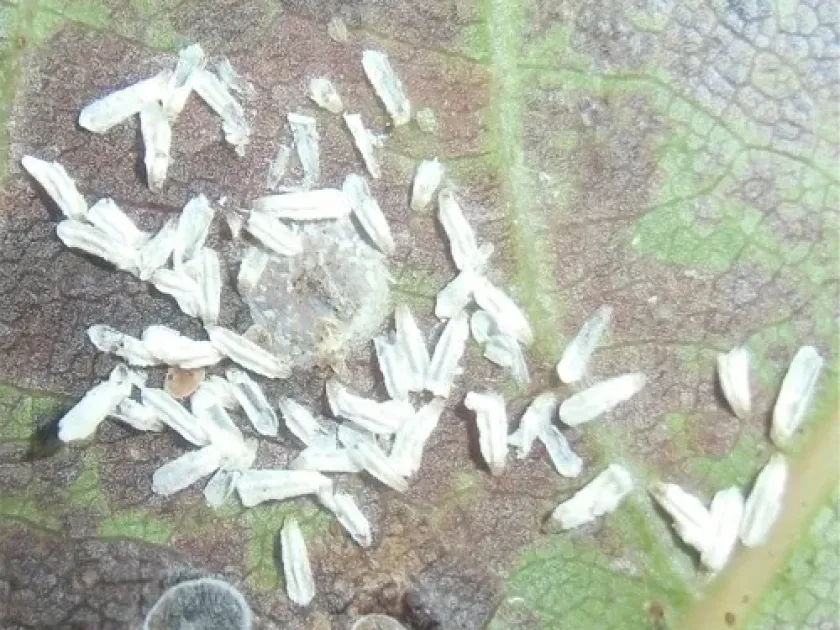
Males of the species develop inside smaller, elongated, and narrow scales. Unlike females, adult males are winged and capable of active movement, although their lifespan is extremely short and primarily focused on mating with females.
The main method of long-distance dispersal for this pest is the movement of infested nursery stock. Within a garden, "crawlers"—the first-instar larvae—can be transported by wind currents, water, or physical contact between the branches of neighboring plants.
A distinctive feature of this species is its high host specificity to certain ornamental plants. Visually, scale colonies often resemble a crust or a powdery coating on the surface of stems and leaves, which can make early detection challenging during a casual inspection.
For accurate identification in a laboratory setting, agronomists perform a microscopic examination of the female's pygidium. The morphological structures of this body segment are the key systematic criteria for differentiating Aulacaspis yabunikkei from related species within the genus Aulacaspis.
What it damages
The primary hosts of this scale insect are plants in the Oleaceae family, particularly species of the genus Ligustrum (privet) and Osmanthus. The pest prefers to settle on shoots, branches, and the undersides of leaves.
While feeding, the scale insect extracts cell sap from plant tissues. This leads to significant depletion of the plant, loss of turgor, yellowing, and premature leaf drop, which drastically reduces the aesthetic value of the plantings.
In cases of heavy infestation, deformation of shoots and the dieback of individual branches are observed. A weakened plant becomes highly susceptible to secondary infections, fungal diseases, and unfavorable environmental stress factors.
In nursery conditions, the Japanese scale insect poses a serious threat to the marketability of young plants. Even if the plant does not die, the damage reduces its commercial value and suitability for landscape projects.
Damage to the bark tissues at feeding sites disrupts normal photosynthesis and metabolic processes within the plant. In the long term, this can lead to the total loss of the specimen if timely sanitary measures are not implemented.
When it appears
The life cycle of Aulacaspis yabunikkei is heavily dependent on regional temperature regimes. In subtropical or warm zones, the pest can develop multiple generations within a single growing season, which accelerates colonization rates.
The most active phase of crawler development occurs during warmer months, coinciding with the emergence of offspring from beneath the maternal scale. This period is when the pest is most vulnerable to contact insecticides.
As autumn approaches, the rate of reproduction slows down. Adult females often overwinter on the bark of host plants, protected by their waxy shields, which exhibit high resistance to low temperatures.
Spring awakening is synchronized with the sap flow of the host plants. Once the ambient temperature remains consistently above critical levels, the insects begin active feeding and preparation for egg-laying.
Population monitoring should be conducted regularly, starting from early spring. Particular attention should be paid to periods when first-instar crawlers are expected to emerge, as this is the most effective window for preventive treatments.
Signs of infestation
The first sign of infestation is the appearance of light-colored, almost white spots or dense clusters on the bark, which upon closer inspection reveal themselves to be insect scales. Infested branches often appear as if they are covered in a fine dust.
A characteristic symptom is general growth retardation of the shrub. If a plant begins losing leaves for no apparent reason during the growing season, it is necessary to inspect the stems and the inner canopy closely for colonies of scale insects.
The presence of scale insects is sometimes accompanied by the development of sooty mold, which feeds on the honeydew excreted by some insects, although Aulacaspis primarily causes direct mechanical damage to the vascular system.
Yellow or chlorotic spots may appear on leaves at the feeding sites. Over time, these areas may necrose, leading to holes or premature perforation of the leaf blade.
In cases of severe infestation, the bark of the shoots may become bumpy. If in doubt, one can gently lift a scale with a sharp tool: if an insect is present underneath, this confirms the presence of an active pest population.
Control measures
Control of scale insects is complicated by the protective waxy shield, which makes the insect resistant to most standard insecticides. The best results are achieved by applying treatments during the crawler emergence phase.
- Mechanical removal of old scales from the bark during the plant's dormant period.
- Application of systemic insecticides that penetrate plant sap and become toxic to the pest.
- Use of mineral oils during the dormant period to suffocate overwintering females.
- Biological control using natural entomophagous predators, such as parasitic wasps.
- Regular sanitary pruning and disposal of heavily infested plant parts.
An important aspect of protection is adhering to quarantine measures when introducing new plants. Each new specimen should undergo rigorous phytosanitary inspection to prevent the introduction of the pest to the site.
When using chemical treatments, it is essential to strictly follow the application frequency, as the life cycle of the scale can be extended. Rotating insecticides from different chemical classes helps prevent the development of resistance in the population.
Taxonomy
- Latin name
- Aulacaspis yabunikkei
- Order
- Hemiptera (bugs, aphids, leafhoppers)
- Family
- Diaspididae
- EPPO code
- AULSCI
Discussion
No discussions yet — be the first.