
Chaff scale
Aulacaspis citri
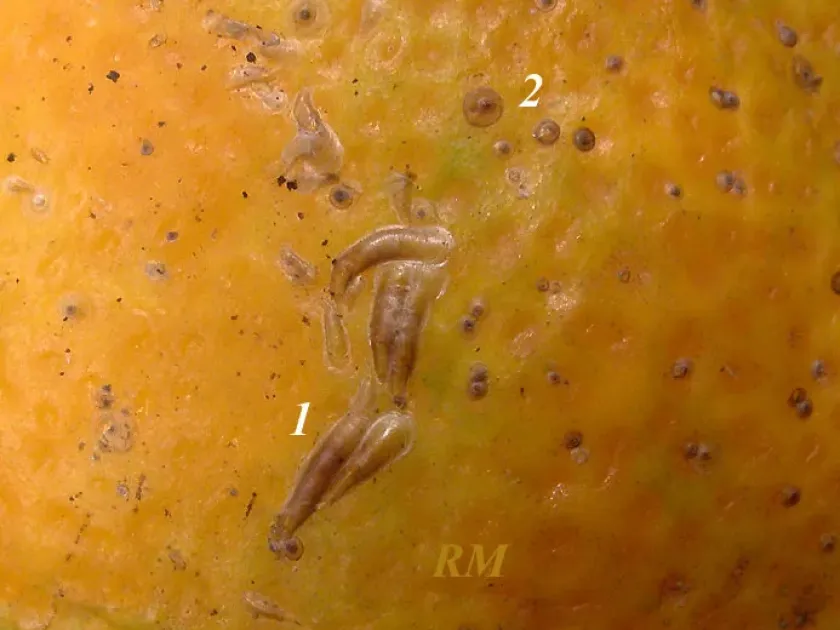
Description
How to identify
Chaff scale, scientifically known as Aulacaspis citri, belongs to the family Diaspididae within the order Hemiptera. The adult females are characterized by a circular or oval-shaped, light-colored scale that adheres firmly to the host plant surface.
Adult males are significantly smaller than females and produce elongated, white-colored scales with a distinct longitudinal ridge. The first-instar nymphs, known as crawlers, are the primary mobile life stage responsible for colonization.
These pests prefer to settle on the bark of trunks, branches, and the undersides of leaves. Under heavy infestation, they aggregate into dense colonies, often creating a white, crust-like appearance over the plant surface.
Sexual dimorphism is prominent in this species: females remain sedentary for life, while males develop wings and are capable of flight, facilitating the spread of the population across the orchard.
Visual identification is possible by observing the white waxy shells. Lifting the shell reveals the insect underneath. Old, empty scales often persist on the bark for extended periods after the insect has perished.
What it damages
The primary hosts of Chaff scale are citrus species, including lemons, oranges, mandarins, and grapefruits. Both nursery seedlings and mature fruit-bearing trees are susceptible to significant damage.
As sucking insects, they extract sap from plant tissues, leading to general physiological decline. This removal of nutrients results in stunted growth and a loss of vitality in affected branches.
Feeding sites often exhibit necrotic spots and surface depressions. Prolonged infestation leads to the drying out of twigs and, in severe cases, the death of entire branches or tree segments.
High population densities contribute to premature leaf drop and fruit loss. Fruit quality is typically reduced due to the compromised metabolic state of the tree and aesthetic damage caused by the scales.
If left unmanaged, the tree's immune system weakens, making it highly susceptible to secondary pathogens, including various fungal diseases and wood-boring insects.
When it appears
The development of Chaff scale is highly dependent on ambient temperatures. In warm climates, the pest can complete multiple overlapping generations throughout a single growing season.
Activity usually resumes in early spring as temperatures rise. The emergence of crawler nymphs peaks during late spring and early summer, which is the most critical period for population expansion.
During the summer months, the rapid reproduction cycle leads to a significant increase in the pest's numbers. This is the period when infestation levels can quickly become critical.
As autumn approaches and temperatures drop, reproduction rates naturally decrease. The pest overwinters as fertilized females or eggs protected under the waxy scales on the woody parts of the tree.
In greenhouses and indoor citrus environments, the lifecycle remains continuous, allowing for year-round development. This necessitates rigorous monitoring and consistent application of control measures.
Signs of infestation
Initial signs include the appearance of small white spots on the bark, which are often overlooked by growers until they begin to cluster. These clusters eventually form a patchy, white, powdery layer.
Leaves on infested branches often show chlorotic spots where the insect is feeding. As the infestation grows, these areas turn yellow, and the leaves may eventually wither and drop prematurely.
Branches that are heavily colonized by males often appear to be coated in a white dust. This visual indicator signifies a severe infestation that requires immediate corrective action.
The presence of honeydew can lead to the growth of sooty mold, appearing as a black film on the foliage. This layer inhibits photosynthesis, further weakening the tree's overall health.
Distorted or twisted growth on new shoots is another common indicator of infestation. Microscopic examination may reveal the presence of active, pale-colored crawlers on the surface of the bark.
Control measures
Effective management of Chaff scale requires an integrated pest management approach that combines cultural, biological, and chemical methods to minimize tree damage and maintain productivity.
- Implement pruning practices to remove heavily infested branches and improve air circulation within the tree canopy.
- Use horticultural oil sprays during the early spring to smother overwintering adults and reduce the initial population.
- Apply systemic insecticides that are translocated within the plant sap, targeting the insects protected by their waxy scales.
- Maintain optimal tree health through regular fertilization and irrigation to help the plant recover from feeding damage.
Biological control involving natural predators, such as parasitoid wasps or predatory beetles, can play a significant role in suppressing scale populations in sustainable orchard programs.
Chemical applications should be timed to coincide with the crawler emergence stage, as this is when the insects are most vulnerable. Always follow local regulations and pre-harvest intervals for all treatments.
Taxonomy
- Latin name
- Aulacaspis citri
- Order
- Hemiptera (bugs, aphids, leafhoppers)
- Family
- Diaspididae
- EPPO code
- AULSCT
Discussion
No discussions yet — be the first.