
Ailanthus webworm
Atteva fabriciella
Description
How to identify
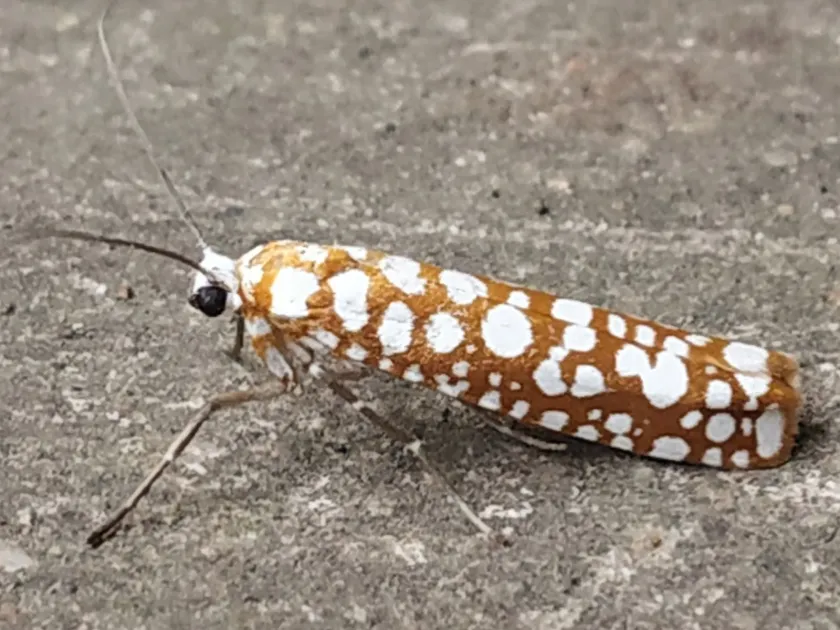
The Ailanthus webworm (Atteva fabriciella) is a member of the Attevidae family within the order Lepidoptera. Adult moths are characterized by their striking orange, yellow, and black patterned wings, making them quite distinctive in appearance.
The larvae are small caterpillars that go through several developmental stages (instars). They are typically dark-colored with white stripes, providing camouflage while they feed on the leaves of their host plants.
Pupation occurs within loose, silken webs created by the caterpillars. These communal nests are often found on leaves or branches, providing a protective shelter for the developing pupae.
Reproduction occurs via sexual mating, and females lay eggs on the foliage of host trees. This ensures that the newly hatched larvae have an immediate food source available.
Adult moths are active fliers and exhibit migratory behavior, which allows the species to spread across significant distances in search of suitable host trees for colonization.
What it damages
The primary host for this pest is the Tree of Heaven (Ailanthus altissima). The larvae consume the leaf tissue, leading to significant defoliation when populations are high.
Heavy infestations can result in complete leaf loss, which places substantial stress on the tree, potentially slowing its overall growth rate and weakening its structural integrity.
The larvae also feed on the terminal buds and new shoots, which can disrupt the natural development of the tree canopy and cause distorted or stunted growth patterns.
Severely stressed trees become increasingly susceptible to secondary pests, such as wood-boring insects, and various opportunistic fungal pathogens that enter through damaged tissues.
While often seen as a nuisance in urban landscapes, the economic impact is particularly noted in nurseries and forestry plantations where the Tree of Heaven is cultivated.
When it appears
The lifecycle of the Ailanthus webworm is closely tied to the growing season of its host tree. In warmer climates, the species can complete multiple generations within a single year.
The first generation of larvae typically emerges in early spring, coinciding with the initial bud burst and leaf expansion of the host plant.
Population levels often reach their peak during mid-summer, when higher temperatures accelerate the insect's metabolism and shorten the development time of each generation.
Multiple generations often overlap, meaning that larvae at various stages of development can be found on the same tree throughout the entire summer season.
The overwintering stage usually consists of pupae or adults that seek refuge under bark or in organic debris to survive the colder winter months until conditions become favorable again.
Signs of infestation
The most obvious sign of an infestation is the presence of silk webs covering clusters of leaves, which the caterpillars spin to protect themselves while feeding.
Significant amounts of larval waste (frass) accumulating on the leaves or falling to the ground beneath the tree canopy are clear indicators of high feeding activity.
Skeletal leaves, where only the veins remain after the soft leaf tissue has been consumed, are another hallmark of advanced caterpillar feeding.
The browning, rolling, and premature drying of leaves are common physiological responses of the tree to the intensive damage caused by the larvae.
In the daytime, the observation of brightly colored adult moths fluttering around the canopy is a strong indicator of an active population and current reproductive efforts.
Control measures
Management of the Ailanthus webworm requires a combination of strategies to keep populations under control and protect the health of the trees.
- Manual removal and disposal of webbed leaf clusters can be effective for small trees or light infestations.
- Biological control using Bacillus thuringiensis sprays can target the larvae without harming beneficial pollinators or natural predators.
- Systemic or contact insecticides can be applied if chemical control is necessary, typically during the early larval development phase.
- Maintaining tree vigor through proper watering and soil management helps trees withstand the stress caused by moderate feeding.
- Monitoring with pheromone traps can help track moth activity and determine the optimal timing for intervention.
Taxonomy
- Latin name
- Atteva fabriciella
- Order
- Lepidoptera (butterflies)
- Family
- Yponomeutidae
- EPPO code
- ATTEFA
Discussion
No discussions yet — be the first.