

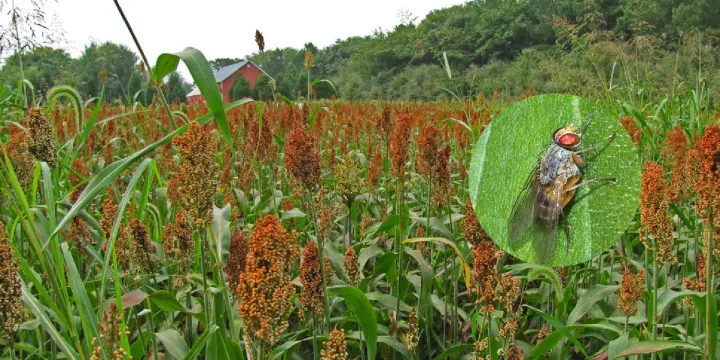
Description
How to identify
The Sorghum shoot fly (Atherigona soccata) is a member of the order Diptera and the family Muscidae. The adult fly is a small, greyish insect, measuring about 3–5 mm in length.
The life cycle consists of four distinct stages: egg, larva, pupa, and adult. Females deposit small, white, spindle-shaped eggs singly on the underside of young sorghum leaves.
The larva, which is the destructive stage, is a cylindrical, creamy-white maggot. It bores into the central shoot of the seedling, feeding on the developing tissues.
Pupation occurs either within the damaged stem or in the soil near the base of the plant. The duration of the life cycle varies depending on ambient temperature and moisture levels.
Outbreaks are heavily influenced by climate; the pest thrives in warm, humid conditions with sufficient rainfall, leading to rapid population growth during the early growing season.
What it damages
The primary host for this pest is sorghum, including grain, sweet, and forage varieties. The larvae destroy the growing point, causing the central leaf to wither and die.
Alternative hosts include maize, pearl millet, sudangrass, and various wild grass species that serve as reservoirs for the pest when sorghum is not present.
Heavy infestations can lead to total crop failure during the seedling stage, forcing farmers to replant, which increases production costs and delays the harvest.
Damage to the central shoot prevents the plant from producing a grain head or significant biomass, resulting in severe yield losses at harvest time.
Young seedlings (up to 3-4 weeks old) are most susceptible to attack. Once the plant passes this critical developmental stage, it generally becomes resistant to shoot fly damage.
Signs of infestation
The most diagnostic symptom of infestation is the appearance of a "dead heart." The central leaf turns yellow, wilts, and eventually dies, becoming easily detached from the stem.
Upon closer inspection, a small entry hole can often be found near the base of the shoot. Internal tissues often show signs of decay due to larval feeding and secondary infections.
Infested plants frequently exhibit excessive tillering as a survival mechanism, producing side shoots that remain weak and fail to produce viable grain.
In the field, infected areas show patches of stunted, wilting seedlings. These patches are clearly distinguishable from healthy areas as the season progresses.
The presence of small, white eggs arranged linearly on the undersides of leaves is a warning sign that egg-laying is occurring and immediate action may be required.
Control measures
Cultural control is the most effective approach. Sowing early in the season is recommended to ensure that seedlings bypass the peak period of fly activity.
Utilizing resistant or tolerant sorghum cultivars is a key component of management, as these varieties show better recovery rates after initial larval attacks.
Maintaining a clean field environment by removing wild grasses and crop residues helps disrupt the fly's life cycle and reduces the local population pressure.
Seed treatment with systemic insecticides is a highly effective prophylactic measure, providing protection for the crop during the most vulnerable seedling stage.
Foliar insecticide applications are generally less effective once the larvae have entered the stem; therefore, scouting and timely intervention are crucial for successful management.
Reference
Connections · Sorghum shoot fly
Most often together:
Marketplace
Products · 1
Biology
Taxonomy
- Latin name
- Atherigona soccata
- Order
- Diptera (flies)
- Family
- Muscidae
- EPPO code
- ATHESO
Community
Discussion
No discussions yet — be the first.